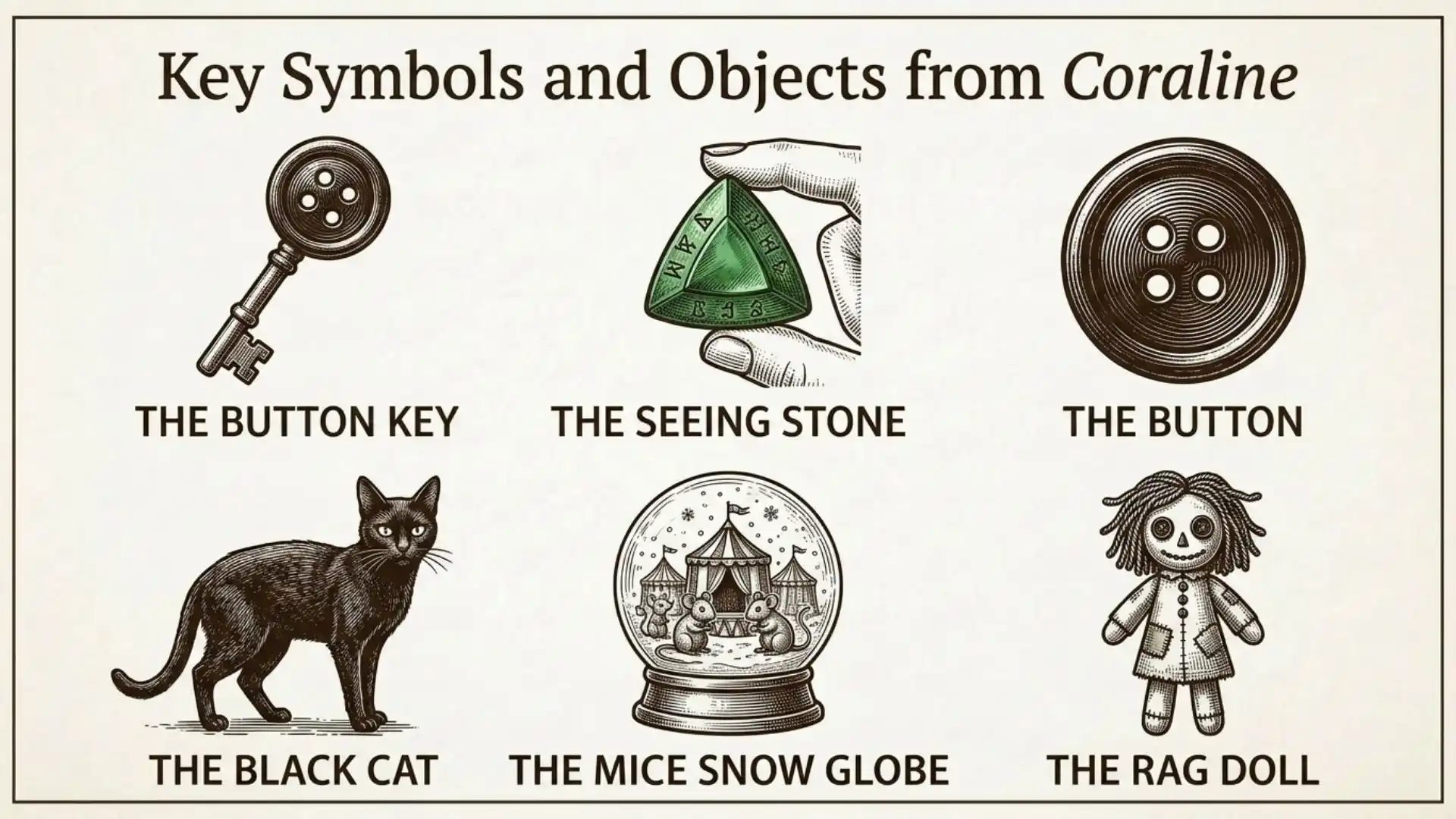
Neil Gaiman’s Coraline is much more than a creepy story about a girl who discovers a strange world behind a small door. Throughout the story, ordinary objects and unusual characters take on deeper meanings.
Button eyes, a mysterious key, a locked door, a black cat, a doll, a mirror, a garden, food, and the Other World all help explore important ideas about freedom, identity, temptation, courage, control, and the difference between appearance and reality.
The most famous symbol in Coraline is the button eye. The Other Mother and the other inhabitants of her world have buttons instead of normal eyes, while Coraline is asked to accept the same transformation if she wants to remain there permanently. This disturbing image can be interpreted as a warning about giving up individuality and freedom for comfort or attention.
However, the symbolism does not stop with the buttons. The key gives Coraline access to a dangerous secret. The little door represents a boundary between ordinary life and temptation. The cat represents independence and instinct. The doll suggests imitation and observation, especially in the 2009 film. The mirror connects with hidden truths and imprisonment, while the Other World represents an attractive but controlled version of reality.
This guide explains the major Coraline symbols and their meanings in simple language. It also separates the novella from the 2009 movie where appropriate, explains how the symbols connect to larger themes, and shows how students can use symbolism in an essay or school project.
Spoiler warning: This article discusses major events and reveals from Coraline, including the Other Mother’s plan and the ending.
What Do the Symbols in Coraline Mean? (Quick Answer)
The major symbols in Coraline can be interpreted as representations of control, identity, freedom, temptation, courage, and appearance versus reality. The button eyes are the central symbol of control and artificial identity. The key represents access, choice, and responsibility. The locked door represents curiosity, temptation, and a boundary between worlds. The cat represents independence and instinct, while the Other World represents false perfection that comes with a dangerous price.
These symbols work together rather than standing alone. The story repeatedly contrasts things that look attractive with things that are genuine.
Coraline Symbols at a Glance
| Symbol | Common interpretation | Main theme |
| Button eyes | Control, conformity, artificial identity | Identity |
| Key | Access, choice, responsibility | Freedom |
| Small door | Curiosity, temptation, boundary | Choice |
| Tunnel | Transition and uncertainty | Change |
| Black cat | Independence, instinct, guidance | Freedom |
| Doll | Imitation, observation, manipulation | Control |
| Mirror | Reflection, hidden truth, imprisonment | Reality |
| Ghost children | Lost identity and consequences of control | Freedom |
| Garden | Artificial beauty and perfection | Deception |
| Food | Temptation, comfort, emotional manipulation | Desire |
| Other World | False perfection and escapism | Temptation |
| Other Mother | Possessive love and control | Manipulation |
| Other Father | Performance and conformity | Control |
| Eyes | Perception, awareness, identity | Truth |
| Needle and thread | Forced transformation and control | Identity |
| Hand | Continuing danger and unfinished conflict | Fear |
| House | Home, belonging, and safety | Family |
| Coraline herself | Courage, independence, and growing maturity | Self-reliance |
These meanings are literary interpretations rather than a list of meanings that the author explicitly assigns to every object. A symbol can support more than one interpretation when the story gives readers evidence for it.
Coraline Book vs. 2009 Movie: Do the Symbols Differ?
Coraline began as Neil Gaiman’s novella and was later adapted into the 2009 stop-motion film directed by Henry Selick. The basic conflict and many major symbols remain recognizable, but the movie expands some ideas through visual storytelling.
This difference matters when analyzing symbolism for a school assignment. A detail from the film should not automatically be presented as though it appeared in exactly the same form in the book.
Symbols Shared by Both Versions
The novella and film both prominently use:
- button eyes
- the mysterious key
- the small door
- the Other World
- the Other Mother
- the black cat
- the ghost children
- the garden
- the contrast between Coraline’s real and artificial worlds
These elements form the symbolic foundation of the story.
Symbols Expanded in the Film
The movie relies heavily on visual motifs because film can communicate ideas through color, movement, design, framing, and repeated images.
The Coraline doll becomes especially visually important in the movie. It resembles Coraline and functions as part of the Other Mother’s manipulation and observation. Film analysis has specifically noted how the doll appears around Coraline and contributes to the idea that Coraline is being watched and shaped.
The film also introduces or expands visual elements that are not identical to the novella, so a strong article should identify adaptation-specific details instead of treating the two versions as interchangeable.
The Button Eyes Symbol in Coraline
The button eyes are the most recognizable symbol in Coraline. The Other Mother, Other Father, and other inhabitants of the Other World have black buttons where their eyes should be.
The image is frightening because eyes normally communicate personality, emotion, attention, and recognition. Buttons are manufactured objects. They are flat, fixed, and unable to show normal human expression.
What Do the Button Eyes Symbolize?
The button eyes can symbolize control, conformity, loss of individuality, artificiality, and deception.
The Other Mother wants Coraline to replace her real eyes with buttons. This is not merely a strange physical transformation. Symbolically, it represents the pressure to give up an authentic self in exchange for belonging to the Other Mother’s world.
The requirement is especially important because Coraline has already discovered that the Other World is not as perfect as it first appears.
Buttons and Identity
Eyes help distinguish one person from another. They can communicate emotion without words and contribute to a person’s individual appearance.
Replacing them with identical buttons creates sameness.
This gives the button symbol a strong connection with identity. Coraline would no longer simply be living in the Other World; she would be changed to fit it.
The symbol therefore raises an important question:
What happens when someone must change who they are to receive acceptance?
Buttons and Control
The button eyes can also represent the Other Mother’s desire to control the people she attracts.
The Other World looks welcoming, but the invitation has conditions. Coraline can enjoy its attractions only while resisting the demand that she surrender part of herself.
This creates a central contrast:
Comfort without freedom is not true happiness.
Buttons and Deception
The buttons also contribute to the uncertainty of the Other World.
Normal eyes can suggest that someone is looking, feeling, or responding. Button eyes are expressionless. They make the inhabitants look less human and more like objects.
This supports one of the story’s major ideas: something can look attractive while hiding what it really is.
Literary analyses commonly connect the button eyes with manipulation, loss of individuality, and the artificial nature of the Other World.
Why Are Buttons More Disturbing Than Ordinary Monster Eyes?
The horror works because buttons are ordinary objects.
A monster with sharp teeth is immediately threatening. Buttons are associated with clothing, toys, and everyday life.
Putting them where human eyes should be turns something familiar into something unnatural.
That contrast reflects the larger design of Coraline: the frightening world is not completely unfamiliar. It is a distorted copy of familiar life.
The Key Symbol in Coraline
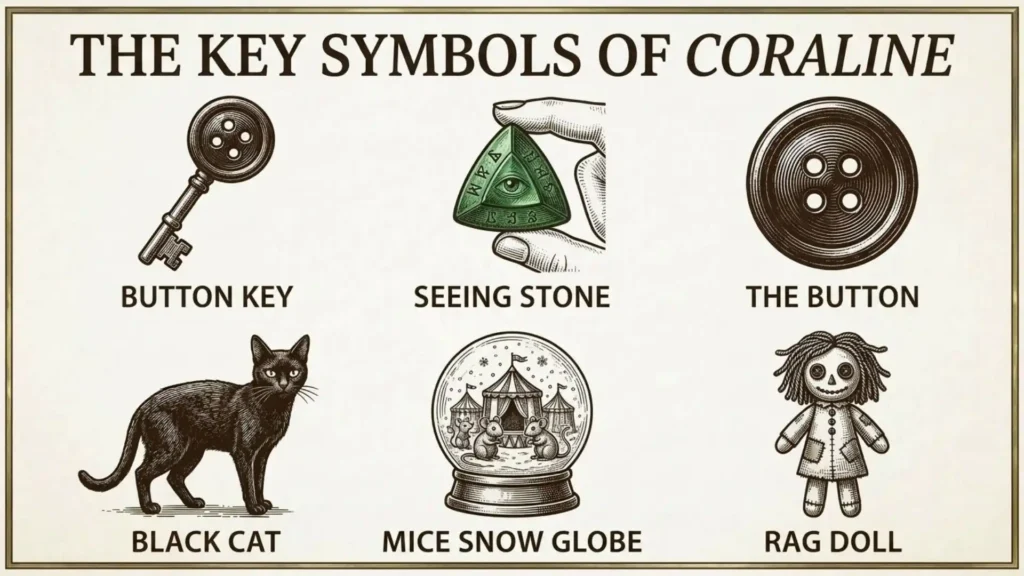
The key is one of the most important objects in the story.
It provides access to the mysterious door and therefore becomes connected with curiosity, discovery, danger, and choice.
What Does the Key Represent?
The key can represent access, opportunity, curiosity, choice, responsibility, and freedom.
At first, having the key gives Coraline the opportunity to discover what is behind the door.
But access is not automatically freedom.
The same key that opens a path to the Other World also becomes part of Coraline’s struggle to protect the boundary between the two worlds.
The Key and Curiosity
Coraline is naturally curious.
The key gives physical form to that curiosity. Instead of merely wondering what is behind the door, she can actually open it.
This makes the key a symbol of discovery.
But the story does not suggest that curiosity is always bad. Coraline’s curiosity eventually helps her understand the danger she faces.
The important lesson is that curiosity becomes valuable when it is combined with judgment.
How the Key’s Meaning Changes
The key has a changing symbolic role.
At the beginning, it represents:
Curiosity and access.
Later, it represents:
Danger and responsibility.
By the end, it becomes associated with:
Protection and freedom.
This changing meaning makes the key more interesting than a simple “freedom symbol.”
The Locked Door Symbol in Coraline
The little door is one of the clearest boundaries in the story.
It separates Coraline’s familiar surroundings from the mysterious Other World.
What Does the Locked Door Represent?
The door can represent:
- curiosity
- temptation
- mystery
- boundaries
- choice
- the unknown
- danger hidden behind something ordinary
The door looks like an ordinary part of a house, but it conceals something extraordinary.
That is an important pattern in the story: ordinary objects can contain extraordinary danger.
The Door as a Boundary
The door represents a choice.
Coraline can leave it closed.
She can investigate it.
She can enter the world beyond it.
This makes the door a physical representation of decision-making.
It asks a question that appears throughout the story:
Should Coraline follow what looks exciting, or should she recognize when excitement becomes dangerous?
How the Door’s Meaning Changes
Like the key, the door changes meaning as the story develops.
At first, it is mysterious.
Then it becomes exciting.
Later, it becomes threatening.
Finally, it represents a boundary that must be protected.
That progression mirrors Coraline’s own development.
The Tunnel Symbol in Coraline
The tunnel between the real world and the Other World represents transition.
It is neither a normal room nor a simple hallway. It is a strange passage between two versions of reality.
What Does the Tunnel Represent?
The tunnel can symbolize:
- transition
- uncertainty
- movement between identities or experiences
- crossing a psychological boundary
- entering the unknown
Coraline does not simply walk from one ordinary room into another. She passes through a space that feels unnatural.
This makes the tunnel a visual representation of leaving the familiar behind.
The Tunnel and Coraline’s Growth
Every journey through the tunnel represents a change in Coraline’s understanding.
The first journey is driven largely by curiosity.
Later journeys are driven by purpose.
Eventually, Coraline enters danger because she knows she must act.
The physical journey therefore parallels her emotional development.
The Cat Symbol in Coraline
The black cat is one of the most interesting symbolic characters in the story.
Unlike many inhabitants of the Other World, the cat does not become part of the Other Mother’s artificial system.
What Does the Cat Symbolize?
The cat can symbolize:
- independence
- instinct
- intelligence
- freedom
- skepticism
- perception
- guidance
The cat does not simply tell Coraline what she wants to hear.
Instead, it helps her recognize that appearances can be deceptive.
The Cat and Independence
Cats are often associated with independence, and the cat’s behavior fits that interpretation.
It does not behave like a servant.
It does not exist to please the Other Mother.
It moves according to its own nature.
This makes the cat a useful contrast with the button-eyed inhabitants.
Coraline and the Cat
Coraline and the cat have something important in common: neither is willing to surrender independence easily.
Coraline uses courage and determination.
The cat relies more on instinct, intelligence, and its ability to understand the Other World.
Together, they create a partnership based on freedom rather than control.
Why Is the Cat Important?
The cat also helps readers question what they see.
When Coraline is tempted by the Other World, the cat provides another perspective.
Its presence reminds her that the attractive surface of the Other World cannot be trusted.
The Coraline Doll Symbol
The doll is especially important in the 2009 film.
It resembles Coraline while also reflecting the artificial world created by the Other Mother.
What Does the Doll Represent?
The doll can represent:
- imitation
- observation
- manipulation
- surveillance
- control
- manufactured identity
A doll looks like a person without actually being that person.
That makes it an excellent symbol for the Other World.
The Doll and Imitation
The Other World repeatedly copies Coraline’s real life.
The doll fits this pattern.
It resembles Coraline, but it is not Coraline.
This creates an important symbolic question:
How close can a copy come to the real thing before the difference becomes dangerous?
The Doll in the Book and Film
When analyzing the doll, identify which version you are discussing.
The 2009 film gives the doll a particularly strong visual role. It resembles Coraline and is repeatedly connected with the Other Mother’s attempts to observe and manipulate her.
For a movie essay, the doll is therefore especially useful when discussing surveillance, imitation, and control.
The Mirror Symbol in Coraline
The mirror is another important image associated with separation and hidden reality.
What Does the Mirror Represent?
The mirror can symbolize:
- reflection
- hidden truth
- separation
- imprisonment
- appearance versus reality
A mirror normally reflects what is already there.
In Coraline, however, the mirror becomes connected with a frightening separation between Coraline and the trapped children and family members.
The Mirror and Hidden Truth
A mirror suggests that what we see may not tell us everything.
This fits the story’s repeated interest in appearances.
The Other World looks wonderful.
The Other Mother looks caring.
The garden looks beautiful.
The food looks delicious.
But the truth underneath these surfaces is darker.
The mirror therefore fits the larger theme of learning to look beyond appearances.
The Ghost Children Symbol
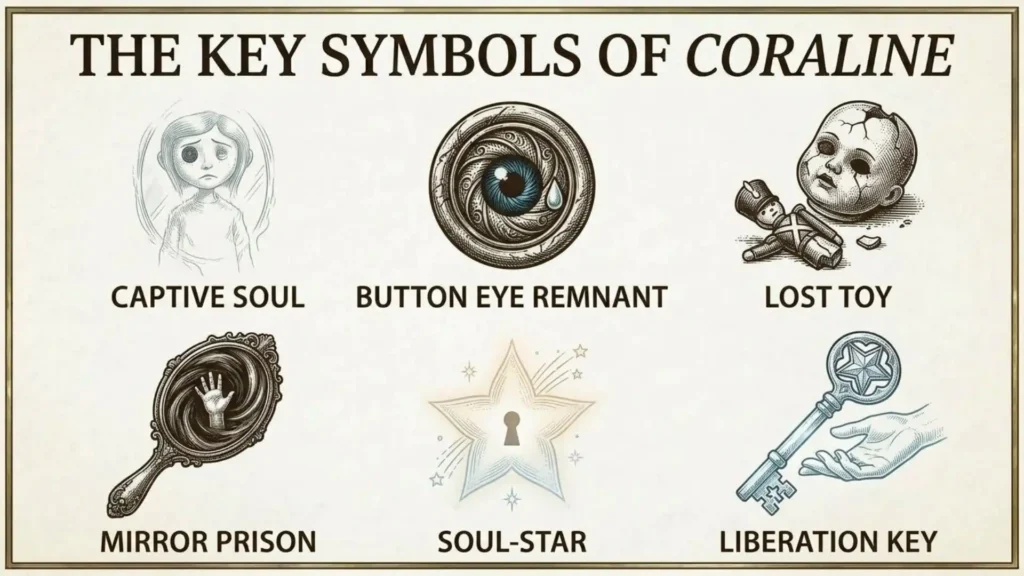
The ghost children represent the consequences of surrendering to the Other Mother’s control.
What Do the Ghost Children Represent?
They can symbolize:
- lost identity
- manipulation
- trapped freedom
- the consequences of deception
- warnings from the past
They are important because they show Coraline what could happen if she makes the wrong choice.
The Ghost Children and Coraline’s Choice
Coraline is not simply fighting for herself.
The existence of the ghost children makes her situation larger.
Their experience shows that the Other Mother’s promises have happened before.
This gives Coraline a warning:
What looks like a wonderful opportunity may have already harmed others.
The Garden Symbol in Coraline
The Other Mother’s garden is visually beautiful, but its perfection feels unnatural.
What Does the Garden Represent?
The garden can symbolize:
- artificial beauty
- perfection
- temptation
- control
- illusion
The garden is attractive because it seems designed around Coraline’s interests.
But that is precisely what makes it unsettling.
The Garden and False Perfection
A natural garden contains irregularity.
The Other Mother’s garden feels carefully designed.
This reflects the Other World itself.
Everything seems to exist for Coraline’s pleasure.
But when every detail is designed to satisfy one person, beauty can become a form of manipulation.
The garden therefore represents perfection without freedom.
Food and Drink as Symbols in Coraline
Food is one of the easiest ways to understand the Other Mother’s strategy.
What Does Food Symbolize?
Food can represent:
- comfort
- attention
- temptation
- generosity
- desire
- emotional manipulation
Coraline’s real life is not always exciting. Her parents are busy, and she sometimes feels overlooked.
The Other Mother responds by creating experiences that make Coraline feel special.
Food and Emotional Manipulation
The important point is not simply that the Other Mother provides better meals.
She uses pleasure to create attachment.
This creates a pattern:
Desire → satisfaction → trust → dependence → control
The food therefore represents how something pleasant can become a tool of manipulation.
The Other World Symbol in Coraline
The Other World is arguably the largest symbol in the story because many smaller symbols exist inside it.
What Does the Other World Represent?
The Other World can represent:
- temptation
- escapism
- false perfection
- emotional manipulation
- artificial happiness
- appearance versus reality
It gives Coraline many things she wants.
That is why it is dangerous.
Why Is the Other World So Attractive?
The Other Mother understands what Coraline wants.
She creates an environment that appears more exciting than Coraline’s real life.
The danger is not that Coraline immediately recognizes the Other World as evil.
The danger is that she initially likes it.
That makes the story’s warning more realistic:
Manipulation often becomes powerful when it begins with something desirable.
The Other World and False Perfection
The real world is imperfect.
Coraline’s parents can be distracted.
Her neighbors can be strange.
Her home can be boring.
The Other World appears to solve all those problems.
But its perfection is conditional.
Coraline must eventually surrender her independence to keep it.
This creates one of the story’s strongest contrasts:
Imperfect freedom is better than perfect captivity.
The Other Mother as a Symbol
The Other Mother is the central force behind the story’s deception.
What Does the Other Mother Symbolize?
The Other Mother can symbolize:
- possessive love
- manipulation
- control
- temptation
- false affection
- conditional acceptance
She looks like a mother, but her behavior gradually reveals that her version of love is based on possession.
Why Is the Other Mother More Dangerous When She Appears Loving?
A monster that immediately looks dangerous is easy to avoid.
The Other Mother is more effective because she begins by offering things Coraline wants.
She gives attention.
She prepares attractive food.
She creates entertainment.
She appears to understand Coraline.
But her affection has a condition: Coraline must ultimately surrender herself.
This makes the Other Mother a symbol of love without freedom.
The Other Mother and Possession
The Other Mother does not simply want Coraline to visit.
She wants Coraline to stay.
She wants Coraline to become part of her world.
The button-eye demand makes the symbolism clear: affection becomes dangerous when it requires the destruction of individuality.
The Other Father as a Symbol
The Other Father can be interpreted as a symbol of performance and conformity.
What Does the Other Father Represent?
He represents:
- performance
- artificial happiness
- obedience
- entertainment used as distraction
- the pressure to fit into someone else’s design
His role changes depending on the Other Mother’s control.
This shows that the Other World does not give its inhabitants complete freedom.
Even apparent happiness exists within someone else’s system.
Eyes as a Symbol in Coraline
Eyes deserve their own discussion because they appear throughout the story in different forms.
What Do Eyes Represent?
Eyes can symbolize:
- perception
- awareness
- identity
- recognition
- truth
- independent judgment
This makes the replacement of eyes with buttons especially meaningful.
Real Eyes vs. Button Eyes
The contrast can be summarized simply:
Real eyes → individual perception
Button eyes → artificial sameness
Coraline’s refusal to give up her eyes therefore becomes more than physical resistance.
It can be interpreted as her refusal to surrender her ability to see and judge the world for herself.
The Needle and Thread Symbol
The needle and thread are connected with the Other Mother’s attempt to physically transform Coraline.
What Can the Needle Represent?
The needle can symbolize:
- forced transformation
- control
- pain
- permanence
- invasion of personal boundaries
Thread is normally associated with repairing or joining things.
In Coraline, sewing becomes frightening because it is being used to alter a person’s body.
Sewing and Control
The image of sewing buttons onto someone’s eyes turns an ordinary domestic action into a threat.
That is typical of the story.
Familiar objects become frightening when placed in the wrong context.
The Hand Symbol in Coraline
The severed hand becomes a symbol of danger that refuses to disappear immediately.
What Does the Hand Represent?
The hand can symbolize:
- unfinished danger
- persistence
- pursuit
- control
- the consequences of the Other Mother’s actions
A hand normally represents action and connection.
Here, it becomes threatening because it continues the Other Mother’s influence beyond the main confrontation.
The Hand and the Ending
The hand also reinforces the idea that defeating a threat does not always mean immediately forgetting it.
Coraline must remain alert.
Her courage involves continuing to act even after the main danger seems to have passed.
The House as a Symbol in Coraline
The house represents home, but Coraline deliberately complicates the meaning of home.
Why Is Home Important?
Home can represent:
- safety
- family
- familiarity
- identity
- belonging
But the story presents two versions of home.
There is Coraline’s real home, which can be boring and imperfect.
Then there is the Other World, which looks like a better version of home.
Real Home vs. Artificial Home
The story eventually encourages readers to appreciate something important:
A genuine relationship does not need to be perfect to be valuable.
The real home may have flaws, but it allows Coraline to remain herself.
The Other World offers perfection at the cost of freedom.
That difference makes home one of the story’s deepest symbols.
What Does Coraline Herself Symbolize?
It is easy to focus on objects and forget that Coraline herself can be interpreted symbolically.
Coraline as a Symbol of Courage
Coraline does not become brave because she stops being afraid.
She becomes brave because she acts despite fear.
This makes courage one of the strongest ideas associated with her character.
Coraline as a Symbol of Independence
At the beginning, Coraline wants attention and excitement.
As the story progresses, she becomes more capable of making decisions for herself.
Her independence does not mean that she does not need others.
Instead, it means she learns to think and act for herself.
Coraline and Growing Maturity
Coraline’s journey can also be interpreted as a movement from curiosity toward responsibility.
At first, she wants to explore because she is bored.
Later, she takes risks because other people need her help.
That difference shows her growth.
Copies, Doubles, and Imitation in Coraline
One of the most powerful patterns in Coraline is the repeated appearance of copies.
The Other Mother and Real Mother
The Other Mother looks like Coraline’s mother but behaves very differently.
This creates a contrast between appearance and genuine identity.
The Other World and Real World
The Other World copies the real world but changes its details.
It is familiar enough to attract Coraline but different enough to become dangerous.
The Doll and Coraline
The doll resembles Coraline without actually being Coraline.
It therefore represents imitation.
Button Eyes and Human Eyes
The buttons are another form of replacement.
They copy the appearance of eyes without functioning as living eyes.
The Importance of the Copies
Together, these examples create a larger pattern:
The Other World can imitate reality, but it cannot become genuine reality.
This may be one of the most useful ways to understand the entire story.
Coraline Symbols and Major Themes
The symbols in Coraline become clearer when they are connected to the story’s major themes.
Symbols of Identity
The strongest identity symbols include:
- button eyes
- the doll
- copies
- mirrors
- the ghost children
All raise questions about what makes a person genuinely themselves.
Symbols of Control
The Other Mother, button eyes, food, the doll, and the Other World all connect with control.
The story repeatedly asks what happens when someone else tries to decide how you should live.
Symbols of Freedom
The key, door, cat, Coraline, and real home connect with freedom.
Freedom does not mean having everything you want.
It means having the ability to make your own choices.
Symbols of Courage
Coraline, the cat, the door, and the ghost children can all connect with courage.
The story presents courage as action taken despite fear.
Symbols of Deception
The Other World, garden, food, doll, mirror, and Other Mother all contribute to the theme of deception.
They remind readers that attractive appearances can hide dangerous intentions.
Symbols of Family
The real parents and the house represent a more complicated form of family.
Real family life is not perfect.
The story suggests that genuine relationships can include disappointment, boredom, mistakes, and imperfections while still being meaningful.
Coraline Symbolism: Appearance vs. Reality
Appearance versus reality may be the central idea connecting the symbols.
The Other Mother looks like Coraline’s mother.
The Other Father looks like her father.
The Other World looks like an improved version of home.
The food looks wonderful.
The garden looks beautiful.
The doll looks like Coraline.
The button eyes look like eyes but are not real eyes.
Almost everything important contains a contrast between what something appears to be and what it actually is.
This is why readers should not analyze the symbols separately only.
They work together.
The story repeatedly teaches Coraline to look beyond appearances.
How Coraline’s Symbols Change Throughout the Story
One of the strongest ways to analyze symbolism is to look at how a symbol changes.
| Symbol | Beginning | Middle | Later meaning |
| Door | Mystery | Temptation | Boundary |
| Key | Curiosity | Access | Responsibility |
| Other World | Exciting | Dangerous | False perfection |
| Cat | Strange | Guide | Independent ally |
| Garden | Beautiful | Suspicious | Artificial perfection |
| Food | Attractive | Manipulative | Temptation |
| Button eyes | Strange | Threatening | Control and conformity |
| Home | Ordinary | Missed | Valuable and genuine |
This development matters because symbols are not always static.
Their meaning can change as Coraline’s understanding changes.
Coraline Symbols vs. Motifs vs. Themes
These three literary terms are related but not identical.
What Is a Symbol?
A symbol is an object, character, place, or image that can suggest a deeper idea.
Example:
Button eyes → control or loss of individuality
What Is a Motif?
A motif is an image, idea, or pattern that appears repeatedly.
In Coraline, repeated images of eyes, buttons, copies, doors, and artificial versions of people form important motifs.
What Is a Theme?
A theme is a larger idea explored by the story.
Examples include:
- freedom versus control
- courage
- identity
- temptation
- appearance versus reality
- genuine love versus possessive love
Why Does This Difference Matter?
A strong literary analysis does not simply say:
“The button eyes are a theme.”
Instead, it explains:
“The button eyes are a symbol that contributes to the larger themes of identity, control, and freedom.”
That is a much more accurate way to discuss literary symbolism.
How to Analyze Coraline Symbols in an Essay
If you are writing an essay about Coraline, do not stop at naming a symbol.
Use a simple five-step method.
Step 1: Identify the Symbol
Choose an important object, character, image, or setting.
For example:
The button eyes
Step 2: Explain Its Literal Role
Explain what happens in the story.
The Other Mother’s world contains characters with buttons instead of normal eyes, and Coraline is pressured to accept them herself.
Step 3: Give the Interpretation
Explain what the symbol can represent.
The button eyes can represent control, conformity, artificiality, and loss of individuality.
Step 4: Connect It to a Theme
Connect the symbol to a larger idea.
The button eyes support the theme of freedom versus control because Coraline must decide whether comfort is worth giving up her independence.
Step 5: Explain Why It Matters
Finish by explaining what the symbol contributes to the story.
The button-eye image makes the Other World visually attractive but deeply unnatural, helping readers understand why Coraline must resist it.
Best Coraline Symbols for an Essay
If you need to choose only a few symbols, these are especially useful.
Button Eyes
Best for essays about:
- identity
- control
- conformity
- deception
- freedom
The Key
Best for:
- choice
- access
- curiosity
- responsibility
- freedom
The Door
Best for:
- temptation
- boundaries
- curiosity
- the unknown
The Cat
Best for:
- independence
- courage
- instinct
- perception
The Mirror
Best for:
- hidden truth
- imprisonment
- reflection
- appearance versus reality
The Other World
Best for:
- temptation
- false perfection
- manipulation
- escapism
The Doll
Best for:
- imitation
- surveillance
- control
- identity
Coraline Symbols for a School Project
For a school project, avoid simply listing ten objects with one-word meanings.
Instead, organize the project around a few important ideas.
A Simple Symbol Chart
You could organize your project like this:
Button eyes: Control and identity
Key: Choice and access
Door: Curiosity and boundaries
Cat: Independence
Mirror: Hidden reality
Garden: Artificial perfection
Food: Temptation
Other World: False perfection
Ghost children: Consequences of manipulation
Other Mother: Possessive control
A Strong Project Question
Instead of asking:
“What are the symbols in Coraline?”
A stronger project question is:
“How does Neil Gaiman use symbols to show the difference between freedom and control?”
This allows you to connect several symbols instead of analyzing them as unrelated objects.
Coraline Symbols for Tattoos and Fan Art
Coraline imagery is also popular in fan art and tattoo designs.
If you are choosing an image based on the story, consider the meaning you want it to communicate.
Button Eye Design
Can suggest:
- the unsettling nature of the Other World
- identity
- control
- resistance
Key Design
Can suggest:
- freedom
- discovery
- curiosity
- opening a new path
Cat Design
Can suggest:
- independence
- intelligence
- courage
Door Design
Can suggest:
- mystery
- transition
- curiosity
- crossing a boundary
The meaning depends on the surrounding design and the personal interpretation of the story.
Coraline Symbolism Cheat Sheet
For a quick reference, remember:
Button eyes → control, conformity, identity
Key → access, choice, responsibility
Door → curiosity, temptation, boundary
Tunnel → transition and uncertainty
Cat → independence, instinct, guidance
Doll → imitation, observation, manipulation
Mirror → reflection, hidden truth, imprisonment
Ghost children → lost identity and consequences
Garden → artificial beauty and false perfection
Food → temptation and emotional manipulation
Other World → false perfection and escapism
Other Mother → possessive love and control
Other Father → performance and conformity
Eyes → perception and independent judgment
Needle → forced transformation and control
Hand → continuing danger
House → home, family, and belonging
Coraline → courage, independence, and maturity
Common Mistakes When Analyzing Coraline Symbols
Mistake 1: Treating Every Interpretation as a Fact
Literary symbolism often allows more than one reasonable interpretation.
Use phrases such as:
- “can represent”
- “can be interpreted as”
- “suggests”
- “may symbolize”
unless the story directly establishes something.
Mistake 2: Confusing the Book With the Movie
Do not describe a film-specific detail as though it appeared exactly the same way in the novella.
Always specify whether you are analyzing the book, the 2009 film, or both.
Mistake 3: Listing Symbols Without Explaining Them
A list such as “button = control” is not enough for an essay.
Explain how the symbol works in the story.
Mistake 4: Confusing Symbols With Themes
Button eyes are a symbol.
Control is an idea connected with that symbol.
Freedom versus control is a broader thematic conflict.
Mistake 5: Assuming the Other World Is Simply “Good” or “Bad”
The Other World is more interesting because it is attractive before its danger becomes clear.
Its beauty is part of the manipulation.
Mistake 6: Ignoring Symbol Development
A symbol can change meaning as the story progresses.
The door is a good example.
It begins as a mystery, becomes a temptation, and eventually becomes a boundary that Coraline must protect.
Mistake 7: Focusing Only on Horror
The creepy imagery is important, but Coraline also explores:
- independence
- family
- courage
- identity
- temptation
- emotional needs
- freedom
A strong analysis should cover these ideas.
Frequently Asked Questions About Coraline Symbols
What is the main symbol in Coraline?
The button eyes are generally the most prominent symbol in Coraline. They can represent control, artificiality, conformity, and the loss of individuality. Their importance becomes clear when Coraline is asked to replace her real eyes with buttons.
What do the button eyes symbolize in Coraline?
The button eyes can symbolize control, conformity, deception, and loss of identity. They distinguish the artificial inhabitants of the Other World from Coraline and represent the price Coraline would have to pay to remain there permanently.
Why does the Other Mother have button eyes?
The button eyes help distinguish the Other Mother and her creations from the real people in Coraline’s world. Symbolically, they make her appear artificial and controlled while reinforcing the story’s ideas about deception and identity.
What does the key symbolize in Coraline?
The key can symbolize access, curiosity, choice, responsibility, and freedom. Its meaning develops as Coraline moves from simply wanting to discover what is behind the door to understanding the responsibility that comes with controlling access between the two worlds.
What does the door symbolize in Coraline?
The small door can symbolize curiosity, temptation, mystery, and boundaries. It separates Coraline’s familiar world from the Other World and becomes a physical representation of the choices she makes.
What does the cat symbolize in Coraline?
The cat can symbolize independence, instinct, intelligence, freedom, and guidance. It helps Coraline recognize that the Other World is not what it appears to be and provides a perspective outside the Other Mother’s control.
What does the Coraline doll symbolize?
The doll can symbolize imitation, observation, manipulation, and surveillance. Its resemblance to Coraline makes it particularly important as an image of copying and control. The 2009 film gives the doll an especially prominent visual role.
What does the mirror symbolize in Coraline?
The mirror can symbolize reflection, hidden truth, separation, and imprisonment. It fits the story’s larger interest in copies and the difference between appearance and reality.
What do the ghost children symbolize?
The ghost children can represent the consequences of manipulation and the loss of freedom. Their existence warns Coraline about what can happen to people who become trapped by the Other Mother.
What does the garden symbolize in Coraline?
The garden can symbolize artificial beauty and false perfection. It appears attractive and carefully designed, reflecting the Other Mother’s ability to create a world that looks wonderful while hiding its controlling nature.
What does food symbolize in Coraline?
Food can symbolize temptation, comfort, attention, and emotional manipulation. The Other Mother’s generous meals help make her world attractive to Coraline before the deeper danger becomes clear.
What does the Other World symbolize?
The Other World can be interpreted as a symbol of false perfection and temptation. It gives Coraline many things she wants, but its attractive appearance hides an attempt to control her.
What does the Other Mother symbolize?
The Other Mother can symbolize possessive love, manipulation, control, temptation, and false affection. She appears caring but ultimately wants Coraline to surrender her independence.
What does Coraline herself symbolize?
Coraline can symbolize courage, independence, curiosity, resilience, and growing maturity. Her journey shows that bravery does not mean having no fear; it means making difficult choices despite fear.
What is the symbolism of the hand in Coraline?
The hand can symbolize persistent danger and the fact that a threat may continue even after its main source has been defeated. It represents the Other Mother’s influence reaching beyond the central confrontation.
What is the main theme behind Coraline’s symbols?
The symbols collectively explore freedom versus control, identity, courage, temptation, family, and appearance versus reality. Many of the symbols contrast something genuine with an artificial copy.
Are the symbols different in the Coraline book and movie?
The major symbols are shared, but the 2009 film expands several ideas through visual storytelling. The doll, visual design, color, movement, and other cinematic details receive greater emphasis in the film. When writing an assignment, identify which version you are analyzing.
What is the best Coraline symbol for an essay?
The button eyes are one of the strongest choices because they connect naturally with identity, control, conformity, freedom, and appearance versus reality. The key and door are also excellent choices because their meanings develop as Coraline’s journey progresses.
Conclusion
The symbols in Coraline are powerful because they work together rather than existing as isolated objects. The button eyes represent the danger of surrendering individuality to control. The key and door turn curiosity into a question of choice and responsibility. The cat represents independence and clear judgment, while the doll and mirror reinforce the story’s interest in copies, observation, and hidden truth.
The Other World is perhaps the largest symbol of all. It offers Coraline an attractive version of life, but its perfection comes with a price. The story repeatedly contrasts genuine relationships with artificial ones, freedom with possession, and imperfect reality with attractive illusion.
Most importantly, Coraline does not suggest that being brave means never feeling afraid. Coraline remains frightened, but she learns to think, choose, and act despite that fear. That is why the story’s symbols continue to matter: they turn a frightening fantasy into a deeper exploration of identity, independence, courage, temptation, and the value of genuine freedom.
When analyzing Coraline symbols, the strongest approach is not to memorize one fixed meaning for every object. Instead, look at what each symbol does in the story, how its meaning changes, which theme it supports, and how it connects with Coraline’s growth. That approach produces a more thoughtful literary analysis and gives readers a much clearer understanding of why Coraline remains such a memorable story.

Adam Sullivan is a dedicated writer who enjoys transforming everyday topics into engaging and informative content. His writing focuses on making complex ideas simple, practical and enjoyable for readers of all backgrounds. Adam is also the fictional author of The Lantern Beyond Autumn Hills and Where the Morning Horizon Waits. Outside of writing, he enjoys photography, traveling and discovering inspiration through new experiences. He believes great content should be both helpful and easy to connect with.
 Dylan Anderson