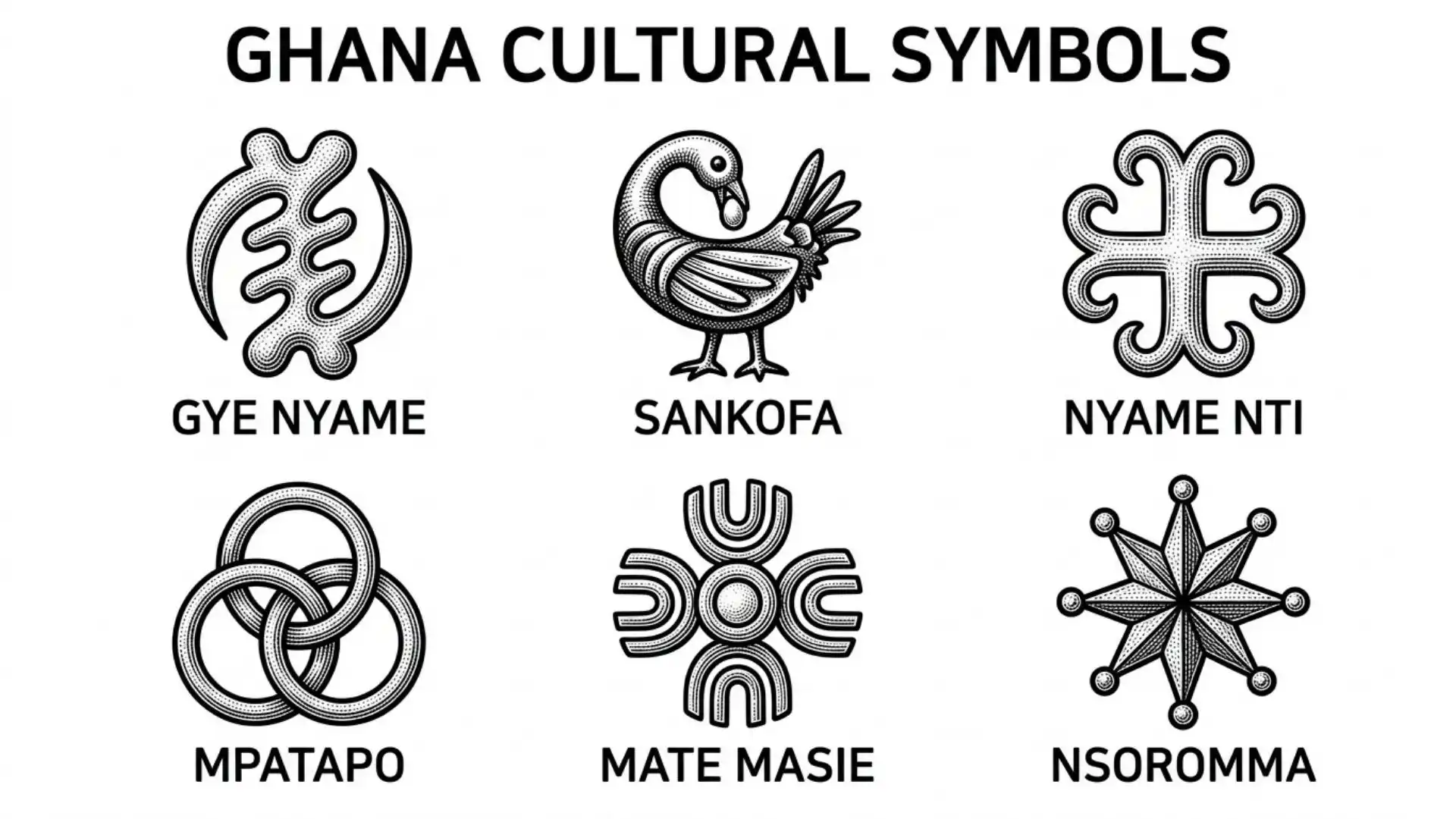
Ghana symbols tell stories about the country’s independence, cultural identity, beliefs, leadership, history, and community values. Some are official national symbols, while others come from traditional cultural systems that have been passed down through generations.
The best-known Ghana symbols include the Ghanaian flag, Black Star, coat of arms, national anthem, and national motto. Beyond these national symbols, Ghana has rich traditional symbolism found in Adinkra designs, Ga Samai, Ewe symbols, Kente patterns, traditional objects, architecture, jewelry, and textiles.
It is important to understand that these categories are not interchangeable. An Adinkra symbol is not automatically an official national symbol, and a Kente pattern is not the same thing as an Adinkra symbol.
Ghana is home to many cultural communities, so a symbol may belong specifically to an Akan, Ga, Ewe, or another cultural tradition.
This guide explains Ghana symbols by category, name, meaning, cultural background, and modern use. Whether you are researching Ghanaian culture, preparing a school project, choosing a tattoo idea, learning about Adinkra, or simply trying to identify a Ghanaian symbol, this guide gives you a practical starting point.
What Are Ghana Symbols? (Quick Answer)
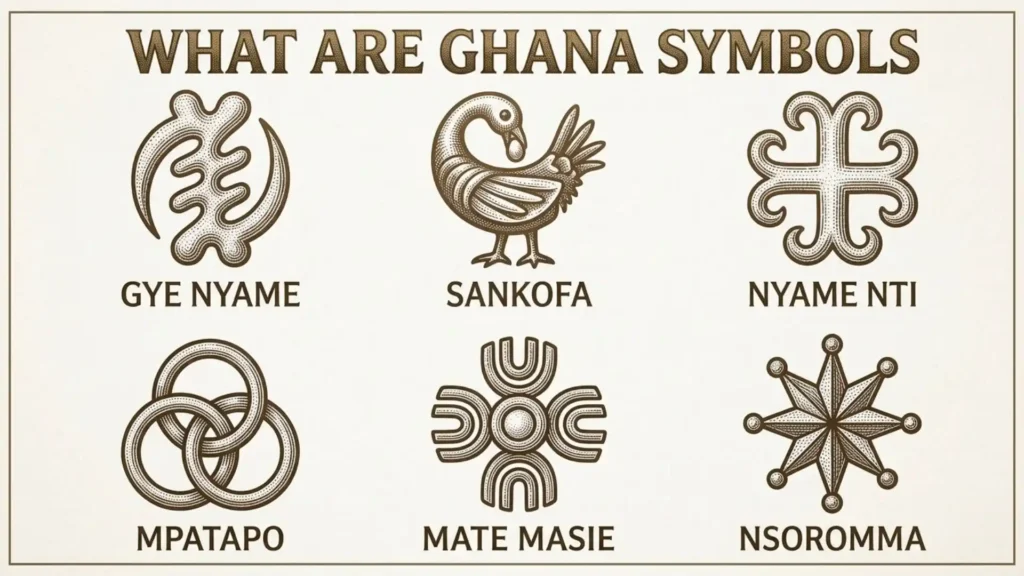
Ghana symbols are visual signs, objects, designs, words, and cultural traditions that communicate Ghana’s national identity or the values and history of its communities. They include national symbols such as the flag and Black Star, as well as traditional systems such as Adinkra, Ga Samai, Ewe symbols, and Kente patterns.
Not every Ghanaian symbol has official national status. Some belong specifically to particular cultural traditions.
Ghana Symbols at a Glance
Before looking at individual symbols, it helps to divide them into groups.
| Category | Examples | Main purpose |
| National symbols | Flag, Black Star, coat of arms | National identity |
| National words and ideals | Anthem, “Freedom and Justice” | National values |
| Adinkra symbols | Sankofa, Gye Nyame, Akoben | Proverbs, beliefs, values |
| Ga symbols | Ga Samai | Ga cultural identity and communication |
| Ewe symbols | Eve Dzesi | Ewe history, authority, religion, philosophy |
| Kente | Named patterns and cloth designs | Heritage, identity, status, history |
| Traditional objects | Sword, linguist’s staff, stool, talking drum | Leadership and cultural identity |
| Jewelry and beads | Beads, bracelets, ornaments | Social, spiritual, and cultural expression |
| Architecture and monuments | Symbolic buildings and memorials | History, identity, remembrance |
Ghana’s Ministry of Tourism, Culture & Creative Arts identifies the Black Star, flag, national coat of arms, national song, ceremonial sword, linguist’s staff, chief’s seat, talking drum, and Kente among important forms of national and cultural symbolism.
Ghana National Symbols and Their Meanings
National symbols represent Ghana as a country rather than only one cultural community. They are closely connected with Ghana’s independence, sovereignty, identity, and national values.
Ghana National Flag
The Ghanaian flag has three horizontal colors—red, gold, and green—with a black five-pointed star in the center of the gold band.
The flag was designed by Theodosia Salome Okoh and became associated with Ghana’s independence in 1957.
According to Ghana’s Information Services material, the colors and Black Star have specific national associations.
| Flag element | Commonly stated meaning |
| Red | The blood and sacrifice connected with the struggle for independence |
| Gold | Ghana’s mineral wealth |
| Green | Forests and natural wealth |
| Black Star | African unity and emancipation |
The flag is therefore much more than a combination of attractive colors. It visually connects Ghana’s natural resources, independence history, and wider African identity.
The Black Star of Ghana
The Black Star is one of Ghana’s most recognizable symbols.
It appears on the national flag and in other national imagery. Ghanaian government material describes the Black Star as a symbol of African unity and emancipation.
Ghana’s Ministry of Tourism, Culture & Creative Arts also describes the Black Star as representing Black pride, strength, and Pan-African solidarity.
For this reason, the Black Star can carry several connected ideas:
- African unity
- Freedom
- Independence
- Black pride
- Strength
- Pan-African identity
- Ghanaian national identity
The Black Star should not be confused with an ordinary decorative star. In the Ghanaian context, it has deep historical and political significance.
Ghana Coat of Arms
Ghana’s coat of arms is another important national symbol.
It combines several visual elements, including a shield, eagle, traditional objects, a castle, a cocoa tree, a mine shaft, and the Black Star.
The coat of arms communicates ideas connected with Ghana’s history, natural resources, traditional authority, national identity, and independence.
Because individual interpretations of heraldic elements can vary between educational and cultural sources, it is better to distinguish officially documented features from broader symbolic interpretations rather than presenting every interpretation as universally fixed.
The National Anthem
Ghana’s national anthem is an important verbal and musical symbol of national identity.
The anthem expresses ideas of:
- Freedom
- National loyalty
- Unity
- Service
- Hope
- African liberation
The Black Star also appears within Ghana’s wider national symbolism and is connected with the country’s historical role in African independence.
Ghana’s National Motto
“Freedom and Justice” is closely associated with Ghana’s national identity.
The phrase captures two major ideals:
- Freedom as independence, dignity, and self-determination
- Justice as fairness, lawful governance, and social responsibility
The motto is particularly meaningful when considered alongside the Black Star and Ghana’s independence history.
Ghana Flag Colors and Their Meanings
The Ghana flag is one of the easiest places to start when learning about Ghana symbols.
What Does Red Mean on the Ghana Flag?
Red is associated with the blood and sacrifice connected with Ghana’s struggle for independence.
It reminds viewers that national freedom involved real human sacrifice.
What Does Gold Mean on the Ghana Flag?
Gold represents Ghana’s mineral wealth.
Gold also connects with Ghana’s long history of gold production and the country’s historical association with the Gold Coast.
What Does Green Mean on the Ghana Flag?
Green represents Ghana’s forests and natural wealth.
It reflects the country’s environmental resources and agricultural potential.
What Does the Black Star Mean on the Ghana Flag?
The Black Star represents African unity and emancipation.
It is also strongly associated with Ghanaian independence, Black pride, and Pan-African solidarity.
Black Star of Ghana: Meaning and Historical Importance
The Black Star deserves special attention because it appears in several forms of Ghanaian national symbolism.
The star became especially important within the independence movement and Ghana’s wider Pan-African identity.
Today, it can represent:
- Freedom from colonial rule
- African unity
- Black identity
- Strength
- Independence
- National pride
The Black Star also appears in Ghanaian monuments and national imagery, making it one of the most useful symbols to understand when studying Ghanaian identity.
Ghana Coat of Arms Symbols and Meanings
The coat of arms brings together national and traditional imagery.
The Eagle
The eagle is a powerful visual element associated with strength, vigilance, and national authority.
However, readers should distinguish broad symbolic interpretations from meanings officially assigned to every individual heraldic element.
The Black Star
The Black Star connects the coat of arms with Ghana’s national identity and broader African symbolism.
The Traditional Sword
The sword connects national imagery with traditional leadership and authority.
Traditional Ghanaian ceremonial swords have cultural importance beyond their practical function.
The Linguist’s Staff
A linguist’s staff is connected with traditional communication and leadership.
In Ghanaian traditional settings, the linguist plays an important role in communicating messages on behalf of a chief or traditional authority.
The Castle
The castle imagery connects the national emblem with Ghana’s historical landscape and colonial-era history.
The Cocoa Tree
The cocoa tree represents an important part of Ghana’s agricultural and economic heritage.
The Mine Shaft
The mine shaft reflects Ghana’s mineral wealth and the country’s long relationship with mining.
Traditional Ghana Symbols
Ghana’s cultural symbolism goes far beyond national emblems.
The National Register of Intangible Cultural Heritage of Ghana specifically lists Traditional Symbols in Ghana: Adinkra symbols, Ga Samai and Eve Dzesi.
This distinction is important because Ghana is culturally diverse.
Adinkra Symbols
Adinkra is strongly associated with Akan cultural traditions.
Adinkra symbols communicate ideas through visual forms. Many are connected with proverbs, moral lessons, beliefs, wisdom, and observations about life.
Adinkra designs have appeared on cloth and in other artistic and cultural contexts.
Ga Samai Symbols
Ga Samai are traditional symbols associated with the Ga people.
Ghana’s official cultural documentation explains that Ga Samai can express messages and reinforce values important to Ga communities. Many are connected with proverbs and traditional forms of oral expression.
This means Ga symbols should not simply be labeled as Adinkra.
They belong to a distinct cultural tradition.
Ewe Symbols or Eve Dzesi
Ewe symbols, also called Eve Dzesi, are another important Ghanaian symbolic tradition.
Official Ghana cultural material explains that Ewe symbols developed from myths, fables, poems, songs, and proverbs. They can appear in traditional art, linguistic staffs, stools, canoes, architecture, doors, paintings, and traditional cloth.
The National Commission on Culture also publishes material on indigenous Ewe symbols and their meanings.
Adinkra Symbols and Their Meanings
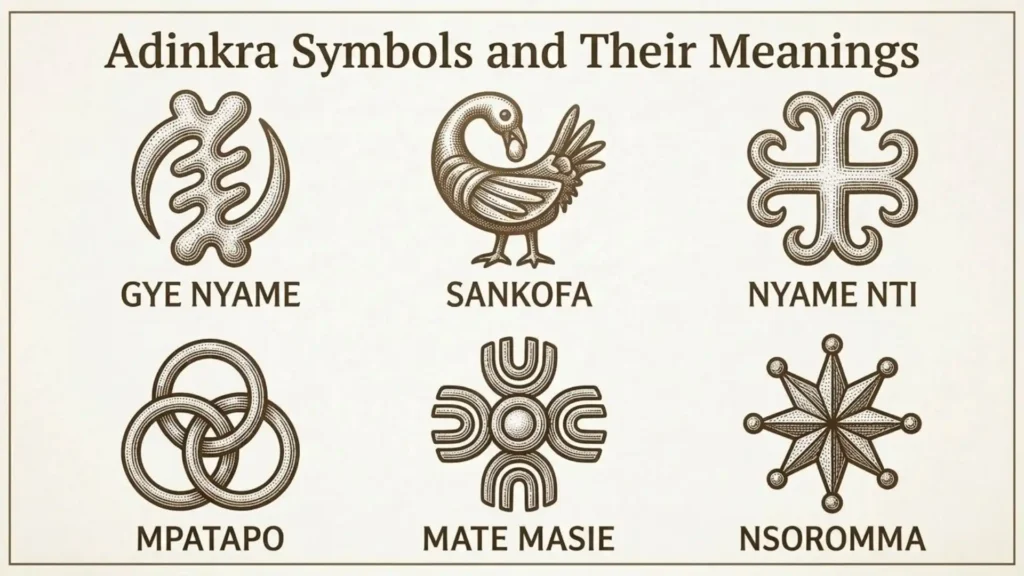
Adinkra symbols are among the most searched Ghanaian cultural symbols.
Their value comes from the way visual designs communicate ideas that might otherwise require a proverb or a longer explanation.
Sankofa
The idea encourages people not to reject their history. Instead, the past can provide knowledge for making better decisions.
- Wisdom
- Learning
- History
- Reflection
- Growth
- Remembering one’s roots
Gye Nyame
Gye Nyame is one of the best-known Adinkra symbols.
It is commonly associated with the supremacy or greatness of God.
The symbol is particularly connected with faith and spiritual reflection.
Akoben
Akoben is commonly associated with vigilance, watchfulness, and readiness.
Its meaning is connected with the traditional idea of the war horn and the need to remain alert.
Dwennimmen
Dwennimmen, often called the “ram’s horns,” is commonly associated with humility combined with strength.
The ram is strong, but the symbolism encourages strength to be balanced by humility.
Mpatapo
The concept is especially useful for understanding how symbols can communicate social values rather than simply represent physical objects.
Ghanaian judicial commentary has also discussed Mpatapo in connection with pacification, mediation, and reconciliation.
Wawa Aba
Wawa Aba is commonly associated with resilience, toughness, and perseverance.
Its name refers to the seed of the wawa tree, which has become a familiar metaphor for strength and endurance.
Adinkrahene
Adinkrahene is associated with leadership and influence and is often described as a central or “king” symbol among Adinkra designs.
It can be connected with authority, leadership, and the importance of setting an example.
Nyame Dua
Nyame Dua is commonly associated with God’s presence, protection, or a sacred place.
Its traditional meaning connects spiritual belief with a physical symbolic form.
Fawohodie
The concept fits naturally within broader Ghanaian themes of liberty and self-determination.
Nyame Nti
Nyame Nti is associated with faith in God and gratitude for divine provision.
Like several Adinkra symbols, its meaning is best understood within the proverb-based cultural system from which it comes.
Ghana Adinkra Symbols Chart
Here is a simple reference chart for readers who want a quick answer.
| Adinkra symbol | Common association |
| Sankofa | Learning from the past |
| Gye Nyame | Supremacy of God |
| Akoben | Vigilance and watchfulness |
| Dwennimmen | Strength with humility |
| Mpatapo | Reconciliation and peace |
| Wawa Aba | Resilience and toughness |
| Adinkrahene | Leadership and influence |
| Nyame Dua | God’s presence and spiritual protection |
| Fawohodie | Freedom and independence |
| Nyame Nti | Faith and divine provision |
Meanings should be understood as traditional or commonly documented interpretations rather than assuming that every symbol has one universally fixed definition.
Ghana Kente Symbols and Patterns
Kente is one of Ghana’s most recognizable cultural textiles.
The Ghana National Register identifies traditional Kente weaving as intangible cultural heritage and documents communities including Bonwire, Adanwomase, Ntonso, Agotime-Kpeotoe, Tafi, and Agbozume.
What Does Kente Represent?
Kente represents heritage, identity, craftsmanship, history, creativity, and social meaning.
It is not simply a colorful fabric.
Kente Pattern Meanings
Different Kente designs can have different names and associations.
Some patterns refer to:
- Proverbs
- Historical events
- Important people
- Relationships
- Social values
- Royal traditions
- Achievement
- Unity
The National Commission on Culture, for example, describes patterns such as Adweneasa in connection with creativity, excellence, and mastery, showing how Kente designs can function as visual statements.
Kente and Ghanaian Heritage
Kente has developed from a traditional textile into a widely recognized symbol of Ghanaian cultural identity.
It appears at ceremonies, celebrations, weddings, graduations, festivals, official occasions, and international cultural events.
Ghana’s cultural authorities describe Kente as a source of identity and pride and continue to document and promote its traditional craftsmanship.
Ghana Symbols of Freedom, Wisdom, Faith, Strength, and Peace
Sometimes readers are not looking for a specific object. They are looking for a Ghanaian symbol that communicates a particular idea.
The following guide makes that search easier.
Symbols of Freedom
Symbols commonly associated with freedom include:
- Black Star
- Fawohodie
- Ghana’s national flag
- “Freedom and Justice”
The Black Star is especially important because of its connection with African unity and emancipation.
Symbols of Wisdom
Sankofa is one of the strongest choices when the intended idea is wisdom gained from experience.
Its central lesson is that understanding the past can help guide the future.
Symbols of Faith
Gye Nyame is strongly associated with belief in God’s supremacy.
Nyame Dua and Nyame Nti can also be relevant when the intended meaning involves spiritual belief or divine provision.
Symbols of Strength
The Black Star can also represent strength within the wider context of Ghanaian and Pan-African identity.
Symbols of Peace
Mpatapo is strongly associated with reconciliation and restoring peaceful relationships.
This makes it especially appropriate when the intended idea is not simply “peace” but the process of resolving conflict.
Ghana Symbols and Their Names
If you are trying to identify Ghanaian symbols, start with the name and cultural tradition.
| Symbol name | Tradition/category | Main idea |
| Black Star | National | African unity and emancipation |
| Sankofa | Adinkra | Learning from the past |
| Gye Nyame | Adinkra | Faith and divine supremacy |
| Akoben | Adinkra | Vigilance |
| Mpatapo | Adinkra | Reconciliation |
| Wawa Aba | Adinkra | Resilience |
| Ga Samai | Ga | Ga cultural symbolism |
| Eve Dzesi | Ewe | Ewe cultural symbolism |
| Kente | Textile tradition | Heritage and identity |
The important point is that these names belong to different symbolic systems. Calling all of them “Adinkra” would erase meaningful cultural distinctions.
Ghana Symbols by Cultural Tradition
Ghana’s cultural diversity is essential to understanding its symbols.
Akan and Adinkra
Adinkra is closely associated with Akan traditions.
Its visual language often communicates proverbs, moral ideas, philosophical concepts, and spiritual beliefs.
Ga and Ga Samai
Ga Samai belongs specifically to Ga cultural traditions.
Official Ghana documentation describes these symbols as connected with Ga proverbs, values, communication, and cultural identity.
Ewe and Eve Dzesi
Ewe symbols have their own cultural history and meanings.
They can appear in traditional art, architecture, cloth, staffs, stools, and other objects and may communicate ideas about authority, religion, history, and philosophy.
Recognizing these differences makes an explanation of Ghana symbols more accurate and respectful.
Traditional Ghanaian Objects With Symbolic Meaning
Ghanaian symbolism is not limited to two-dimensional designs.
Ceremonial Swords
Ceremonial swords can represent authority and traditional leadership.
Linguist’s Staffs
Linguist’s staffs are connected with communication and traditional authority.
Their carved imagery can communicate stories, proverbs, or values.
Chief’s Stool
The stool is an important symbol within several Ghanaian traditional leadership systems.
It can represent authority, ancestry, community identity, and continuity.
Talking Drums
Talking drums have cultural and communicative significance.
They demonstrate how sound and performance can also function as symbolic communication.
Ghana’s Ministry of Tourism, Culture & Creative Arts specifically identifies ceremonial swords, linguist’s staffs, chief’s seats, and talking drums among important cultural symbols.
Ghana Symbols in Beads and Jewelry
Ghanaian beads and jewelry can carry cultural, social, spiritual, and personal meaning.
The National Commission on Culture notes that among groups including the Krobo, Ashanti, and Ewe, beads can function as social and spiritual signifiers connected with important stages and events in life.
Jewelry can therefore be decorative while also communicating identity or cultural belonging.
When using Ghanaian symbolic designs in jewelry, it is helpful to learn the tradition behind the design instead of treating every motif as a generic “African symbol.”
Ghana Symbols in Art, Architecture, and Monuments
Symbols also appear in Ghanaian buildings, monuments, traditional art, and public spaces.
Traditional architecture can include imagery connected with animals, plants, birds, proverbs, authority, and community values.
Modern monuments also use symbols to preserve memories of independence and national history.
This is important because Ghanaian symbolism is not confined to cloth.
It can appear throughout the built environment.
Ghana Symbols for Tattoos and Jewelry
Ghana symbols are sometimes chosen for tattoos and jewelry because their meanings can be deeply personal.
For a Wisdom Tattoo
Sankofa can be considered when the intended message is learning from history and remembering one’s roots.
For a Faith Tattoo
Gye Nyame may be chosen because of its association with God’s supremacy.
For a Freedom Tattoo
Fawohodie or the Black Star may fit a theme of freedom, independence, or emancipation.
For a Strength Tattoo
Wawa Aba may suit a message of resilience.
For a Peace Tattoo
Mpatapo can represent reconciliation and the restoration of peaceful relationships.
When using a Ghanaian symbol as a tattoo, it is worth learning its cultural background first. A symbol should not be reduced to a fashionable graphic if its original meaning is important to a living cultural tradition.
Ghana Symbols for School Projects
Students often search for Ghana symbols because they need a simple explanation for a class assignment or cultural project.
A useful school-project list includes:
- Ghana national flag
- Black Star
- Coat of arms
- National anthem
- National motto
- Adinkra symbols
- Kente
- Ga Samai
- Ewe symbols
- Traditional objects such as stools and linguist’s staffs
For a school project, explain what the symbol is, where it comes from, and what it represents rather than simply listing names.
Ghana Symbols vs Adinkra Symbols vs Kente
These terms are related, but they are not synonyms.
| Term | Meaning |
| Ghana symbols | Broad category covering national and cultural symbols |
| National symbols | Symbols representing Ghana as a country |
| Adinkra symbols | Traditional symbolic designs associated with Akan culture |
| Ga Samai | Traditional symbols associated with Ga culture |
| Eve Dzesi | Traditional Ewe symbols |
| Kente | Ghanaian handwoven textile tradition containing named patterns and designs |
This distinction is one of the most important things to understand when researching Ghana symbols.
Ghana Symbols vs African Symbols
A Ghanaian symbol can also have wider African significance, but the terms are not interchangeable.
For example, the Black Star is deeply associated with Ghana while also carrying Pan-African meaning.
Likewise, Adinkra is strongly associated with Ghanaian Akan traditions, even though Adinkra designs are now recognized internationally.
Therefore, it is better to say:
“This is a Ghanaian symbol with wider African significance.”
rather than automatically labeling every Ghanaian cultural symbol as a universal African symbol.
How to Identify a Ghanaian Symbol
If you find an unfamiliar Ghanaian design, use a simple identification process.
Step 1: Identify Where You Found It
Ask whether it appears on:
- A flag
- A coat of arms
- Cloth
- Jewelry
- Architecture
- A traditional staff
- A stool
- A monument
- Artwork
The location can provide important clues.
Step 2: Identify the Cultural Tradition
Determine whether the design is connected with:
- Akan
- Ga
- Ewe
- Another Ghanaian community
- National Ghanaian identity
This prevents the common mistake of calling every design Adinkra.
Step 3: Look for the Symbol’s Name
If the design appears in a traditional chart, textile description, museum collection, or cultural publication, look for its local name.
Step 4: Check the Meaning
Look for the proverb, story, historical event, belief, or cultural practice associated with the design.
Step 5: Verify the Source
Prefer Ghanaian cultural institutions, government sources, museums, academic publications, and recognized heritage organizations.
This is especially important because symbolic meanings are frequently copied from one website to another without clear evidence.
Common Mistakes About Ghana Symbols
Mistake 1: Calling Every Ghanaian Symbol an Adinkra Symbol
Adinkra is one important Ghanaian symbolic tradition, but it is not the name for every Ghanaian symbol.
Ghana’s official cultural register separately identifies Adinkra, Ga Samai, and Eve Dzesi.
Mistake 2: Assuming Every Meaning Is Universal
Symbolic meanings can depend on cultural context.
Use phrases such as “commonly associated with” when the meaning is an interpretation rather than a formal national definition.
Mistake 3: Confusing Kente With Adinkra
Kente is a textile tradition.
Adinkra refers to a system of symbolic designs strongly associated with Akan culture.
Adinkra designs can appear on cloth, including traditional textiles, but Kente and Adinkra are not the same thing.
Mistake 4: Treating the Black Star as Just a Decorative Star
The Black Star has important historical connections with Ghanaian independence, African unity, emancipation, and Pan-African identity.
Mistake 5: Ignoring Ghana’s Cultural Diversity
Ghana contains many cultural communities.
An explanation focused only on Akan traditions gives an incomplete picture of Ghanaian symbolism.
Mistake 6: Assuming a Modern Design Is an Ancient Symbol
A contemporary designer may create a new design inspired by traditional Ghanaian aesthetics.
That does not automatically make the design an ancient traditional symbol.
Mistake 7: Treating Every Online Meaning as Authoritative
Symbol websites often repeat information without citing where the meaning came from.
For important cultural claims, check credible Ghanaian sources.
10 Important Ghana Symbols to Know
If you need a short list, start with these:
- Ghanaian flag — national identity and independence.
- Black Star — African unity and emancipation.
- Coat of arms — national identity and Ghana’s history.
- National anthem — patriotism, freedom, unity, and service.
- Freedom and Justice — national ideals.
- Sankofa — learning from the past.
- Gye Nyame — faith in God’s supremacy.
- Akoben — vigilance.
- Mpatapo — reconciliation.
- Kente — Ghanaian cultural heritage and identity.
This list is a practical introduction rather than an official ranking of Ghana’s symbols.
Frequently Asked Questions About Ghana Symbols
What are the main symbols of Ghana?
The main national symbols commonly discussed include Ghana’s national flag, Black Star, coat of arms, national anthem, and national motto. Ghana also has numerous traditional cultural symbols, including Adinkra, Ga Samai, Eve Dzesi, Kente designs, and symbolic traditional objects.
What is the most famous Ghana symbol?
The Black Star is one of Ghana’s most recognizable symbols. It appears prominently on the national flag and is associated with African unity, emancipation, Black pride, and Pan-African solidarity.
What does the Black Star symbolize in Ghana?
The Black Star symbolizes African unity and emancipation. It is also strongly associated with Ghanaian independence and Pan-African identity.
What do the colors of Ghana’s flag mean?
Red is associated with the sacrifice connected with independence, gold represents mineral wealth, green represents forests and natural wealth, and the Black Star represents African unity and emancipation.
What are Adinkra symbols?
Adinkra symbols are traditional visual symbols associated with Akan culture. They communicate ideas, values, proverbs, beliefs, and philosophical concepts through visual designs.
What does Sankofa mean?
Sankofa is commonly associated with learning from the past so that the knowledge gained can guide the future.
What does Gye Nyame mean?
Gye Nyame is commonly associated with the supremacy or greatness of God and is widely recognized as a symbol of faith within the Adinkra tradition.
What does Mpatapo symbolize?
Mpatapo is commonly associated with reconciliation, pacification, and the restoration of peaceful relationships.
What does Wawa Aba symbolize?
Wawa Aba is commonly associated with resilience, toughness, and perseverance.
What are Ga Samai symbols?
Ga Samai are traditional symbols associated with the Ga people of Ghana. Official Ghana cultural material explains that they are connected with Ga traditions, proverbs, communication, and community values.
What are Ewe symbols?
Ewe symbols, also called Eve Dzesi, are traditional symbols connected with Ewe culture. They can communicate ideas related to history, religion, philosophy, authority, and community life and appear in traditional art, cloth, architecture, staffs, stools, and other cultural forms.
Is Kente a Ghanaian symbol?
Kente is a major symbol of Ghanaian cultural heritage and identity. It is a traditional handwoven textile whose patterns and finished cloths can carry names and meanings connected with proverbs, customs, beliefs, and community traditions.
What is the difference between Ghana symbols and Adinkra symbols?
“Ghana symbols” is a broad term covering national and cultural symbols. Adinkra symbols are one specific traditional symbolic system strongly associated with Akan culture.
Are Ghana symbols good for tattoos?
Some people choose Ghanaian symbols for tattoos because of their meaningful associations with faith, wisdom, freedom, strength, peace, or heritage. However, it is respectful to learn the cultural background and traditional meaning before using a symbol permanently.
What Ghana symbol represents wisdom?
Sankofa is commonly associated with wisdom gained through understanding and learning from the past.
What Ghana symbol represents freedom?
Fawohodie is commonly associated with freedom and independence, while the Black Star is strongly connected with African emancipation and Ghana’s independence history.
What Ghana symbol represents peace?
Mpatapo is particularly associated with reconciliation and restoring peaceful relationships.
Are all Ghana symbols Adinkra symbols?
No. Ghana has several symbolic traditions. The official National Register identifies Adinkra, Ga Samai, and Eve Dzesi as distinct traditional-symbol traditions.
Why are Ghana symbols important?
Ghana symbols preserve and communicate national history, cultural identity, traditional values, beliefs, community stories, and ideas about leadership, freedom, faith, wisdom, and social responsibility.
Conclusion
Ghana symbols are much richer than a simple list of decorative designs. They form a visual language connecting Ghana’s national identity with the histories, beliefs, values, and traditions of its diverse communities.
The Ghanaian flag, Black Star, coat of arms, national anthem, and national motto help express national identity and the country’s history of independence. Traditional systems such as Adinkra, Ga Samai, and Eve Dzesi provide another layer of meaning through proverbs, stories, beliefs, values, authority, and community traditions. Kente adds another important dimension by turning color, pattern, craftsmanship, and proverb-based ideas into wearable cultural heritage.
The most important lesson is to understand each symbol in its proper context. Not every Ghanaian symbol is an official national symbol, not every traditional design is Adinkra, and not every symbolic meaning is universal. Learning the cultural tradition behind a design makes your understanding more accurate and respectful.
Whether you are researching Ghanaian culture, creating a school project, choosing a meaningful design, studying Adinkra, or simply exploring Ghana’s history, these symbols offer a powerful way to understand how ideas can be preserved and communicated through visual culture.

Adam Sullivan is a dedicated writer who enjoys transforming everyday topics into engaging and informative content. His writing focuses on making complex ideas simple, practical and enjoyable for readers of all backgrounds. Adam is also the fictional author of The Lantern Beyond Autumn Hills and Where the Morning Horizon Waits. Outside of writing, he enjoys photography, traveling and discovering inspiration through new experiences. He believes great content should be both helpful and easy to connect with.
 Dylan Anderson