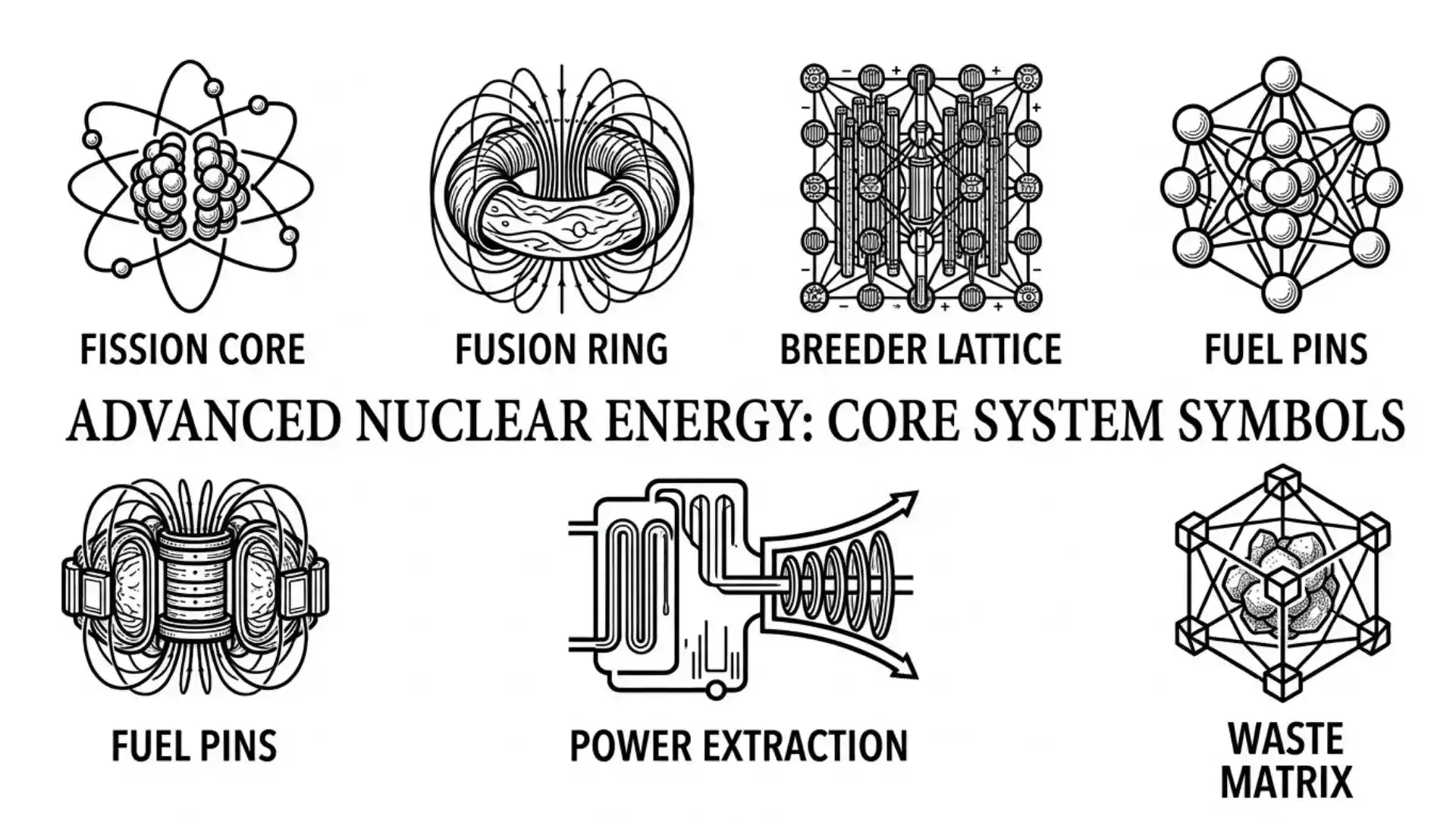
Nuclear symbols can look confusing at first because the same topic includes warning signs, scientific letters, Greek symbols, isotope notation, and nuclear equations.
If you have searched for nuclear symbols, you may be trying to identify the familiar ☢ radiation sign, understand α, β, and γ, or learn how symbols such as ¹⁴C and ²³⁵U are written.
The key is to understand that these symbols do not all serve the same purpose. The ☢ trefoil is primarily a radiation warning symbol, while α, β, and γ are scientific symbols used to describe forms of radiation or particles. Symbols such as p⁺ and n⁰ identify nuclear particles, and notation such as ¹⁴₆C identifies a particular nuclide.
This guide brings these different meanings together in one easy reference. You will learn what the most common nuclear symbols mean, how to read isotope and nuclide notation, how alpha, beta, and gamma symbols differ, and how nuclear reaction notation works.
Whether you are a student, teacher, science reader, or simply trying to understand a radiation sign, this guide gives you a clear starting point.
What Are Nuclear Symbols?
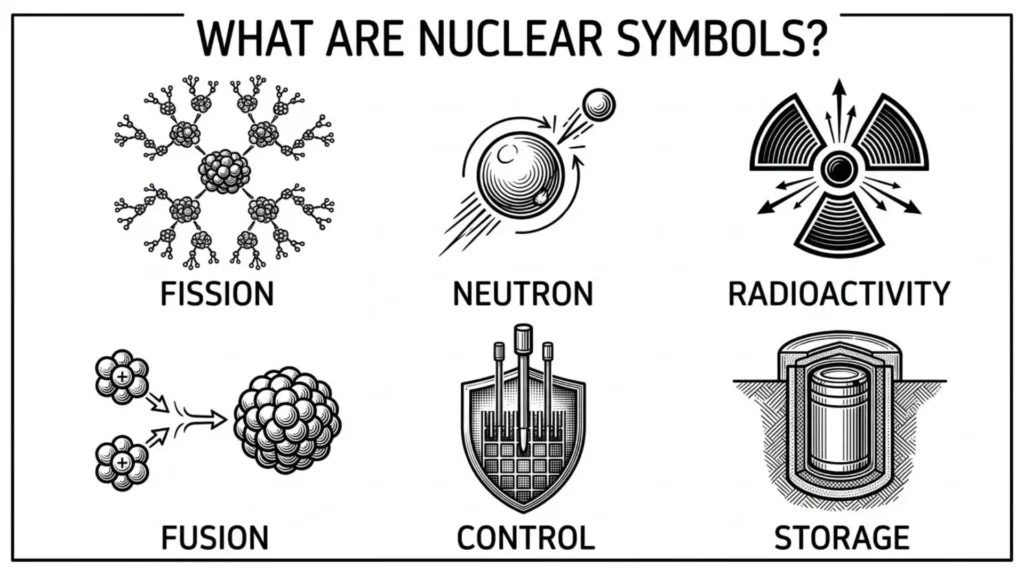
Nuclear symbols are symbols and scientific notation used to represent atomic nuclei, nuclides, nuclear particles, radiation, radioactive processes, and nuclear reactions.
The phrase can therefore refer to several different symbol systems.
For example:
- ☢ is a radiation warning symbol.
- α represents an alpha particle.
- β⁻ represents a beta-minus particle.
- γ represents gamma radiation or a gamma photon.
- p⁺ represents a proton.
- n⁰ represents a neutron.
- ¹⁴C identifies carbon-14.
- ²³⁵U identifies uranium-235.
Understanding the context is important because a symbol printed on a warning sign has a different purpose from a symbol used in a nuclear physics equation.
Nuclear Symbols Chart
The following chart provides a quick reference to some of the most common symbols associated with nuclear science and radiation.
| Symbol | Name | Basic meaning | Common use |
| ☢ | Radiation trefoil | Radiation or radioactive-material warning | Safety signs and labels |
| α | Alpha | Alpha particle | Radioactive decay and nuclear physics |
| β⁻ | Beta minus | Electron emitted in beta-minus decay | Nuclear decay |
| β⁺ | Beta plus | Positron emitted in beta-plus decay | Nuclear decay |
| γ | Gamma | Gamma photon | Nuclear transitions |
| p⁺ | Proton | Positively charged nuclear particle | Nuclear physics |
| n⁰ | Neutron | Electrically neutral nuclear particle | Nuclear physics |
| e⁻ | Electron | Negatively charged particle | Physics and decay notation |
| ν | Neutrino | Very weakly interacting particle | Nuclear and particle physics |
| ¹⁴C | Carbon-14 | A specific carbon nuclide | Nuclear science and dating |
| ²³⁵U | Uranium-235 | A specific uranium nuclide | Nuclear science |
| A | Mass number | Total protons and neutrons | Nuclide notation |
| Z | Atomic number | Number of protons | Nuclide notation |
| → | Arrow | Indicates transformation or reaction direction | Nuclear equations |
This is a beginner-friendly reference. Advanced nuclear physics uses additional symbols and conventions depending on the subject.
What Does the ☢ Radiation Symbol Mean?
The ☢ trefoil is the most recognizable radiation-related symbol.
It is used as a warning to communicate the presence or potential presence of ionizing radiation or radioactive material in appropriate situations. In the United States, the Nuclear Regulatory Commission specifies the radiation symbol for particular regulated applications.
The symbol itself does not tell you everything about a radiation hazard. It does not independently identify the isotope, radiation level, exposure conditions, or all required safety procedures.
Instead, it is an important hazard communication symbol.
You may encounter the trefoil on or near:
- Radiation-controlled areas
- Radioactive-material containers
- Certain laboratory locations
- Medical facilities
- Radiation-related equipment
- Transportation packages
- Warning signs
The accompanying words, labels, instructions, and applicable regulations provide the additional information needed to understand the situation.
Why Is the Radiation Symbol Called a Trefoil?
The radiation warning symbol is commonly called a trefoil because its graphic design consists of three similar blade-like sections arranged around a central point.
Its familiar appearance makes it recognizable even when a person does not understand the technical details of radiation.
For regulated applications, the appearance and use of the symbol can be governed by specific standards.
Is ☢ the Same as a Nuclear Power Symbol?
Not necessarily.
The ☢ trefoil is primarily a radiation warning symbol. It should not automatically be interpreted as a logo for nuclear power, nuclear energy, or a nuclear facility.
Context matters.
A symbol printed on a radiation warning sign has a safety-communication purpose, while a graphic used in a company’s branding may simply be a design inspired by nuclear imagery.
Nuclear Radiation Symbols
Several scientific symbols are used to describe radiation or particles associated with nuclear processes.
The three most familiar are:
- α — alpha
- β — beta
- γ — gamma
These should not be confused with the ☢ warning symbol.
The difference is simple:
☢ = warning sign
α, β, γ = scientific notation
Alpha Symbol α
The Greek letter α is used to represent an alpha particle.
An alpha particle consists of two protons and two neutrons. It is therefore equivalent to the nucleus of a helium-4 atom.
In basic nuclear notation, it can be represented as:
α
or more explicitly as a helium nucleus:
⁴₂He
Alpha particles are associated with certain radioactive decay processes.
Beta Symbols β⁻ and β⁺
The Greek letter β is used for beta radiation.
Two important forms are:
β⁻ — beta-minus particle, an electron
β⁺ — beta-plus particle, a positron
Using the superscript makes the distinction clear.
Beta-minus and beta-plus processes are different nuclear processes, so simply writing “β” can be less precise when the type matters.
Gamma Symbol γ
The Greek letter γ represents gamma radiation or a gamma photon.
Gamma radiation is electromagnetic radiation produced in nuclear processes.
Unlike alpha and beta radiation, gamma radiation is not a massive charged particle.
For introductory nuclear science, remembering the basic distinction is useful:
- α → alpha particle
- β⁻ → electron
- β⁺ → positron
- γ → gamma photon
Alpha, Beta, and Gamma Symbols Compared
| Feature | Alpha | Beta minus | Beta plus | Gamma |
| Symbol | α | β⁻ | β⁺ | γ |
| Basic description | Helium nucleus | Electron | Positron | Photon |
| Electric charge | +2 | −1 | +1 | 0 |
| Symbol type | Particle | Particle | Particle | Electromagnetic radiation |
| Common context | Radioactive decay | Radioactive decay | Radioactive decay | Nuclear transitions |
This comparison is useful when studying radioactive decay because the symbols look different and represent different physical entities.
Nuclear Particle Symbols
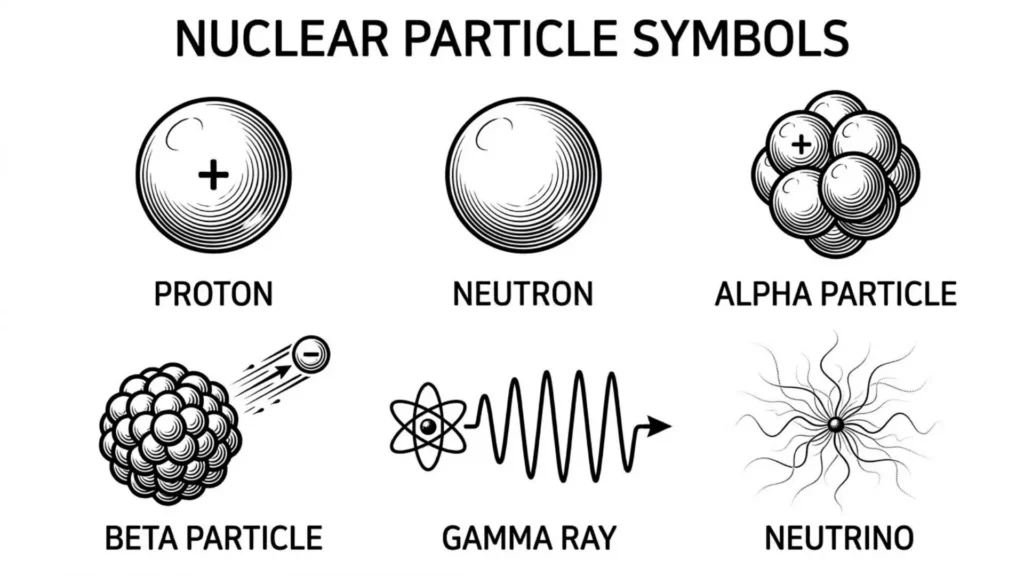
Nuclear science also uses symbols for individual particles.
Proton Symbol p⁺
A proton is commonly represented by:
p⁺
The positive superscript indicates its positive electric charge.
The number of protons in an atomic nucleus determines the element.
For example, every carbon nucleus has six protons, while every uranium nucleus has 92 protons.
Neutron Symbol n⁰
A neutron is represented by:
n⁰
The zero indicates that the neutron has no net electric charge.
Neutrons are found in the nuclei of most atoms.
The number of neutrons can vary among isotopes of the same element.
Electron Symbol e⁻
An electron is commonly written:
e⁻
It has a negative electric charge.
Electrons are not located inside the nucleus, but they can appear in nuclear equations, especially when describing beta-minus decay.
Neutrino Symbol ν
The Greek letter ν is commonly used for a neutrino.
More specific notation can be used for different neutrino types.
Neutrinos are important in nuclear and particle physics and can appear in descriptions of radioactive decay.
What Is a Nuclide Symbol?
A nuclide symbol identifies a particular type of atomic nucleus.
A common notation is:
ᴬZX
where:
- X = chemical symbol of the element
- A = mass number
- Z = atomic number
For example:
¹⁴₆C
means carbon-14.
The number 14 is the mass number, while 6 is the atomic number.
The mass number tells you the total number of protons and neutrons.
The atomic number tells you the number of protons.
What Is the Mass Number?
The mass number, represented by A, is the total number of protons and neutrons in a nucleus.
The formula is:
Mass number = protons + neutrons
Therefore:
Neutrons = mass number − atomic number
For carbon-14:
14 − 6 = 8 neutrons
So a carbon-14 nucleus contains:
- 6 protons
- 8 neutrons
What Is the Atomic Number?
The atomic number, represented by Z, is the number of protons in the nucleus.
This number identifies the chemical element.
For example:
- Hydrogen has 1 proton.
- Carbon has 6 protons.
- Oxygen has 8 protons.
- Uranium has 92 protons.
If the number of protons changes, the atom becomes a different element.
How to Read a Nuclear Symbol
Reading nuclear notation becomes easy once you know what each position represents.
Consider:
¹⁴₆C
Step 1: Identify the Element
The letter C is the chemical symbol for carbon.
Therefore, the nuclide is carbon.
Step 2: Find the Mass Number
The upper-left number is:
14
This means the nucleus contains 14 protons and neutrons altogether.
Step 3: Find the Atomic Number
The lower-left number is:
6
This means the nucleus contains six protons.
Step 4: Calculate the Neutrons
Use:
14 − 6 = 8
Therefore, carbon-14 has eight neutrons.
This simple four-step method works for many common nuclide symbols.
Nuclear Symbol Examples
Carbon-12: ¹²₆C
Carbon-12 has:
- 6 protons
- 6 neutrons
The total is:
6 + 6 = 12
Carbon-14: ¹⁴₆C
Carbon-14 has:
- 6 protons
- 8 neutrons
The total is:
6 + 8 = 14
Carbon-12 and carbon-14 are different isotopes because they have the same number of protons but different numbers of neutrons.
Uranium-235: ²³⁵₉₂U
Uranium-235 has:
- 92 protons
- 143 neutrons
because:
235 − 92 = 143
Uranium-238: ²³⁸₉₂U
Uranium-238 has:
- 92 protons
- 146 neutrons
because:
238 − 92 = 146
Uranium-235 and uranium-238 are isotopes of uranium because both have 92 protons but different numbers of neutrons.
What Is the Difference Between an Isotope and a Nuclide?
These terms are closely related but should not be treated as identical.
A nuclide refers to a specific nuclear species characterized by its nuclear composition and state.
An isotope refers to nuclides belonging to the same element that have the same atomic number but different mass numbers.
For example:
- Carbon-12
- Carbon-13
- Carbon-14
are isotopes of carbon.
They all have six protons, but they contain different numbers of neutrons.
This distinction is especially useful when reading nuclear symbols in chemistry and physics.
Nuclear Symbols vs Chemical Element Symbols
A chemical element symbol identifies an element.
Examples include:
- H = hydrogen
- C = carbon
- O = oxygen
- U = uranium
Nuclear notation can provide additional information.
For example:
U
identifies uranium generally.
But:
²³⁵U
specifies uranium-235.
Likewise:
C
identifies carbon, while:
¹⁴C
specifies carbon-14.
This is why a nuclear symbol can provide more information than a simple element symbol.
Nuclear Symbols vs Radioactive Symbols
The terms “nuclear symbol” and “radioactive symbol” are sometimes used interchangeably online, but they can describe different things.
| Nuclear notation | Radiation warning notation |
| Used in scientific communication | Used in hazard communication |
| May describe a nuclide or particle | Warns about radiation or radioactive material |
| Examples: ¹⁴C, p⁺, n⁰ | Example: ☢ |
| Used in equations and textbooks | Used on signs and labels |
| Primarily scientific | Primarily safety-related |
A nuclear symbol does not automatically mean that something is a warning sign.
Nuclear Symbols vs Radiation Symbols
There is another useful distinction.
Nuclear symbols can be a broad category that includes notation for nuclei and nuclear particles.
Radiation symbols often describe either radiation itself or warning signs associated with radiation.
For example:
¹⁴C is nuclear/nuclide notation.
α is particle/radiation notation.
γ is radiation notation.
☢ is a radiation warning symbol.
These categories overlap in subject matter but have different purposes.
Nuclear Reaction Symbols
Nuclear reactions are also represented with scientific notation.
A simplified reaction can look like:
A + B → C + D
The arrow indicates the direction of the transformation or reaction.
In more detailed nuclear notation, nuclides and particles can be shown together.
For example:
¹⁴N(α,p)¹⁷O
This compact notation contains several pieces of information.
How to Read a Nuclear Reaction Symbol
In:
¹⁴N(α,p)¹⁷O
you can identify:
- ¹⁴N → starting nuclide
- α → incoming particle
- p → outgoing particle
- ¹⁷O → resulting nuclide
The parentheses provide a compact way to describe the particles involved in the reaction.
Nuclear reaction notation can become much more detailed in advanced physics, but this basic structure is useful for beginners.
Common Symbols Used in Nuclear Equations
| Symbol | Meaning |
| + | Particles or reactants shown together |
| → | Transformation or reaction direction |
| α | Alpha particle |
| β⁻ | Beta-minus particle |
| β⁺ | Positron |
| γ | Gamma photon |
| p | Proton |
| n | Neutron |
| ν | Neutrino |
The exact equation and notation depend on the nuclear process being described.
Nuclear Decay Symbols
Radioactive decay occurs when an unstable nucleus undergoes a spontaneous transformation.
Common forms include:
- Alpha decay
- Beta-minus decay
- Beta-plus decay
- Electron capture
- Gamma emission
Different particles or radiation types appear in the corresponding notation.
For example, alpha decay involves an alpha particle, while beta-minus decay involves an emitted electron and beta-plus decay involves a positron.
Gamma emission involves the release of a gamma photon as a nucleus changes its energy state.
What Happens to Nuclear Numbers During Decay?
One useful way to understand nuclear symbols is to see how the atomic and mass numbers change.
Alpha Decay
An alpha particle contains two protons and two neutrons.
Therefore, when a nucleus emits an alpha particle:
- Mass number decreases by 4.
- Atomic number decreases by 2.
Beta-Minus Decay
In beta-minus decay, a neutron changes into a proton while an electron is emitted.
As a result:
- Mass number remains the same.
- Atomic number increases by 1.
Beta-Plus Decay
In beta-plus decay, a proton changes into a neutron while a positron is emitted.
As a result:
- Mass number remains the same.
- Atomic number decreases by 1.
Gamma Emission
Gamma emission involves the release of energy as a gamma photon.
The nucleus changes its energy state, but its:
- Mass number stays the same.
- Atomic number stays the same.
These rules are useful when learning how to balance basic nuclear equations.
Is the Trefoil the Only Radiation Warning Symbol?
The ☢ trefoil is the familiar radiation warning symbol, but radiation safety communication can involve additional graphical conventions.
For example, the International Organization for Standardization developed a supplementary ionizing-radiation warning symbol intended for certain situations where the traditional trefoil might not be understood.
This supplementary symbol does not simply replace the traditional trefoil everywhere.
The important lesson is that warning symbols are governed by standards and context. If you encounter an unfamiliar radiation-related sign, use the accompanying wording and applicable safety information rather than interpreting it from appearance alone.
Where You May See Nuclear and Radiation Symbols
Nuclear and radiation-related symbols appear in many scientific and professional environments.
Hospitals and Medical Facilities
Radiation-related signs can be used in areas involving radiation-producing equipment or radioactive materials.
Nuclear medicine is one example of a medical field involving radioactive substances.
Radiation also has important applications in medical diagnosis and treatment when used under appropriate controls.
Scientific Laboratories
Research laboratories may use radiation warning symbols on controlled areas, equipment, containers, or storage locations where applicable.
Researchers also use symbols such as α, β, γ, and nuclide notation in scientific documents.
Industrial Facilities
Radioactive sources and radiation-producing equipment can have industrial applications.
The relevant signs and labels communicate the presence of radiation-related hazards and help identify controlled areas.
Transportation
Regulated radioactive materials may be transported using specific labels and markings.
The exact labeling requirements depend on the applicable transportation and radiation-safety rules.
Classrooms and Textbooks
Students frequently encounter nuclear notation in:
- Chemistry
- Physics
- Nuclear science
- Environmental science
- Medical science
In educational contexts, symbols such as ¹⁴C, α, β, γ, p, and n are generally being used as scientific notation rather than as warning signs.
Nuclear Symbols for Students
Students do not need to memorize every nuclear symbol at once.
Start with the core concepts.
Learn These Symbols First
p⁺ → proton
n⁰ → neutron
e⁻ → electron
α → alpha particle
β⁻ → beta-minus particle
β⁺ → positron
γ → gamma photon
☢ → radiation warning
Then learn how to read:
ᴬZX
This gives you a strong foundation for nuclear notation.
Remember the Mass Number Rule
A simple rule is:
Mass number = protons + neutrons
Therefore:
Neutrons = mass number − protons
Since the atomic number equals the number of protons:
Neutrons = A − Z
This formula is one of the most useful tools for reading nuclide symbols.
Quick Nuclear Symbols Practice
Try these questions before checking the answers.
Question 1
What does ☢ mean?
Question 2
What particle does α represent?
Question 3
In ¹⁴₆C, what does 14 represent?
Question 4
How many protons are in ²³⁵₉₂U?
Question 5
How many neutrons are in ²³⁵₉₂U?
Answers
1. ☢ is a radiation warning symbol.
2. α represents an alpha particle.
3. 14 is the mass number.
4. Uranium-235 has 92 protons.
5. It has 143 neutrons because 235 − 92 = 143.
Nuclear Symbols Cheat Sheet
Here is a compact reference you can return to when studying.
| Symbol | Meaning |
| ☢ | Radiation warning |
| α | Alpha particle |
| β⁻ | Beta-minus particle |
| β⁺ | Positron |
| γ | Gamma photon |
| p⁺ | Proton |
| n⁰ | Neutron |
| e⁻ | Electron |
| ν | Neutrino |
| A | Mass number |
| Z | Atomic number |
| ¹⁴C | Carbon-14 |
| ²³⁵U | Uranium-235 |
| → | Reaction/transformation |
| + | Combined reactants or particles |
How to Identify an Unknown Nuclear Symbol
If you find a symbol you do not recognize, do not guess immediately.
Use the following process.
Step 1: Look at the Context
Ask where the symbol appears.
Is it on:
- A warning sign?
- A textbook?
- A chemistry worksheet?
- A laboratory label?
- A nuclear equation?
- A medical sign?
Context can immediately narrow down its meaning.
Step 2: Check Whether It Is a Graphic or Scientific Notation
A trefoil such as ☢ is a warning graphic.
A Greek letter such as α or γ is more likely scientific notation.
Step 3: Look for Numbers
Numbers next to an element symbol may indicate a nuclide.
For example:
¹⁴C
is carbon-14.
Step 4: Check the Position of the Numbers
In full nuclide notation:
ᴬZX
the upper-left value is the mass number, while the lower-left value is the atomic number.
Step 5: Look for a Charge
Symbols such as:
p⁺
and:
e⁻
include charge information.
Step 6: Look for an Equation
If the symbol appears next to an arrow, plus sign, parentheses, or other particles, it may be part of a nuclear reaction or decay equation.
Step 7: Verify the Relevant Standard
For scientific notation, use an authoritative scientific reference.
For radiation warning signs, consult the applicable radiation-safety authority or standard.
This final step is particularly important because a symbol’s appearance alone may not provide enough information.
Common Mistakes When Reading Nuclear Symbols
Mistake 1: Thinking ☢ Is a Scientific Particle Symbol
The trefoil is primarily a warning symbol.
It does not represent a proton, neutron, alpha particle, or gamma photon.
Mistake 2: Confusing ☢ With γ
These symbols have completely different roles.
☢ → radiation warning
γ → gamma photon/radiation notation
Mistake 3: Confusing Mass Number With Atomic Number
The mass number tells you the total number of protons and neutrons.
The atomic number tells you the number of protons.
Mistake 4: Assuming the Mass Number Is the Number of Neutrons
It is not.
For:
¹⁴₆C
there are 14 total nucleons but only 8 neutrons.
Mistake 5: Treating All Nuclear Symbols as Warning Signs
Scientific notation such as ¹⁴C, p⁺, or n⁰ is not automatically a hazard warning.
Mistake 6: Assuming Every Symbol Has One Universal Meaning
Scientific symbols should always be interpreted according to their context and notation system.
Mistake 7: Using “Nuclear” and “Radioactive” as Perfect Synonyms
They overlap, but they are not identical concepts.
“Nuclear” broadly relates to atomic nuclei, while “radioactive” specifically concerns spontaneous nuclear transformations.
Why Are Nuclear Symbols Important?
Symbols make scientific communication faster and clearer.
Instead of repeatedly writing a long description, scientists can use a short standardized symbol.
For example:
p⁺ communicates “proton.”
n⁰ communicates “neutron.”
α communicates “alpha particle.”
γ communicates “gamma photon.”
¹⁴C communicates “carbon-14.”
Likewise, ☢ can communicate a radiation warning without requiring a long sentence.
Standardized scientific notation is particularly useful because researchers and students need to communicate complex information consistently across languages and disciplines.
What Nuclear Symbols Tell You—and What They Do Not
A nuclear symbol can provide valuable information, but it does not always tell you everything about an object or situation.
For example:
¹⁴C
tells you the nuclide being represented.
It does not by itself tell you:
- How much material is present
- Where it came from
- Its physical form
- The exposure conditions
- What safety procedures apply
Likewise, ☢ communicates a radiation warning but does not independently provide every detail about the hazard.
This is why scientific notation, labels, legends, and safety instructions should be considered together.
Frequently Asked Questions About Nuclear Symbols
What is the main nuclear symbol?
There is no single symbol that represents every meaning of “nuclear.” The most recognizable radiation warning symbol is ☢, while nuclear science also uses symbols such as α, β, γ, p, n, and nuclide notation such as ¹⁴C.
What does the ☢ symbol mean?
The ☢ trefoil is a radiation warning symbol used to alert people to the presence or potential presence of radiation or radioactive material in applicable situations.
What is the symbol for radioactive radiation?
The familiar warning symbol is ☢. It is important to distinguish this warning graphic from scientific symbols such as α, β, and γ.
What are the three common nuclear radiation symbols?
The three commonly taught symbols are:
- α for alpha
- β for beta
- γ for gamma
They represent different forms of radiation or particles associated with nuclear processes.
What does α mean in nuclear science?
α represents an alpha particle, which consists of two protons and two neutrons.
What does β⁻ mean?
β⁻ represents a beta-minus particle, which is an electron emitted during beta-minus decay.
What does β⁺ mean?
β⁺ represents a positron emitted during beta-plus decay.
What does γ mean?
γ represents gamma radiation or a gamma photon.
What is the symbol for a proton?
A proton is commonly written as p⁺.
What is the symbol for a neutron?
A neutron is commonly represented as n⁰.
What is the symbol for an electron?
An electron is commonly represented as e⁻.
What does ¹⁴C mean?
¹⁴C represents carbon-14, a specific nuclide of carbon. The 14 is its mass number.
What does ²³⁵U mean?
²³⁵U represents uranium-235. The 235 is its mass number, and uranium has an atomic number of 92.
How do you calculate neutrons from a nuclear symbol?
Subtract the atomic number from the mass number:
Neutrons = A − Z
For ¹⁴₆C:
14 − 6 = 8 neutrons
What is the difference between a nuclear symbol and a chemical symbol?
A chemical symbol identifies an element, such as C for carbon. A nuclide symbol can identify a specific nuclear species, such as ¹⁴C for carbon-14.
What is the difference between an isotope and a nuclide?
Isotopes are nuclides of the same element that have the same number of protons but different numbers of neutrons and therefore different mass numbers.
Are nuclear symbols always dangerous?
No. Many nuclear symbols are simply scientific notation used in textbooks, equations, research, and education. The ☢ symbol is specifically used as a radiation warning in applicable contexts.
Where are nuclear symbols used?
They can appear in textbooks, laboratories, hospitals, research facilities, radiation warning areas, scientific equations, transportation labels, and other contexts involving nuclear science or radiation.
Is ☢ the symbol for nuclear energy?
Not exactly. The trefoil is primarily a radiation warning symbol. It may appear in environments connected with nuclear technology, but its direct purpose is to communicate a radiation-related warning.
Official References for Nuclear Symbols
For readers who want to verify technical terminology, it is best to use authoritative scientific and regulatory sources.
The International Union of Pure and Applied Chemistry (IUPAC) provides internationally used terminology and conventions for chemical symbols, nuclides, particles, and scientific notation.
The U.S. Nuclear Regulatory Commission (NRC) provides authoritative information about radiation, radioactive materials, radiation warning symbols, and radiation safety within its regulatory scope.
The International Atomic Energy Agency (IAEA) provides international information and guidance relating to nuclear safety, radiation protection, and the use of radiation-related symbols.
Because technical standards can change and specific requirements depend on jurisdiction and application, readers should consult the current applicable standard when interpreting an official warning, label, or regulated technical document.
Conclusion
Nuclear symbols cover much more than the familiar ☢ radiation symbol. They include warning graphics, nuclear particle symbols, radiation notation, isotope and nuclide notation, and the shorthand used in nuclear reactions.
The easiest way to understand them is to separate them into categories. ☢ is primarily a radiation warning symbol. α, β⁻, β⁺, and γ describe particles or radiation associated with nuclear processes. p⁺, n⁰, and e⁻ identify particles, while symbols such as ¹⁴C and ²³⁵U identify specific nuclides.
If you are studying nuclear science, start with the basic symbols, then learn how atomic number and mass number work. Once you understand A, Z, protons, neutrons, and isotope notation, nuclear symbols become much easier to read.
Most importantly, always consider the context. A symbol in a physics equation may be scientific notation, while the same subject area may use ☢ as a safety warning. Understanding that difference helps you read nuclear science more accurately and confidently.

Adam Sullivan is a dedicated writer who enjoys transforming everyday topics into engaging and informative content. His writing focuses on making complex ideas simple, practical and enjoyable for readers of all backgrounds. Adam is also the fictional author of The Lantern Beyond Autumn Hills and Where the Morning Horizon Waits. Outside of writing, he enjoys photography, traveling and discovering inspiration through new experiences. He believes great content should be both helpful and easy to connect with.
 Dylan Anderson