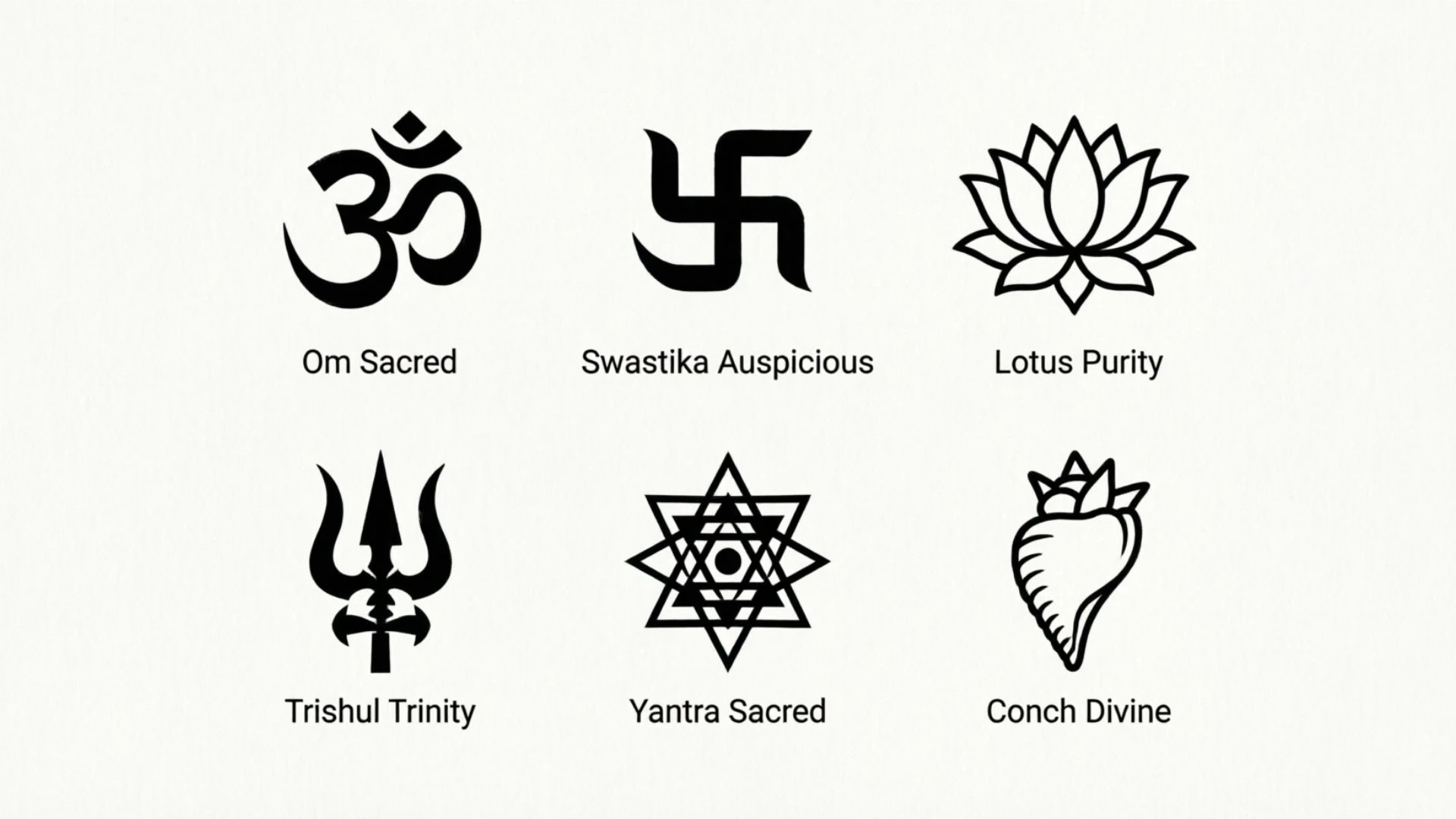
Hinduism has one of the world’s richest traditions of sacred imagery. From the familiar Om symbol to the lotus, diya, swastika, trishula, and sacred markings worn on the forehead, these symbols can communicate ideas about spirituality, divine presence, protection, knowledge, prosperity, purity, and the journey toward liberation.
If you are searching for Hinduism symbols and meanings, it is important to remember that Hindu traditions are diverse. A symbol may have several interpretations depending on the scripture, devotional tradition, region, family practice, or religious context. Therefore, it is better to understand Hindu symbols as layered expressions of spiritual ideas rather than giving every symbol only one fixed definition.
This guide explains the most important Hindu symbols in simple language. You will learn what they are called, what they commonly represent, which deities or traditions they are associated with, and where you may see them used.
What Do Hindu Symbols Mean? (Quick Answer)
Hindu symbols represent spiritual ideas, divine qualities, religious teachings, and important parts of Hindu practice. Some are connected with particular deities, while others are used more broadly in worship, meditation, festivals, homes, temples, and religious art.
For example:
- Om (Aum) — sacred sound and spiritual reality.
- Swastika — auspiciousness, well-being, and good fortune in Hindu tradition.
- Lotus — purity, spiritual growth, and transcendence.
- Trishula — associated with Shiva and commonly represents his power.
- Shankha — sacred conch associated especially with Vishnu.
- Sudarshana Chakra — divine discus associated with Vishnu.
- Diya — light, devotion, and the removal of darkness.
- Bindi and Tilak — religious or cultural markings with different meanings depending on context.
- Nandi — sacred bull associated with Shiva.
- Shiva Lingam — an important representation used in Shiva worship.
- Kalasha — sacred vessel associated with auspiciousness, abundance, and ritual.
- Rudraksha — sacred beads strongly associated with Shiva traditions.
- Yantra — geometric sacred design used in particular Hindu spiritual practices.
The meanings are not always identical across Hindu communities. The same symbol can carry philosophical, ritual, devotional, and cultural meanings at the same time.
Hinduism Symbols and Meanings Chart
The following table provides a quick reference for some of the most recognizable Hindu symbols.
| Hindu Symbol | Common Name | Common Meaning or Association | Often Connected With |
| ॐ | Om / Aum | Sacred sound, divine reality, meditation | Hinduism broadly |
| 卐 / Swastika | Swastika | Auspiciousness, well-being, good fortune | Hindu traditions broadly |
| 🪷 | Lotus | Purity, spiritual growth, transcendence | Lakshmi, Saraswati, Vishnu traditions |
| 🔱 | Trishula | Divine power, Shiva’s attributes | Shiva |
| 🐚 | Shankha | Sacred sound, ritual purity | Vishnu |
| Chakra | Sudarshana Chakra | Divine power and protection | Vishnu |
| 🪔 | Diya | Light, devotion, spiritual awareness | Hindu worship and festivals |
| • | Bindi | Forehead marking with cultural and religious meanings | Hindu traditions |
| Tilak | Religious/devotional marking | Various Hindu traditions | |
| Nandi | Devotion and Shiva worship | Shiva | |
| Shiva Lingam | Sacred representation in Shiva worship | Shiva | |
| Kalasha | Auspiciousness, abundance, ritual purity | Hindu rituals | |
| Rudraksha | Devotion and Shiva-associated practice | Shiva traditions | |
| Yantra | Sacred geometry and contemplative practice | Various traditions |
This chart is a starting point rather than a complete dictionary. Hindu symbolism is extensive, and individual traditions may give the same image additional meanings.
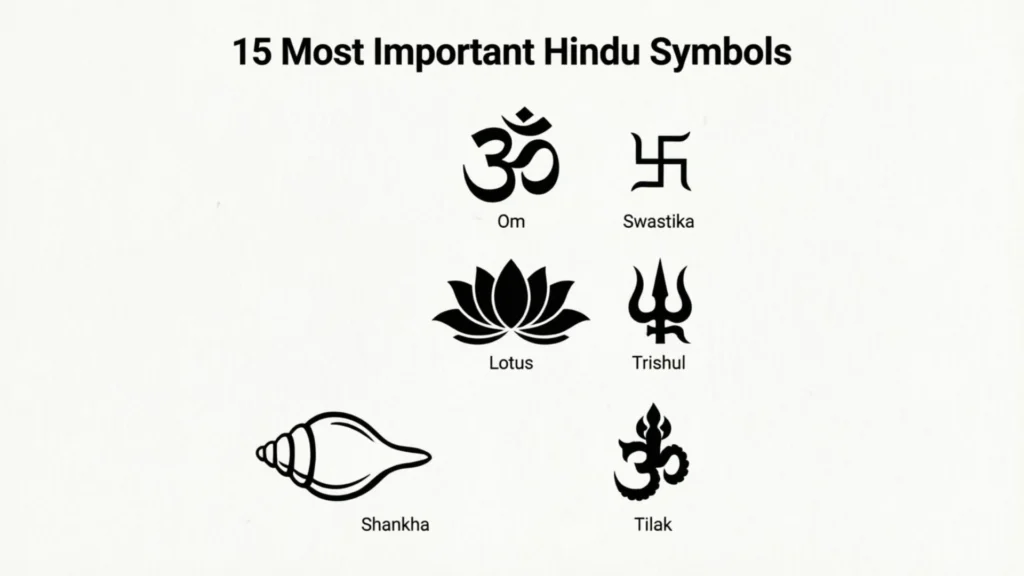
15 Most Important Hindu Symbols
Om or Aum
Om, also written Aum, is among the most recognizable sacred symbols associated with Hinduism.
It is both a sacred syllable and a written symbol. Hindu philosophical traditions give Om profound significance, and it is frequently associated with the ultimate spiritual reality.
The three sounds of A-U-M have been interpreted in several ways. Hindu teachings may connect them with different states of consciousness, aspects of time, or divine functions. The Hindu American Foundation notes that Om is deeply embedded in Hindu philosophy and that its interpretations vary across traditions.
Om is commonly encountered in:
- Prayer and mantra practice
- Meditation
- Religious texts
- Temple spaces
- Hindu artwork
- Yoga and spiritual settings
- Religious jewelry
Because Om is sacred, it is worth treating it as more than a decorative logo or trendy graphic.
Hindu Swastika
The swastika is one of the most misunderstood Hindu symbols in modern Western culture.
In Hindu tradition, it is an ancient sacred symbol associated with auspiciousness, well-being, and good fortune. It can appear on homes, temples, religious objects, invitations, and during important ceremonies.
The Sanskrit term is commonly explained through su meaning good and asti meaning to exist, giving the broader sense of well-being or auspicious existence. Hindu interpretations of its four arms can include the four Vedas, four goals of life, four stages of life, four directions, four seasons, or four yugas.
Is the Hindu swastika the same as the Nazi symbol?
No. The symbol has a far older history across South Asian religious traditions. The Nazi regime appropriated a form of the symbol for its own hateful ideology, creating a powerful and painful association in the modern West.
Understanding the Hindu meaning does not erase the Holocaust or the suffering associated with Nazi symbolism. It simply recognizes that the symbol existed in Hindu traditions long before its 20th-century appropriation.
For this reason, articles about Hindu symbols should explain the distinction carefully rather than presenting the swastika without context.
Lotus
The lotus, often called padma in Sanskrit, is one of the most important images in Hindu religious art.
It commonly represents qualities such as purity, spiritual development, beauty, and rising above difficult circumstances.
The lotus grows in muddy water but can produce a clean and beautiful flower. This natural image has made it a powerful metaphor for remaining spiritually focused despite the challenges of ordinary life. Hindu religious imagery frequently depicts deities seated on or holding lotus flowers.
The lotus is especially associated with figures such as Lakshmi and Saraswati, although its symbolism extends beyond one deity.
Trishula
The trishula, or trident, is one of the best-known symbols associated with Shiva.
Its three points have been given multiple interpretations in Hindu thought. Depending on the context, they may be connected with different spiritual or cosmic triads.
The trishula is also an important visual reminder of Shiva’s divine power and his role within Hindu traditions.
You may see it:
- Near Shiva temples
- In images of Shiva
- On religious objects
- In devotional artwork
- Alongside other Shiva symbols
The trishula should not be understood simply as an ordinary weapon. Within its religious setting, it carries symbolic and theological significance.
Shankha
The shankha is a sacred conch shell that is strongly associated with Vishnu.
The conch can be used in ritual settings, where its sound becomes part of a sacred environment. Its association with Vishnu also makes it an important feature of Vaishnava religious imagery.
The shankha is commonly connected with ideas such as:
- Sacred sound
- Ritual purity
- Divine presence
- Protection
- Vishnu’s power
Its distinctive spiral shape also contributes to its visual importance in Hindu art.
Sudarshana Chakra
The Sudarshana Chakra is the divine discus associated with Vishnu.
It is commonly portrayed as a powerful circular weapon and symbol of divine authority.
The word chakra can also mean wheel or circle, and the concept of the wheel has broad importance in Indian religious thought. In Vishnu traditions, the Sudarshana Chakra specifically belongs to the iconography of Vishnu and is frequently shown alongside other attributes such as the conch, lotus, and mace.
It can be understood as representing divine power, order, and protection within its devotional context.
Diya
A diya is a small oil or ghee lamp commonly used in Hindu religious practice.
Light is an important spiritual image in Hindu traditions. Lighting a diya can symbolize the movement from darkness toward light, ignorance toward knowledge, or ordinary awareness toward spiritual awareness.
Diyas are especially visible during Diwali, the festival of lights, but their use is not limited to Diwali.
You may find diyas:
- In home prayer areas
- At temples
- During puja
- During festivals
- At religious ceremonies
- In decorative rangoli designs
A diya is therefore both a physical source of light and a meaningful part of ritual practice.
Bindi and Tilak
Bindi and tilak are forehead markings, but they should not automatically be treated as exactly the same thing.
A bindi may have religious, cultural, social, or aesthetic meanings depending on the person and context. A tilak is generally associated more directly with religious or devotional practice and can have different shapes and colors according to tradition.
Different Hindu communities use different markings, so there is no single universal meaning for every forehead mark.
This distinction is useful because popular culture sometimes reduces the bindi to a fashion accessory while overlooking its broader cultural and religious contexts.
Nandi
Nandi, the sacred bull, is closely associated with Shiva.
In many Shiva temples, a statue or image of Nandi faces toward the main shrine. Nandi is commonly understood as Shiva’s vehicle and a figure associated with devotion.
For many worshippers, Nandi represents qualities such as:
- Loyalty
- Devotion
- Strength
- Patience
- Service
Nandi’s presence near Shiva temples also provides an important clue when identifying Hindu religious spaces connected with Shiva worship.
Shiva Lingam
The Shiva Lingam, also called the lingam, is an important sacred representation used in Shiva worship.
It has a long and complex history within Hindu religious traditions and should not be reduced to a simplistic interpretation.
For devotees, the lingam is connected with Shiva and profound ideas concerning divine reality, creation, consciousness, and the nature of existence. Interpretations can vary among Hindu traditions.
When discussing the Shiva Lingam, respectful language is important because it is a living object of worship rather than merely an archaeological or artistic symbol.
Kalasha
The kalasha is a sacred vessel frequently used in Hindu rituals.
It may be filled with water and decorated with leaves, a coconut, cloth, or other auspicious elements depending on the ritual.
The vessel can represent abundance, sacred presence, purity, and prosperity.
Kalasha symbolism appears in:
- Puja ceremonies
- Weddings
- Religious festivals
- Temple rituals
- House blessings
- Decorative religious arrangements
Its meaning depends on the ceremony in which it is used.
Ganesha
Ganesha, recognized by his elephant head, is one of the most widely recognized Hindu deities.
Although Ganesha himself is a deity rather than simply a symbol, images of Ganesha function as powerful religious representations.
Ganesha is widely associated with:
- Wisdom
- Learning
- Auspicious beginnings
- Removing obstacles
- Discernment
Because of these associations, images of Ganesha are commonly found in homes, temples, educational settings, businesses, and religious celebrations.
Rudraksha
Rudraksha beads are strongly associated with Shiva traditions.
They come from the seeds of trees belonging to the Elaeocarpus genus and are commonly used in prayer beads and devotional practices.
Rudraksha is often connected with:
- Meditation
- Prayer
- Devotion to Shiva
- Spiritual discipline
- Personal religious practice
Because Rudraksha beads can have specific religious significance, they should be treated respectfully rather than viewed only as fashionable accessories.
Yantra
A yantra is a sacred geometric design used in particular Hindu spiritual traditions.
Yantras can contain geometric forms, circles, triangles, lotus patterns, and other carefully arranged elements. Their designs are not merely decorative; they can function as visual supports for meditation, worship, or ritual practice.
Different yantras have different associations and purposes, so it is inaccurate to say that every yantra has exactly the same meaning.
The Sri Yantra, for example, is one of the most well-known yantras and has a particularly rich philosophical and devotional context.
Six-Pointed Star
A six-pointed star made from two interlocking triangles also appears in Hindu religious symbolism.
One interpretation describes the upward-pointing triangle as human spiritual effort and the downward-pointing triangle as divine grace. Together, they express a relationship between human striving and divine assistance.
It is important not to assume that every six-pointed geometric design encountered in South Asian art has the same religious meaning. Context matters.
Hindu Symbols by Meaning
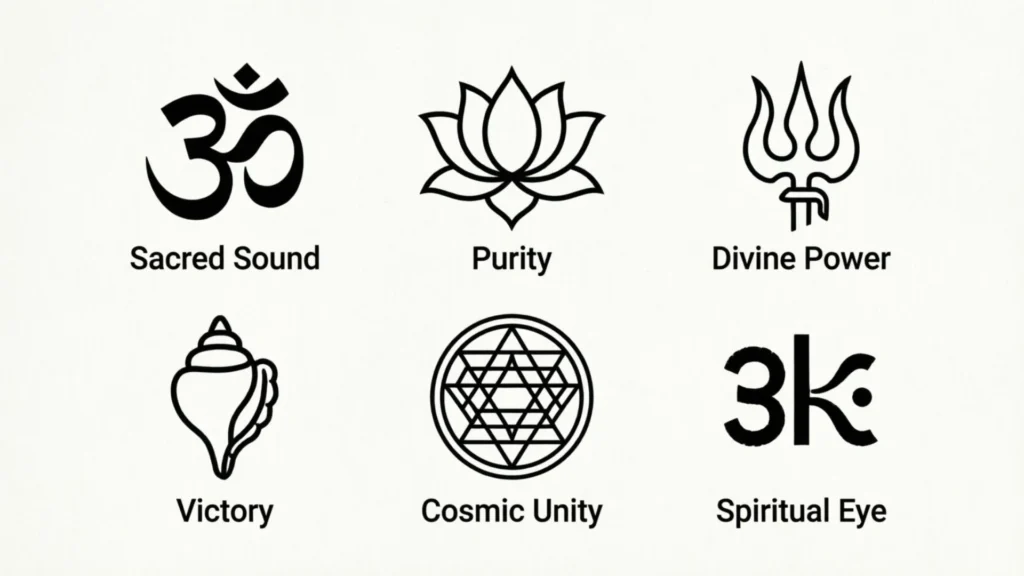
Looking at symbols according to the ideas they represent can make Hindu symbolism easier to understand.
Symbols of Good Luck and Auspiciousness
Several Hindu symbols are associated with auspicious beginnings and well-being.
The most recognizable include:
- Swastika
- Om
- Lotus
- Kalasha
- Diya
- Ganesha
The swastika has particularly strong associations with auspiciousness and good fortune in Hindu traditions. It can be placed near entrances or used during auspicious ceremonies.
Symbols of Protection
Protection can be represented through religious objects, deities, and sacred imagery rather than through one universal Hindu protection symbol.
Examples include:
- Sudarshana Chakra
- Trishula
- Hanuman imagery
- Ganesha imagery
- Protective yantras
- Sacred mantras and symbols
The meaning depends strongly on the particular devotional tradition.
Symbols of Purity
The lotus is perhaps the strongest example of purity in Hindu symbolism.
Its growth from muddy water into a beautiful flower provides a natural image for spiritual development and remaining unattached to negative influences.
The lotus can therefore communicate the idea that spiritual beauty is possible even in difficult surroundings.
Symbols of Knowledge
Knowledge and learning are particularly associated with Saraswati.
Common Saraswati-associated imagery includes:
- Veena
- Book
- Lotus
- Swan
- White clothing
The veena, in particular, is strongly connected with music, learning, creativity, and refined knowledge.
Symbols of Prosperity
Lakshmi, the Hindu goddess associated with wealth, abundance, and prosperity, is commonly represented with lotus imagery.
Other prosperity-related symbols can include:
- Lotus
- Kalasha
- Diya
- Coins
- Elephants
- Auspicious decorative designs
The exact symbolism varies by festival, region, and devotional tradition.
Symbols of Spiritual Growth
Symbols connected with spiritual development include:
- Om
- Lotus
- Yantras
- Rudraksha
- Diya
- Sacred geometric designs
These symbols can be used in contexts involving meditation, prayer, self-discipline, and contemplation.
Symbols of Strength and Courage
Strength and courage are especially associated with Hanuman.
Hanuman is widely revered for devotion, courage, service, strength, and dedication.
His image may therefore be used in religious settings where devotees seek inspiration from these qualities.
Hindu Symbols Associated With Shiva
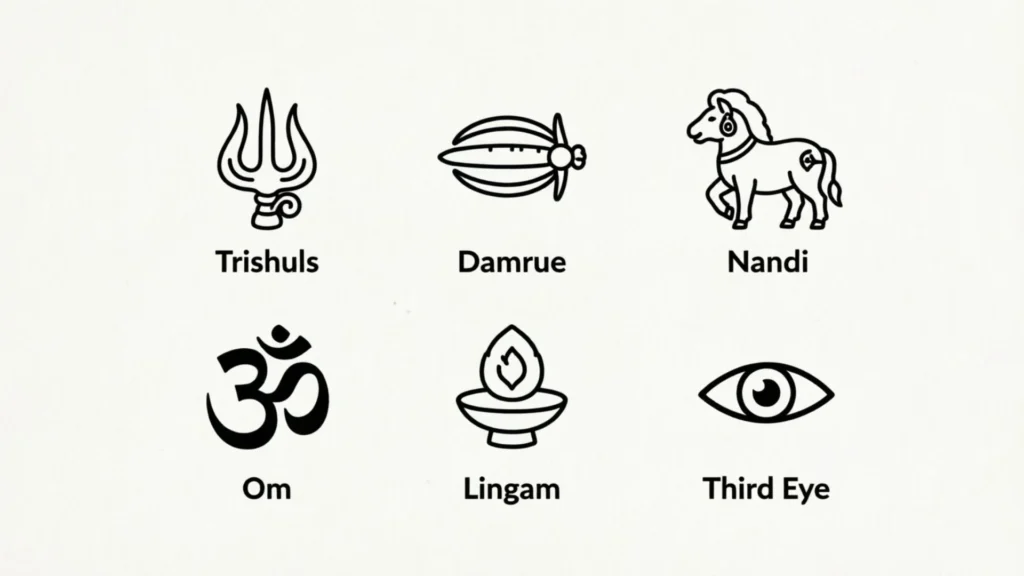
Shiva has an especially rich collection of symbols and attributes.
Trishula
The trishula is perhaps Shiva’s most recognizable attribute. Its three-pronged form appears frequently in Shiva temples and artwork.
Nandi
Nandi, Shiva’s sacred bull and vehicle, represents devoted service and is commonly positioned facing Shiva’s shrine in temples.
Shiva Lingam
The Shiva Lingam is a central object of worship in many Shaiva traditions and carries deep theological meaning.
Damaru
The damaru is a small two-headed drum associated with Shiva.
Its sound can symbolize rhythm, creation, transformation, and the cosmic order in different interpretations.
Rudraksha
Rudraksha beads are particularly associated with Shiva devotion and are used by some practitioners for prayer and meditation.
Together, these symbols make Shiva’s iconography one of the easiest areas of Hindu religious art to recognize once the major attributes are understood.
Hindu Symbols Associated With Vishnu
Vishnu is also represented through a recognizable group of sacred attributes.
Shankha
The conch shell represents one of Vishnu’s major attributes and is used in religious ritual and iconography.
Sudarshana Chakra
The discus is another principal attribute of Vishnu and is associated with divine authority and protection.
Lotus
The lotus frequently appears in Vishnu-related imagery and carries broader Hindu associations with purity and spiritual development.
Gada
The gada, or mace, is another traditional attribute of Vishnu.
It represents divine strength and authority and is commonly shown in traditional images of Vishnu.
Hindu Symbols Associated With Lakshmi and Saraswati
Not every Hindu symbol belongs to one deity, but certain images are strongly connected with particular goddesses.
Lakshmi Symbols
Lakshmi is commonly associated with prosperity, abundance, good fortune, and beauty.
Her imagery may include:
- Lotus flowers
- Elephants
- Coins
- Lamps
- Auspicious symbols
- Kalasha imagery
During festivals such as Diwali, Lakshmi-related symbolism becomes especially visible in many Hindu homes.
Saraswati Symbols
Saraswati is associated with knowledge, learning, music, speech, and the arts.
Her common attributes include:
- Veena
- Book
- Lotus
- Swan
- White clothing
For students and educators, Saraswati imagery can have particular cultural and devotional importance.
Hindu Religious Markings
Religious markings deserve their own category because they are worn on the body rather than simply displayed as objects.
Bindi
A bindi is generally worn on the forehead and can have different meanings depending on the person and cultural setting.
It may be associated with Hindu identity, tradition, marital or social customs in particular communities, or personal expression.
It should not be assumed that every bindi has one religious meaning.
Tilak
A tilak is a religious marking applied to the forehead or another part of the body.
Its shape, color, and placement may communicate affiliation with a particular Hindu tradition or devotional practice.
For example, Vaishnava and Shaiva traditions can use different styles of markings.
This is why identifying a tilak can sometimes provide clues about religious tradition, although visual identification alone should not be treated as absolute.
Hindu Ritual and Cultural Symbols
Some things commonly described online as “Hindu symbols” are better understood as ritual objects, decorative traditions, or practices.
Diya
The diya is a ritual lamp associated with light, worship, devotion, and spiritual awareness.
Kalasha
The kalasha is a sacred vessel used in many Hindu ceremonies and can symbolize abundance, purity, and auspiciousness.
A rangoli is therefore not one single symbol. It is a form of sacred or celebratory visual expression.
Toran
A toran is a decorative hanging or doorway decoration often used during festivals, weddings, and auspicious occasions.
Traditional torans may use leaves, flowers, fabric, beads, or other materials.
They can make an entrance visually welcoming while also participating in a broader tradition of auspicious decoration.
Sacred Fire
Fire, or Agni, has an important role in many Hindu rituals.
Fire can serve as a sacred medium during ceremonies, including certain marriage rituals and Vedic practices.
Its presence is closely connected with offerings, prayer, purification, and transformation.
What Is the Difference Between Hindu Symbols and Hindu Deity Symbols?
The terms are sometimes used interchangeably online, but there is a useful distinction.
A broad Hindu symbol may be used across multiple traditions. Om and the swastika are examples of symbols with broad Hindu significance.
A deity-associated symbol is more specifically connected with a particular deity.
For example:
- Trishula → Shiva
- Nandi → Shiva
- Shankha → Vishnu
- Sudarshana Chakra → Vishnu
- Veena → Saraswati
- Lotus → strongly associated with Lakshmi and also appears widely in Hindu symbolism
- Ganesha image → Ganesha
A ritual object may have a different category again. A diya or kalasha may participate in worship without functioning as a symbol belonging exclusively to one deity.
This classification helps prevent a common mistake: treating every Hindu religious object as though it has one universal definition.
Hindu Symbols in Homes, Temples, Festivals, and Daily Life
Hindu symbols are not limited to museums or religious books.
They can appear in everyday settings such as:
- Home prayer rooms
- Temple entrances
- Religious ceremonies
- Wedding invitations
- Festival decorations
- Jewelry
- Clothing
- Religious artwork
- Books and devotional materials
- Vehicles
- Business entrances
For example, the swastika may be displayed in homes or at auspicious events, while diyas are widely used during religious celebrations.
During Diwali, homes may feature lamps, rangoli, Lakshmi imagery, auspicious designs, and other forms of religious decoration.
The setting is important because the same symbol can communicate different layers of meaning depending on how and why it is being used.
Hindu Symbols for Tattoos and Jewelry
Hindu symbols sometimes appear in tattoos, necklaces, bracelets, pendants, and other forms of personal decoration.
Popular choices include:
- Om
- Lotus
- Trishula
- Ganesha
- Rudraksha
- Sanskrit mantras
- Yantra designs
However, sacred symbols are not simply decorative graphics. For many Hindus, they are connected with worship, devotion, meditation, or religious identity.
If you are considering using a Hindu symbol as a tattoo or permanent design, learn its meaning and religious context first. Avoid placing sacred imagery in locations or situations that could be considered disrespectful.
This is especially important with images of deities and sacred mantras.
How to Identify a Hindu Symbol
If you encounter an unfamiliar Hindu symbol, start by looking at its visual features and surrounding context.
Look at the Shape
Ask whether the image is:
- A sound symbol such as Om
- A geometric design such as a yantra
- A flower such as a lotus
- A weapon or attribute such as a trishula
- A religious marking such as a tilak
- A ritual object such as a diya or kalasha
Look for Associated Objects
A symbol becomes easier to identify when it appears with other objects.
For example:
- Trishula + Nandi → strong clue toward Shiva worship
- Shankha + Chakra → strong clue toward Vishnu imagery
- Veena + book → strong clue toward Saraswati
- Lotus + prosperity imagery → may indicate Lakshmi
- Elephant-headed figure → Ganesha
Consider the Location
A symbol painted on a temple entrance may have a different purpose from a similar image appearing on jewelry or a festival decoration.
Look at whether it appears in:
- A temple
- A home shrine
- A wedding
- A festival
- A religious book
- Clothing
- Jewelry
- A meditation space
Avoid Assuming One Meaning
The most important rule is not to decide too quickly.
Hinduism contains many philosophical schools, devotional traditions, regional practices, and family customs. A symbol can have several meanings at once.
A Cultural Note About Hindu Symbols
Hinduism is not a single uniform tradition with one central symbol dictionary.
Its religious life includes many traditions, texts, philosophical schools, devotional movements, regional customs, and forms of worship.
That is why responsible explanations should use phrases such as “commonly associated with,” “in many traditions,” “often interpreted as,” or “especially connected with.”
This approach is more accurate than saying a symbol always means one particular thing.
It also respects the fact that Hindu communities around the world may understand or use symbols somewhat differently.
Frequently Asked Questions
What is the main symbol of Hinduism?
Om (Aum) is widely regarded as one of the most important and recognizable sacred symbols associated with Hinduism. It represents profound spiritual ideas and is used in prayer, meditation, mantras, and religious contexts.
What are the most important Hindu symbols?
Some of the best-known include Om, the swastika, lotus, trishula, shankha, Sudarshana Chakra, diya, bindi, tilak, Nandi, Shiva Lingam, kalasha, Rudraksha, yantra, and sacred deity imagery.
What does Om mean in Hinduism?
Om, or Aum, is a sacred syllable with deep philosophical significance. Different Hindu teachings connect its sounds and symbolism with ideas such as consciousness, time, and divine reality.
What does the Hindu swastika mean?
The Hindu swastika is traditionally associated with auspiciousness, well-being, good fortune, and positive beginnings. It can be found on homes, temples, religious objects, and materials connected with auspicious occasions.
Is the Hindu swastika the same as the Nazi symbol?
They have very different historical and ideological contexts. The swastika has ancient and continuing religious significance in Hindu traditions, while the Nazi regime appropriated a form of the symbol for its hateful ideology. Because of the Holocaust, Nazi symbolism carries a profound and painful meaning that should never be minimized.
What Hindu symbol represents purity?
The lotus is one of the strongest Hindu symbols associated with purity and spiritual growth. Its ability to emerge beautifully from muddy water provides a powerful metaphor for spiritual development.
What is the Hindu symbol for protection?
There is no single universal Hindu protection symbol. Depending on the tradition, protective meanings may be associated with the Sudarshana Chakra, trishula, Hanuman, Ganesha, specific yantras, and devotional practices.
What is the Hindu symbol for good luck?
The swastika is traditionally one of the strongest Hindu symbols of auspiciousness and good fortune. It is used in homes, temples, ceremonies, and other auspicious settings.
What symbols are associated with Shiva?
Major Shiva-associated symbols include the trishula, Nandi, Shiva Lingam, damaru, and Rudraksha.
What symbols are associated with Vishnu?
Important Vishnu-associated symbols include the shankha, Sudarshana Chakra, lotus, and gada.
What is the difference between a bindi and a tilak?
Both are forehead markings, but they are not identical. A bindi can have religious, cultural, social, or personal meanings, while a tilak is generally more directly connected with religious or devotional practice. Styles vary between Hindu communities.
What is a yantra in Hinduism?
A yantra is a sacred geometric design used in certain Hindu spiritual traditions. It may support meditation, worship, visualization, or ritual practice. Different yantras have different meanings and associations.
Can Hindu symbols be used in tattoos?
They can be, but people should understand their religious significance before using them permanently. Symbols such as Om, deity images, mantras, and yantras can be sacred to practicing Hindus, so respectful use matters.
Why are Hindu symbols used in homes?
Hindu symbols can be displayed in homes for worship, meditation, auspiciousness, devotion, cultural identity, or religious decoration. Their specific purpose depends on the household and tradition.
Conclusion
Hinduism symbols and meanings are much richer than a simple list of icons and definitions. Om expresses profound spiritual ideas, the lotus evokes purity and spiritual growth, the swastika traditionally represents auspiciousness and well-being, and symbols such as the trishula, shankha, chakra, Nandi, diya, kalasha, and Rudraksha connect people with particular deities, rituals, and spiritual practices.
The most important thing to remember is that Hindu symbolism is diverse. A symbol can carry several meanings depending on its religious tradition, location, ritual, and the person using it. Understanding that context makes these symbols easier to recognize and, more importantly, helps us appreciate them respectfully.
Whether you are researching Hindu symbols for education, identifying religious artwork, learning about Hindu traditions, or exploring the meaning behind a particular symbol, looking at the symbol, its associated deity, its setting, and its cultural context together will give you a much more accurate understanding.

Adam Sullivan is a dedicated writer who enjoys transforming everyday topics into engaging and informative content. His writing focuses on making complex ideas simple, practical and enjoyable for readers of all backgrounds. Adam is also the fictional author of The Lantern Beyond Autumn Hills and Where the Morning Horizon Waits. Outside of writing, he enjoys photography, traveling and discovering inspiration through new experiences. He believes great content should be both helpful and easy to connect with.
 Dylan Anderson