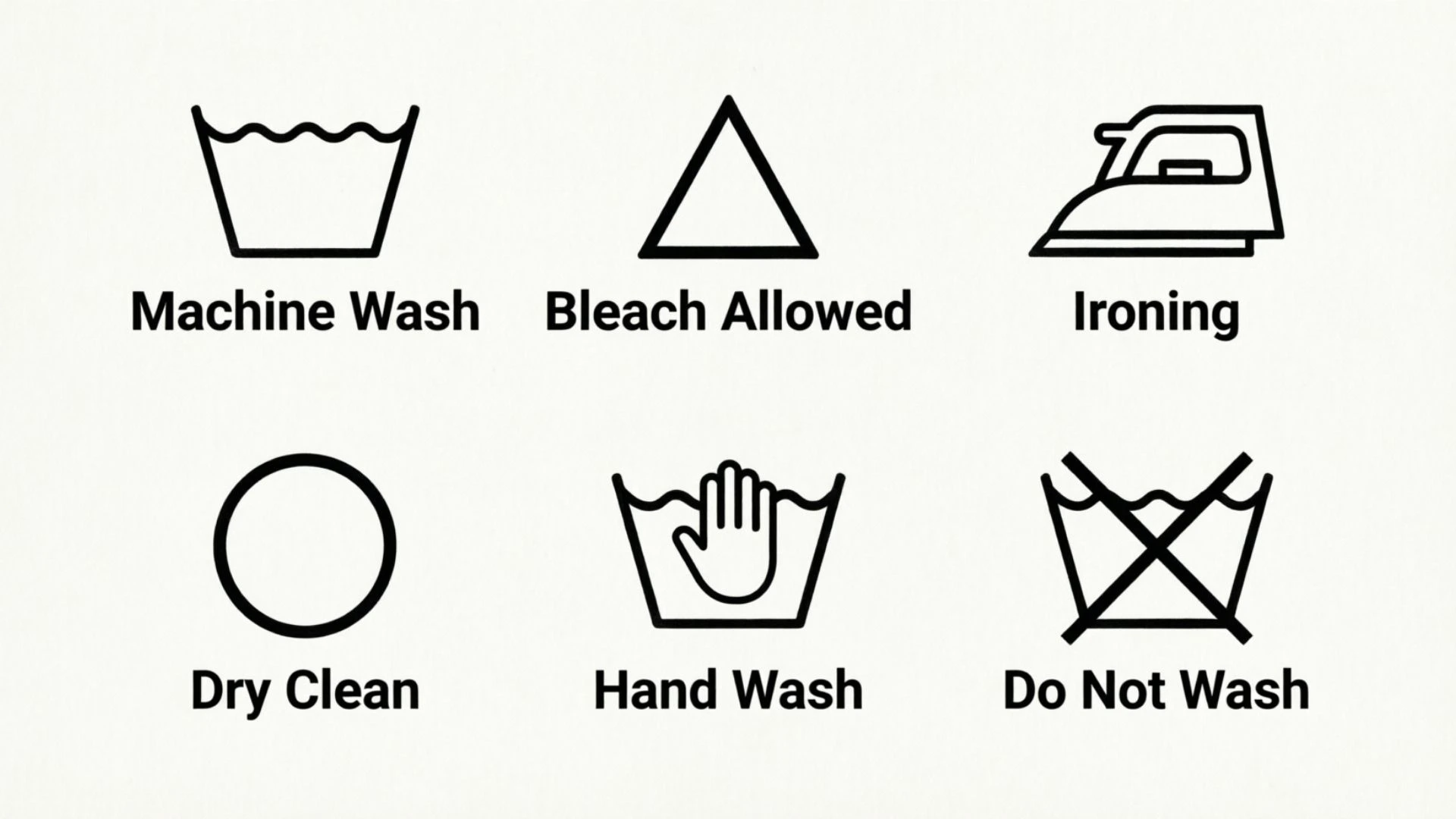
Laundry washing symbols can seem confusing when you first look at a clothing label. A small tub, a number, a hand, a line, or a crossed-out symbol can determine whether a garment belongs in the washing machine, needs a gentler treatment, or should not be washed at all.
The good news is that these symbols follow a logical system. The wash tub is the main symbol to look for when you want to know how a garment should be washed. A number inside the tub indicates the maximum washing temperature in degrees Celsius. A hand indicates hand washing, while one or two lines underneath the tub indicate increasingly gentle washing processes. A crossed-out tub means the item should not be washed.
But washing is only one part of a clothing care label. You may also see a triangle for bleaching, a square for drying, an iron for ironing, and a circle for professional care. Understanding the whole label can help you avoid unnecessary shrinking, stretching, color problems, and heat damage.
This guide explains laundry washing symbols in simple terms, including temperature numbers, lines under the tub, hand washing, do-not-wash symbols, machine cycles, drying symbols, bleaching symbols, ironing symbols, and the best way to read a complete clothing care label.
Laundry Washing Symbols Chart
If you only need a quick answer, start with this chart.
| Washing symbol description | Meaning | What you should do |
| Tub with 30 | Maximum wash temperature of 30°C | Choose a suitable cycle at or below 30°C |
| Tub with 40 | Maximum wash temperature of 40°C | Choose a suitable cycle at or below 40°C |
| Tub with 60 | Maximum wash temperature of 60°C | Use a suitable cycle up to 60°C |
| Tub with a hand | Hand wash | Wash gently by hand according to the label |
| Tub with one line underneath | Mild wash | Use reduced mechanical action |
| Tub with two lines underneath | Very mild wash | Choose an especially gentle treatment |
| Crossed-out tub | Do not wash | Do not use a domestic washing process |
The international care-symbol system described by GINETEX under ISO 3758:2023 uses the wash tub to communicate whether domestic washing is possible. The temperature number represents the maximum washing temperature, while bars underneath the tub indicate progressively gentler mechanical treatment.
The Most Important Rule
Think of the washing tub as answering three questions:
Can I wash it?
How hot can I wash it?
How gentle does the washing process need to be?
Once you understand those three points, most washing symbols become much easier to interpret.
What Does the Wash Tub Symbol Mean?
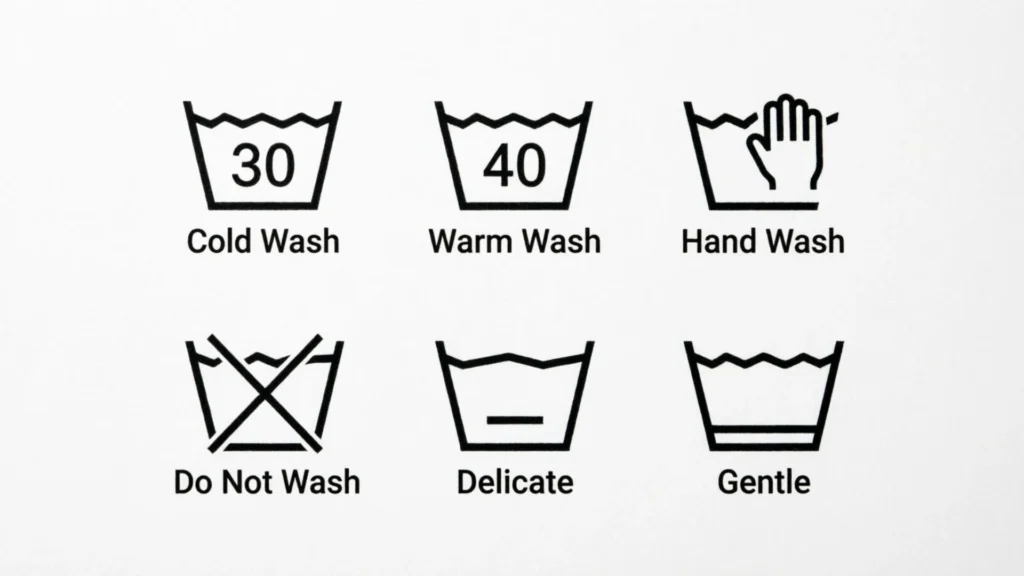
The wash tub is the main laundry symbol used for washing instructions.
It can tell you whether the garment is suitable for domestic washing and, depending on the markings, whether you should use a particular temperature or a gentler washing process. GINETEX explains that the washing symbol applies to both hand and machine washing.
A plain tub is different from a tub containing a number, a hand, or lines.
Tub With a Number
A number inside the tub indicates the maximum washing temperature in degrees Celsius.
For example:
30 = maximum 30°C
40 = maximum 40°C
60 = maximum 60°C
The number should not be interpreted as a requirement to wash at exactly that temperature. It establishes the upper temperature limit for the indicated treatment. GINETEX states that milder treatments and lower temperatures are permitted.
Tub With a Hand
A hand inside the tub means the garment is intended for hand washing.
This symbol is different from an ordinary machine-wash instruction. It signals that the item needs the gentler handling associated with hand washing. GINETEX advises gentle handling of sensitive articles and warns against actions such as aggressive rubbing, pulling, or wringing.
Tub With Lines Underneath
Lines below the tub indicate that the washing process should be gentler.
- One line = mild washing process with reduced mechanical action
- Two lines = very mild washing process
The bars are therefore not temperature indicators. They tell you about the mechanical intensity of the washing process.
Crossed-Out Tub
A tub with a cross through it means:
Do not wash.
This is a strong instruction. The garment should not be put through a normal domestic washing process. It may require another form of care or may be unsuitable for wet treatment.
What Do Numbers on Washing Symbols Mean?
Numbers inside washing symbols represent the maximum washing temperature in degrees Celsius.
Understanding this is important because a number does not mean “wash at exactly this temperature.”
| Number | Maximum temperature | Simple meaning |
| 30 | 30°C | Cooler washing |
| 40 | 40°C | Moderate washing |
| 50 | 50°C | Higher washing temperature |
| 60 | 60°C | Hotter washing |
| 70 | 70°C | Very hot washing |
| 95 | 95°C | Extremely hot washing for suitable textiles |
Not every care label will use every possible temperature. The symbol attached to the garment is the instruction you should follow. The current GINETEX overview includes several temperature levels under the ISO 3758 care-symbol system.
What Does 30°C Mean?
A wash tub marked 30 means the garment should not be washed above 30°C under that care instruction.
A lower temperature may be appropriate when it still provides the cleaning result you need and is compatible with the garment and washing method.
What Does 40°C Mean?
A 40 inside the tub means the maximum washing temperature is 40°C.
This is a common instruction for many everyday garments, but you should not assume that every fabric or item can be washed at 40°C. Always check the actual care label.
What Does 60°C Mean?
A 60 means the maximum washing temperature is 60°C.
Some durable garments can carry this instruction, but the temperature should never be increased simply because the fabric looks strong.
What Does 95°C Mean?
A 95 permits a maximum washing temperature of 95°C for the indicated treatment.
This is a very high temperature and should only be used when the garment’s care label specifically allows it.
What Do Lines Under a Washing Symbol Mean?
Lines underneath the wash tub tell you about mechanical action, not simply water temperature.
This distinction is easy to miss.
One Line Under the Tub
One horizontal line means the garment requires a milder washing process with reduced mechanical action.
GINETEX describes this as a mild process suitable for easy-care and mechanically sensitive articles.
In practical terms, look for a washing-machine program that provides gentler movement and treatment appropriate for the garment.
Two Lines Under the Tub
Two horizontal lines indicate an especially mild washing process.
This treatment is intended for particularly sensitive items, including garments for which strong mechanical action could cause problems. GINETEX gives woollens as an example of articles for which a very mild process may be relevant.
Why Are the Lines Important?
Imagine two garments that both have a 30°C symbol.
If one has no line and the other has two lines underneath, they do not necessarily require the same washing treatment.
The temperature limit may be the same, but the required mechanical treatment is different.
Number = maximum temperature
Line = mechanical gentleness
That simple distinction can prevent many care-label mistakes.
What Does the Hand Wash Symbol Mean?
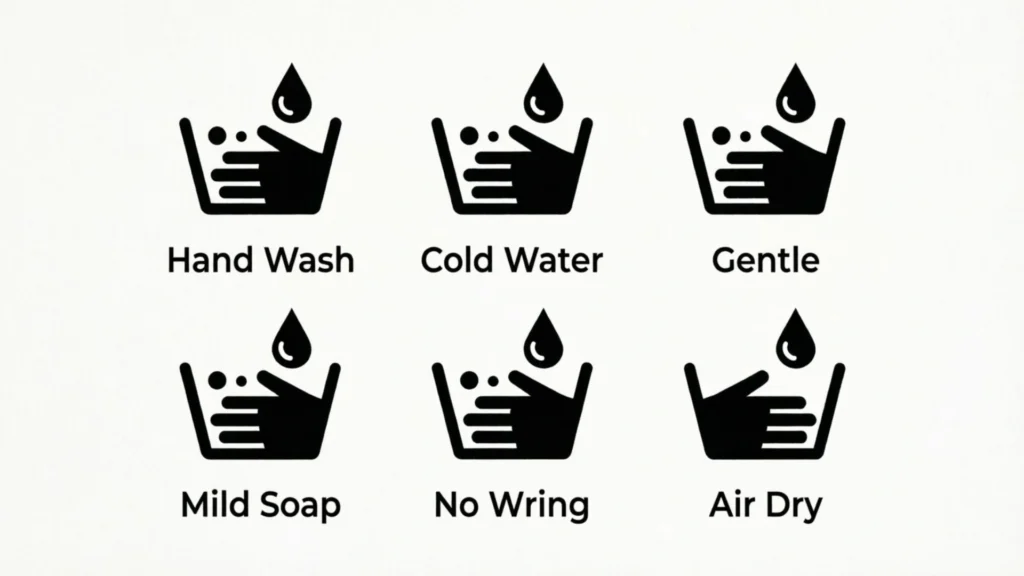
The hand-wash symbol shows a hand inside the wash tub.
It means the garment should be hand washed rather than treated as an ordinary machine-wash item.
Hand washing generally involves water, detergent or soap, and gentle handling. FTC terminology for hand washing describes gentle squeezing rather than harsh mechanical treatment.
How to Hand Wash Clothing
When a garment calls for hand washing:
- Check the temperature information on the label.
- Use suitable water and detergent.
- Gently move or squeeze the garment.
- Avoid aggressive rubbing.
- Do not twist or wring sensitive clothing unless the care instructions specifically permit it.
- Rinse carefully.
- Follow the label’s drying instructions.
The drying method is important because washing a garment correctly does not mean every drying method is safe for it.
Can You Put a Hand-Wash Garment in the Washing Machine?
Do not automatically assume that a machine’s delicate or hand-wash program is equivalent to actual hand washing.
Washing machines differ in their programs and mechanical action.
If the care label specifically requires hand washing, follow that instruction unless the garment manufacturer provides additional guidance.
What Does a Crossed-Out Washing Symbol Mean?
A crossed-out wash tub means:
Do not wash.
Do not place the garment in a standard washing machine cycle simply because it looks washable.
The item may be sensitive to wet treatment or unsuitable for domestic washing. GINETEX specifically states that articles carrying this symbol must not be washed.
What Should You Do Instead?
If you see a crossed-out washing symbol:
- Read the complete care label.
- Look for professional-care instructions.
- Check whether a circle symbol is present.
- Follow any written warning.
- If necessary, ask a professional cleaner about the appropriate treatment.
A do-not-wash symbol does not automatically mean the garment cannot be cleaned. It means that washing is not an approved care method for that item.
Can You Wash Clothes at a Lower Temperature Than the Label?
In general, yes.
If a garment has a maximum washing temperature of 40°C, using a lower temperature can be permitted when the washing process is otherwise appropriate.
GINETEX explains that lower temperatures and milder treatments than those shown by the care symbol are allowed.
Why Would You Choose a Lower Temperature?
A lower temperature may make sense when:
- the garment is lightly soiled
- a cooler cycle is sufficient
- you want a gentler treatment
- the detergent and cycle are appropriate
- the garment does not require a hotter wash for the particular cleaning task
However, don’t assume that the lowest temperature is always the best choice. Consider the garment, level of soiling, detergent, and the complete care label.
Can You Machine Wash a Garment?
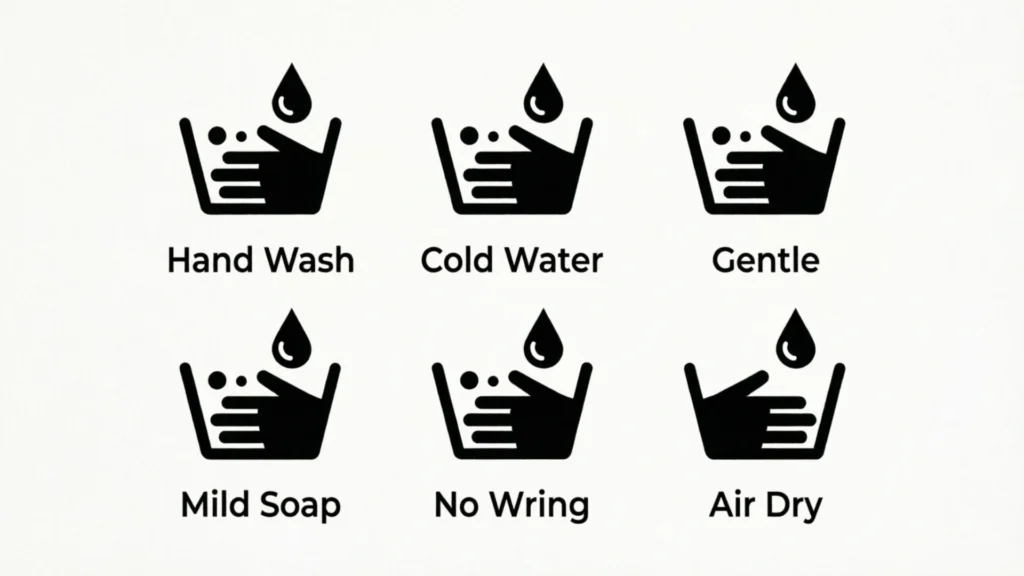
The answer depends on the washing symbol.
Ordinary Wash Tub
A standard wash tub indicates that domestic washing is possible within the treatment shown on the label.
Check the temperature and any additional markings.
One Bar Under the Tub
A single bar means the garment needs a milder washing process.
Choose a suitable gentle or reduced-action program on your machine.
Two Bars Under the Tub
Two bars call for an even gentler treatment.
Use the machine’s most appropriate very-gentle program only if it matches the garment’s care requirements.
Hand Symbol
A hand in the tub indicates hand washing.
Do not assume that a normal machine cycle is suitable.
Crossed-Out Tub
A crossed tub means do not wash.
Do not put the garment through a domestic washing cycle.
The exact names of washing-machine programs vary by manufacturer, so the machine’s manual should be used to understand what each program actually does.
Which Washing Machine Cycle Should You Choose?
The care label should guide your choice, but washing-machine programs are not identical across brands.
| Care-label instruction | What to look for |
| Normal wash tub | A suitable standard washing program |
| One bar | Mild or gentle program |
| Two bars | Very gentle program |
| Hand symbol | Hand washing or an explicitly suitable machine program if the manufacturer permits it |
| Crossed tub | No domestic washing |
The important thing is not to match the symbol based only on its appearance. Consider the temperature, mechanical action, and program characteristics together.
For example, selecting a low-temperature program is not necessarily enough if the care label also requires very gentle mechanical treatment.
What Do Other Laundry Care Symbols Mean?
Washing symbols are part of a larger care-label system.
The major categories include washing, bleaching, drying, ironing, and professional care. GINETEX lists these categories under its current ISO 3758:2023 care-symbol overview.
| Symbol shape | Care category | What it tells you |
| Tub | Washing | Washing method and temperature |
| Triangle | Bleaching | Whether and how bleaching is permitted |
| Square | Drying | Drying method |
| Iron | Ironing | Ironing temperature or restrictions |
| Circle | Professional care | Professional cleaning treatment |
Triangle: Bleaching
The triangle is used for bleaching instructions.
A crossed-out triangle means do not bleach.
Other markings can specify whether particular types of bleach are permitted. The FTC care-symbol chart includes instructions for bleach and warnings against bleaching where appropriate.
Square: Drying
The square represents drying instructions.
Additional markings can indicate methods such as:
- tumble drying
- line drying
- drip drying
- drying flat
- drying in the shade
A square containing a circle is associated with tumble drying.
Iron: Ironing
An iron-shaped symbol provides ironing instructions.
Dots inside the iron indicate different heat levels. A crossed-out iron means the garment should not be ironed.
The FTC’s care-symbol chart identifies low, medium, and high ironing temperatures through one, two, and three dots.
Circle: Professional Care
A circle is associated with professional textile care.
Letters or additional markings can provide information about the professional treatment.
If the garment has a crossed-out washing symbol and a professional-care instruction, do not substitute a normal household wash.
What Do Dots Mean on Laundry Symbols?
Dots generally indicate temperature levels in certain care symbols, but their meaning depends on the symbol where they appear.
For example:
- dots inside an iron relate to ironing temperature
- dots inside a tumble-drying symbol relate to drying heat
The safest approach is to interpret the complete symbol rather than treating dots as a universal temperature code.
Dots in an Iron Symbol
For ironing:
- one dot = low heat
- two dots = medium heat
- three dots = high heat
The FTC’s care-symbol chart associates these levels with approximately 110°C, 150°C, and 200°C respectively.
Dots in a Tumble-Dry Symbol
Dots can also appear inside the tumble-drying symbol.
They indicate the permitted drying heat level.
Always check the complete symbol because a crossed-out tumble-drying symbol has a completely different meaning.
What Does “Do Not Tumble Dry” Mean?
A crossed-out tumble-drying symbol means the garment should not be placed in a tumble dryer.
Instead, check the rest of the care label for an approved drying method.
Possible instructions can include:
- line dry
- drip dry
- dry flat
- dry in the shade
The FTC care-symbol chart includes these different drying methods and the warning against tumble drying.
Why Is Drying Important?
A garment can tolerate washing but still be damaged by high dryer heat or unsuitable mechanical drying.
That’s why you should check the drying symbol before transferring clothes from the washer to the dryer.
What Does “Do Not Bleach” Mean?
A crossed-out triangle means do not bleach.
Bleaching products can affect dyes and fibers, so a garment with this symbol should not be treated as though bleach is automatically safe.
In the U.S. care-label framework, manufacturers must provide appropriate bleaching information when regular use of bleach could harm the garment.
Should You Use Non-Chlorine Bleach?
Do not assume that “non-chlorine” automatically means safe.
Follow the actual care label. Some labels permit a specific type of bleach, while others prohibit bleaching entirely.
The FTC distinguishes between instructions allowing bleach, restricting bleach to non-chlorine products, and prohibiting bleach.
What Does “Do Not Iron” Mean?
A crossed-out iron means:
Do not iron the garment.
This may be particularly important for fabrics, prints, coatings, embellishments, or finishes that can be damaged by heat.
If ironing is allowed, look at the dots inside the iron to determine the appropriate heat level.
Laundry Washing Symbols vs Washing Machine Symbols
These terms are easy to confuse, but they refer to different things.
Laundry Washing Symbols
These appear on clothing care labels.
They tell you what washing treatment the garment can handle.
Examples include:
- 30°C
- 40°C
- hand wash
- gentle wash
- do not wash
Washing Machine Symbols
These appear on the washing machine itself.
They identify programs or functions available on that particular appliance.
Examples may include:
- cotton
- synthetics
- wool
- delicate
- quick wash
- rinse
- spin
The clothing label tells you the garment’s care requirements. The washing-machine controls tell you how that particular machine performs its available programs.
How to Read a Complete Clothing Care Label
Don’t stop after finding the wash tub. A complete care label can contain several instructions that work together.
Step 1: Find the Washing Symbol
Start with the tub.
Ask:
- Can I wash it?
- Is it machine washable?
- Does it need hand washing?
- Is washing prohibited?
Step 2: Check the Temperature
Look inside the tub.
If there is a number, treat it as the maximum washing temperature.
For example:
30 = maximum 30°C
40 = maximum 40°C
Step 3: Look for Lines
Check underneath the tub.
- No bar → standard treatment indicated by the symbol
- One bar → milder treatment
- Two bars → very mild treatment
The bars concern mechanical action, not simply temperature.
Step 4: Check for Special Washing Instructions
Look for:
- hand symbol
- crossed-out tub
- additional written warnings
- special washing instructions
Step 5: Check the Drying Symbol
Before putting the garment into the dryer, check the square.
A crossed-out tumble-dry symbol means you should choose another drying method.
Step 6: Check Bleaching
Look for the triangle.
If it is crossed out, do not bleach the garment.
Step 7: Check Ironing
Look for the iron.
Dots indicate heat levels, while a crossed-out iron means do not iron.
Step 8: Check Professional Care
A circle may provide instructions for professional cleaning.
If the garment is not suitable for washing, this information can be especially important.
Should You Follow the Fabric Type or the Care Label?
When the two seem to conflict, the garment’s care label should be your primary guide.
It is tempting to think:
“This is cotton, so I can wash it hot.”
But the fiber alone does not tell you everything about the finished garment.
A garment may contain:
- dyes
- finishes
- coatings
- linings
- trims
- buttons
- zippers
- prints
- other components
The FTC explains that care instructions need to account for the garment as a whole and its components, not just an individual material.
A Better Rule
Think of it this way:
Fabric tells you what the material is.
The care label tells you how the finished garment should be treated.
That is why the label attached to the actual item is more useful than a general rule about a fabric category.
Common Mistakes When Reading Laundry Symbols
Even familiar-looking symbols can be misunderstood.
Mistake 1: Treating the Number as a Required Temperature
A 40°C symbol does not necessarily mean:
“You must wash this at 40°C.”
It indicates the maximum temperature under the relevant care instruction.
Mistake 2: Ignoring the Lines
A 30°C symbol with two bars is not the same treatment as a plain 30°C symbol.
The temperature may be the same, but the required mechanical action is different.
Mistake 3: Assuming “Machine Washable” Means Any Cycle
A garment can be machine washable while still requiring a particular temperature or gentle treatment.
Always read the entire washing symbol.
Mistake 4: Ignoring the Hand Symbol
A hand inside the tub is not simply another version of a standard machine-wash symbol.
It specifically indicates hand washing.
Mistake 5: Washing a Crossed-Out Tub
A crossed tub means do not wash.
Don’t take a chance simply because the garment appears washable.
Mistake 6: Checking Only the Washing Instructions
A garment can be washed safely but still have restrictions on:
- tumble drying
- bleaching
- ironing
Read the complete label.
Mistake 7: Assuming the Machine’s “Delicate” Setting Always Matches the Label
Washing machines differ.
A program called “delicate” on one machine may not behave exactly like a similarly named program on another.
Use the machine manual together with the garment’s care instructions.
Mistake 8: Assuming Care Symbols Guarantee Stain Removal
Care symbols tell you how to treat the garment safely; they are not a promise that every stain will disappear.
The FTC’s care-label framework focuses on regular care and warnings needed to prevent harm to the product.
Are Laundry Washing Symbols the Same Around the World?
Many clothing-care symbols are standardized, but the exact labeling requirements and symbol systems can vary by market.
GINETEX describes its care symbols as part of the international ISO 3758 system and provides current information under ISO 3758:2023.
The U.S. Federal Trade Commission also regulates care labeling for covered textile apparel. Its guidance discusses ASTM care symbols and notes that these are similar to, but not identical with, international ISO symbols.
What Should You Do If Symbols Look Different?
Don’t assume that every symbol system is identical.
Instead:
- Read the complete label.
- Look for written instructions.
- Identify the main symbol category.
- Check the manufacturer’s care information if available.
- When uncertain, choose the safer treatment or seek professional advice.
The actual label attached to your garment should be your primary reference.
Why Are Care Labels Important?
Care labels aren’t just decorative tags.
They provide information about the regular care a garment requires. In the United States, the FTC Care Labeling Rule requires covered manufacturers and importers to provide appropriate care instructions for textile wearing apparel.
The FTC also explains that care instructions should have a reasonable basis and should account for the garment as a whole.
For shoppers and clothing owners, this means the label is an important source of information about how the item should be cleaned and maintained.
A Simple Laundry Symbol Decision Guide
If you’re standing beside your washing machine and need a quick decision, use this process.
If You See a Number
Check the number inside the tub.
That is the maximum washing temperature.
If You See One Line
Choose a milder washing process with reduced mechanical action.
If You See Two Lines
Choose a very gentle washing process.
If You See a Hand
Hand wash the garment.
If You See a Crossed Tub
Do not wash it.
If You See a Square With a Circle
Check the tumble-drying instructions before using your dryer.
If You See a Crossed Triangle
Do not bleach.
If You See a Crossed Iron
Do not iron.
This simple sequence covers many of the most common laundry-care questions without requiring you to memorize the entire symbol system.
Frequently Asked Questions
What is the washing symbol on a clothing label?
The washing symbol is usually a tub filled with water. It tells you whether domestic washing is permitted and can show the maximum temperature and required level of mechanical gentleness.
What does a number inside the washing symbol mean?
The number indicates the maximum washing temperature in degrees Celsius. For example, 30 means the indicated washing treatment should not exceed 30°C.
What does one line under a washing symbol mean?
One line indicates a milder washing process with reduced mechanical action.
What do two lines under a washing symbol mean?
Two lines indicate a very mild washing process for particularly sensitive articles.
What does a hand inside the washing symbol mean?
It means the garment should be hand washed rather than treated as an ordinary machine-wash item.
What does a crossed-out washing symbol mean?
A crossed-out tub means do not wash. The garment should not receive the indicated domestic washing treatment.
Can I wash at a lower temperature than the label shows?
Generally, yes. A temperature shown on the care label represents a maximum treatment level, and milder treatments or lower temperatures are permitted under the GINETEX system.
What does 30°C mean on a laundry label?
It means the maximum washing temperature is 30°C for that care instruction.
What does 40°C mean on a washing symbol?
It means the maximum washing temperature is 40°C.
What does 60°C mean on a washing symbol?
It means the maximum washing temperature is 60°C.
What does a triangle mean on a laundry label?
A triangle relates to bleaching. A crossed-out triangle means do not bleach.
What does a square mean on a laundry label?
A square represents drying instructions. Additional markings can indicate tumble drying, line drying, drip drying, drying flat, or other drying methods.
What does an iron symbol mean?
An iron symbol gives ironing instructions. Dots inside the iron indicate heat levels, while a crossed-out iron means do not iron.
What does a circle mean on a clothing label?
A circle is associated with professional textile care or cleaning.
Are laundry washing symbols the same as washing machine symbols?
No. Laundry care symbols appear on clothing labels and explain how the garment should be treated. Washing-machine symbols identify programs or functions on the appliance.
Can I machine wash a hand-wash garment?
You should not automatically assume that a machine’s delicate or hand-wash program is equivalent to hand washing. Follow the garment’s specific care instruction unless the manufacturer provides additional guidance.
Should I follow the fabric type or the care label?
Follow the care label for the finished garment. The label takes the construction and components of the actual item into account, whereas a fabric name alone does not provide complete care instructions.
Does following a washing symbol guarantee that every stain will come out?
No. Care symbols communicate suitable care treatment and restrictions; they do not guarantee removal of every stain or type of soil.
Conclusion
Understanding laundry washing symbols becomes much easier once you know what the basic markings represent.
Start with the wash tub. A number tells you the maximum washing temperature, a hand means hand washing, one or two lines indicate progressively gentler mechanical treatment, and a crossed-out tub means the garment should not be washed.
Then look beyond washing. The triangle provides bleaching information, the square relates to drying, the iron explains ironing requirements, and the circle is associated with professional care.
The most useful rule is simple: read the entire care label before choosing a laundry setting. Don’t rely only on the fabric name, the temperature number, or what you normally do with similar clothing.
Once you understand the symbols, a clothing tag stops looking like a confusing collection of tiny icons. It becomes a practical guide that helps you choose a suitable washing method and care for your clothes more confidently.

Adam Sullivan is a dedicated writer who enjoys transforming everyday topics into engaging and informative content. His writing focuses on making complex ideas simple, practical and enjoyable for readers of all backgrounds. Adam is also the fictional author of The Lantern Beyond Autumn Hills and Where the Morning Horizon Waits. Outside of writing, he enjoys photography, traveling and discovering inspiration through new experiences. He believes great content should be both helpful and easy to connect with.
 Dylan Anderson