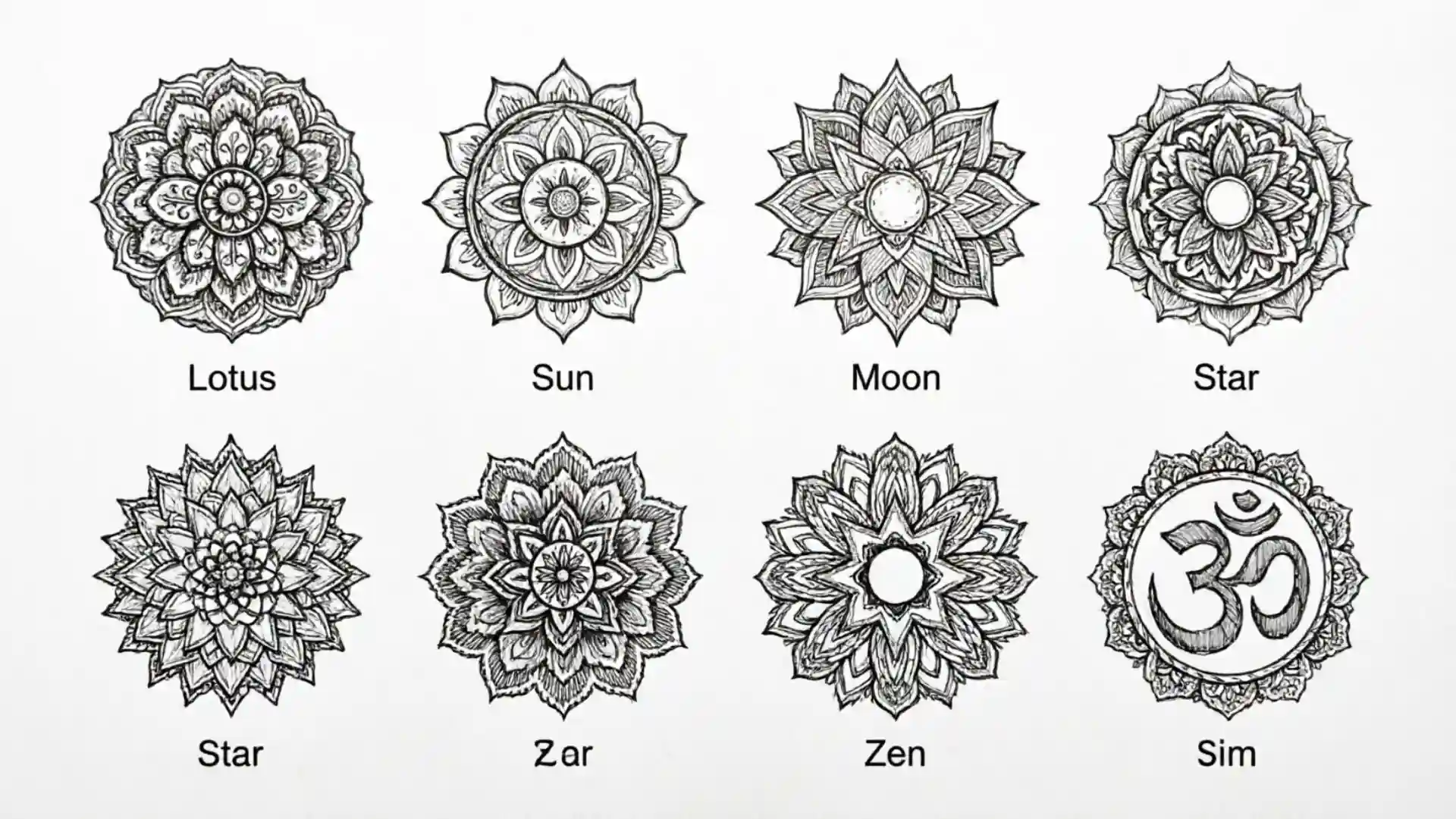
Mandala symbols are beautiful, highly structured designs that have attracted attention for centuries. Their circular forms, repeating patterns, geometric shapes, lotus petals, sacred figures, and carefully arranged colors can look like decorative artwork, but traditional mandalas often carry deep religious and philosophical meanings.
The word mandala comes from Sanskrit and is commonly associated with the idea of a “circle.” In Tibetan usage, the concept can also carry the sense of an essence or central meaning.
Mandalas have important connections with Buddhist traditions and also with Hindu sacred imagery and geometry. However, not every mandala has the same meaning. A Tibetan Buddhist mandala used for meditation is not necessarily equivalent to a modern mandala coloring design, tattoo, or wall decoration.
Some traditional mandalas represent the universe, sacred space, a deity’s realm, or a path of spiritual practice. The Metropolitan Museum of Art describes Tibetan mandalas as diagrams of the universe and maps of reality used as a focus for Buddhist religious practice.
In this guide, you will learn what mandala symbols mean, what their different parts represent, how Buddhist and Hindu mandalas differ, what colors and shapes may symbolize, how sand mandalas work, and how traditional mandalas differ from modern decorative designs.
What Do Mandala Symbols Mean? (Quick Answer)
Mandala symbols commonly represent ideas such as wholeness, balance, sacred order, the universe, spiritual focus, meditation, and transformation. However, the exact meaning depends on the particular mandala, religious tradition, historical setting, and purpose.
A traditional mandala may include a central deity or sacred focus surrounded by geometric structures, circles, lotus petals, gates, and other symbolic elements. In Tibetan Buddhism, the central deity can occupy a sacred palace represented within the mandala, and practitioners may use the design as a focus for meditation and visualization.
Here are some common mandala elements and their broad associations:
- Circle: wholeness, completeness, cycles, or unity
- Center: spiritual focus, deity, sacred principle, or central reality
- Square: structured sacred space or cosmic order in certain traditional designs
- Four gates: entrances into a sacred realm in some Buddhist mandalas
- Lotus petals: purity, spiritual development, and sacred beauty
- Concentric circles: layers, boundaries, realms, or stages within a design
- Symmetry: balance, harmony, and order
- Deities: specific religious teachings, qualities, or meditation practices
- Sacred syllables: sounds or representations associated with particular deities or practices
- Colors: meanings that vary according to the religious system and specific mandala
There is no universal mandala symbol dictionary. The safest way to interpret a mandala is to consider the complete design and its cultural context rather than assigning one fixed meaning to every shape.
Mandala Symbols and Meanings at a Glance
The following chart provides a quick reference for common elements found in mandalas or mandala-inspired designs.
| Mandala Symbol or Element | What It Looks Like | Common Association | Context |
| Circle | Round boundary or ring | Wholeness, unity, completeness | Broad mandalic symbolism |
| Center | Central point, deity, or design | Focus or sacred reality | Many traditional mandalas |
| Square | Four-sided inner structure | Order and sacred space | Especially visible in Tibetan Buddhist designs |
| Four Gates | Openings on four sides | Entry into sacred space | Traditional Buddhist mandalas |
| Lotus | Repeated petals | Purity and spiritual development | Buddhist and Hindu symbolism |
| Concentric Circles | Rings inside one another | Layers, realms, boundaries | Many mandala designs |
| Triangle | Three-sided geometric form | Varies by tradition | Sacred geometry |
| Deity | Sacred figure | Religious or meditative focus | Deity-centered mandalas |
| Sacred Syllable | Letter or mantra element | Deity or sacred sound | Some Buddhist mandalas |
| Flame Border | Fire-like outer ring | Boundary, transformation, or protection in certain contexts | Some traditional designs |
| Symmetry | Repeated balanced forms | Harmony and order | Most mandalas |
| Sand | Colored grains arranged in patterns | Impermanence and ritual practice | Tibetan Buddhist sand mandalas |
This chart should be treated as a starting point rather than a universal code. The Smithsonian, for example, documents Buddhist mandalas containing Sanskrit seed syllables that represent deities, while other mandalas place those deities in visible human or symbolic forms.
What Is a Mandala?
A mandala is a structured visual design organized around a center. In religious contexts, it can represent a sacred universe, a deity’s realm, sacred space, or a path of contemplation.
Traditional mandalas can be highly complex. Rather than being random patterns, their elements may be arranged according to specific religious systems.
The Metropolitan Museum of Art describes Tibetan mandalas as diagrams of the universe and maps of true reality used as a focus for Buddhist practice.
The Smithsonian similarly describes Tibetan mandalas as balanced geometric compositions in which deities reside, with a principal deity often placed at the center.
Where Does the Word Mandala Come From?
The word mandala comes from Sanskrit and is commonly translated or explained through the idea of a circle. The Smithsonian notes that in Tibetan, the term kyil-khor can convey both “circle” and “essence.”
The word’s association with a circle is important because circular organization is one of the most recognizable features of mandalic designs.
However, the concept is broader than simply drawing a circle. A traditional mandala can combine geometry, religious imagery, sacred architecture, cosmology, and meditation.
Why Are Mandalas Important?
Mandalas can provide a visual framework for religious teachings that might otherwise be difficult to represent.
In Tibetan Buddhist traditions, a mandala can represent a sacred environment populated by deities. Practitioners may visualize themselves entering or contemplating this sacred realm as part of spiritual practice.
The Met’s collection also describes mandalas as visualizations of the Buddhist cosmos, with celestial palaces for divine beings represented in two-dimensional form.
This is why a traditional mandala should not automatically be treated as ordinary decorative artwork.
Parts of a Mandala and Their Meanings
Understanding the individual parts of a mandala makes the complete design much easier to interpret.
The Center of a Mandala
The center is often the visual and symbolic focal point.
In many traditional Buddhist mandalas, a principal deity occupies the center. The surrounding elements then create a structured environment around that central figure.
Depending on the design, the center may represent:
- A deity
- A sacred principle
- A spiritual focus
- A source of cosmic order
- A point of meditation
The meaning cannot always be determined from the center alone, because different mandalas use different central figures and symbols.
The Circle
The circle is one of the defining features of mandalic design.
Its continuous shape naturally lends itself to ideas such as:
- Wholeness
- Unity
- Completion
- Cycles
- Continuity
The association with circles is also reflected in the Sanskrit origin of the word mandala.
Still, it is important not to assume that every circle appearing in religious art has exactly the same meaning.
The Square
A square structure often appears inside circular mandalas.
In Tibetan Buddhist designs, the square may form a palace-like sacred environment surrounding a central deity. Its carefully ordered architecture can communicate structure and sacred organization.
The square can therefore be associated with:
- Sacred space
- Structure
- Order
- Stability
- Cosmic organization
The exact interpretation depends on the mandala.
The Four Gates
Some traditional mandalas feature four entrances or gates around a square palace.
These gates can create the impression of entering a sacred realm from different directions.
The Met’s collection includes Tibetan mandalas in which deities occupy a central cosmic position and gateways form part of the surrounding sacred structure.
Four-gate designs are therefore especially useful clues when identifying traditional Buddhist mandalas.
The Four Directions
Many mandalic designs use four directions to organize the composition.
North, south, east, and west can create a balanced spatial structure around the center.
In certain Buddhist systems, different directions can also be connected with particular deities, colors, wisdoms, or other religious concepts. Because these relationships vary by tradition, they should be interpreted from the specific mandala rather than treated as a universal rule.
Lotus Petals
Lotus imagery appears frequently in Buddhist and Hindu religious art.
In mandalas, lotus petals can form layers around the center or appear as individual symbolic elements.
The lotus is widely associated with ideas such as:
- Purity
- Spiritual development
- Awakening
- Beauty
- Transformation
The Met notes the lotus as a Buddhist symbol of purity in its collection materials.
Concentric Circles
Concentric circles are circles arranged around a shared center.
They create a layered structure that can visually separate different areas of a mandala.
Depending on the specific tradition, these layers may represent:
- Different sacred realms
- Boundaries
- Stages of a symbolic journey
- Cosmic layers
- Protective divisions
The important point is that the meaning belongs to the complete mandala system, not simply to the existence of several circles.
Triangles
Triangles are common in sacred geometric designs, including some mandala-related imagery.
Their meanings vary considerably.
A triangle can be associated with particular religious principles, deities, elements, or forms of sacred geometry depending on the tradition.
This is one reason it is risky to publish a universal statement such as “every upward triangle means X.”
Sacred Syllables
Some mandalas use written sacred syllables rather than full deity figures.
The Smithsonian’s Japanese Buddhist mandala collection includes Sanskrit “seed syllables” that symbolize Buddhist deities.
This shows why identifying the written characters can be important when interpreting a mandala.
Deities
Deities are central to many traditional Buddhist mandalas.
A principal deity may occupy the center while other figures surround it.
The deities are not simply decorative characters. The Smithsonian explains that they can serve as objects of meditation and as representations of qualities on the path toward enlightenment.
Outer Rings and Flame Borders
Some traditional mandalas have elaborate outer borders containing flames, vajras, lotus petals, burial grounds, protective figures, or other imagery.
For example, a Mandala of Jnanadakini in The Met’s collection includes concentric circles containing lotus petals, vajras, flames, and other symbolic elements.
These outer layers can help separate the sacred interior from the surrounding world.
Types of Mandala Symbols
There is no single universal classification of mandalas. Different traditions use different designs for different purposes.
Buddhist Mandalas
Buddhist mandalas are among the most extensively documented forms.
They can represent:
- The Buddhist cosmos
- Sacred realms
- Deity palaces
- Meditative paths
- Philosophical teachings
- Ritual environments
The Met describes Tibetan mandalas as maps of true reality and focuses on their role in Buddhist religious practice.
Tibetan Buddhist Mandalas
Tibetan mandalas often have highly organized geometric structures.
A central deity may occupy a palace surrounded by gates, circles, lotus forms, other deities, and symbolic boundaries.
The Smithsonian describes the Tibetan mandala as a tool for developing wisdom and compassion and guiding practitioners toward enlightenment.
Sand Mandalas
Sand mandalas are temporary mandalas traditionally associated with Tibetan Buddhism.
Monks may spend days carefully constructing the design from millions of grains of colored sand. After the mandala is completed and consecrated, the sand is swept away and dispersed.
The destruction is intentional rather than a sign that the artwork failed.
It emphasizes the Buddhist teaching of impermanence: even something beautiful and carefully created does not remain unchanged forever.
Hindu Mandalas
Hindu traditions also contain extensive use of sacred geometry, circular forms, cosmological diagrams, and deity-centered designs.
However, it is important not to treat every Hindu sacred diagram as identical to a Tibetan Buddhist mandala.
Hindu sacred diagrams may have their own names, purposes, ritual uses, and theological meanings.
Yantra-Based Designs
A yantra is a sacred geometric diagram particularly associated with Hindu traditions.
Yantras can contain:
- Triangles
- Circles
- Lotus petals
- Geometric grids
- A central point
- Sacred inscriptions
Although mandalas and yantras can look similar, they should not automatically be treated as identical.
Deity Mandalas
Some mandalas are organized around a specific deity or group of deities.
The central figure can provide an important clue to the mandala’s purpose.
The Met’s collection includes mandalas centered on specific Buddhist figures, including Hevajra and Jnanadakini.
Modern Mandala-Inspired Designs
Modern artists often use the word mandala for symmetrical circular artwork.
These designs may contain:
- Flowers
- Leaves
- Animals
- Geometric shapes
- Abstract patterns
- Repeating lines
- Decorative circles
A modern design can be inspired by mandala geometry without being a traditional religious mandala.
This distinction is important when researching the meaning of a design.
Mandala Meanings and Symbolism
Mandalas can represent different ideas depending on their tradition and purpose.
Wholeness
A mandala’s circular organization can create a visual impression of completeness.
The center and surrounding layers work together as one structured composition.
For this reason, wholeness is a common modern interpretation of mandala artwork.
Balance
Radial symmetry is one of the strongest visual characteristics of mandalas.
Patterns extend outward from a center, creating a balanced composition.
This is why modern audiences often connect mandalas with:
- Inner balance
- Harmony
- Stability
- Emotional calm
- Equilibrium
These interpretations are common today but should not automatically be presented as the historical meaning of every traditional mandala.
Unity
A mandala can bring many different elements together around one center.
The design may therefore be interpreted as an image of unity.
In religious contexts, however, the precise meaning of that unity depends on the tradition.
Spiritual Growth
Traditional Buddhist mandalas can function as visual maps connected with spiritual practice and the path toward enlightenment. The Smithsonian specifically describes Tibetan mandalas as tools for guiding individuals toward enlightenment.
This gives “spiritual growth” a stronger traditional basis than simply calling every decorative mandala a symbol of personal development.
Meditation
Mandalas can provide a visual focus for contemplation.
In Tibetan Buddhist practice, practitioners may visualize the mandala as a three-dimensional palace.
Modern meditation practices may also use mandala designs for concentration, although a modern relaxation exercise should not be confused with specialized Buddhist meditation practices.
Cosmic Order
Cosmic order is especially important in traditional religious mandalas.
The Met describes Tibetan mandalas as diagrams of the universe and maps of reality.
Some mandalas therefore function as visual models of an ordered universe rather than simply symbolic artwork.
Transformation
A mandala can represent transformation through its movement from an outer boundary toward a central focus.
In Buddhist contexts, the mandala may be part of a spiritual framework designed to help transform ordinary consciousness toward enlightenment.
Mandala Color Meanings
Red
Red may carry associations with particular deities, qualities, or forms of spiritual power in specific Buddhist and Hindu systems.
These modern associations should not be confused with a universal traditional definition.
Blue
Blue appears frequently in Buddhist and Hindu religious imagery.
Depending on the specific tradition, it may be connected with particular deities, wisdom, vastness, protection, or other religious ideas.
The meaning must be determined from the design’s context.
Green
Green may be associated with particular deities, natural imagery, activity, or other symbolic qualities in certain traditions.
Yellow and Gold
Yellow and gold can be used to communicate ideas such as brightness, richness, preciousness, or spiritual importance.
In traditional religious art, however, these colors can have more specific associations.
White
White is commonly associated with qualities such as purity and clarity in many religious and cultural settings.
In a specific mandala, its meaning can depend on the surrounding imagery and tradition.
Black
Black should not automatically be interpreted as something negative.
In religious artwork, dark colors can represent boundaries, powerful forces, protection, transformation, or other concepts.
The exact meaning depends on the symbolic system being used.
Mandala Symbols in Buddhism
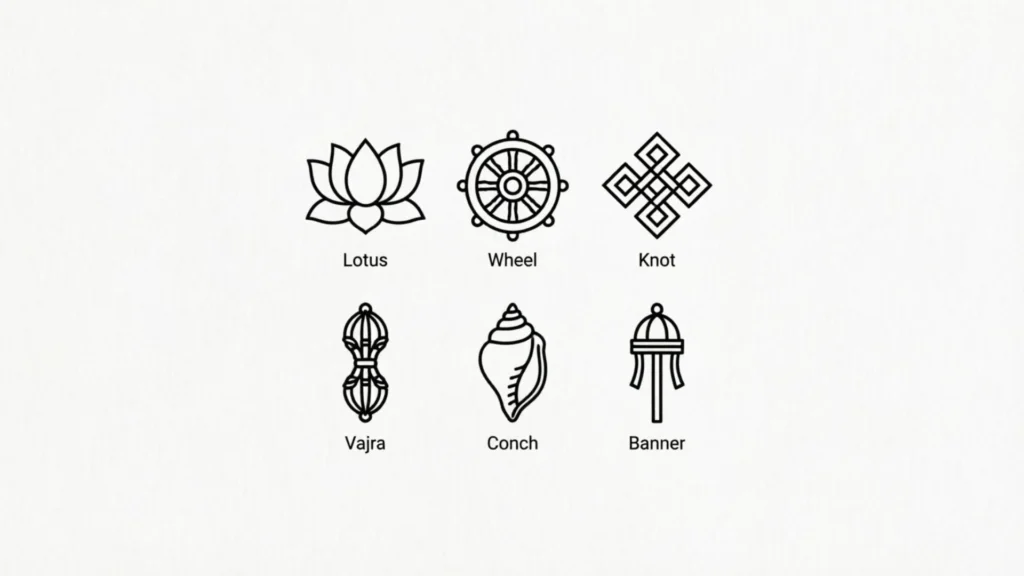
Buddhism contains some of the most elaborate and historically documented mandala traditions.
Tibetan Buddhist Mandalas
Tibetan mandalas can function as maps of sacred reality.
The central deity may reside inside a palace-like structure, while gates, circles, lotus petals, protective imagery, and other figures create a carefully organized environment.
Japanese Buddhist Mandalas
Mandalas also developed within Japanese Buddhist traditions.
The Smithsonian’s collection includes a Japanese mandala in which Sanskrit seed syllables represent Buddhist deities. It identifies the design as a schematic representation of the universe and connects it with esoteric Buddhist ceremonies and devotional practices.
Mandalas and Meditation
In Tibetan Buddhist practice, meditation may involve imagining the mandala as a three-dimensional sacred palace rather than merely looking at a flat painting.
The purpose is therefore deeper than relaxation or decoration.
Mandala Symbols in Hinduism
Hindu religious traditions contain many forms of sacred geometry and diagrammatic symbolism.
Hindu Sacred Geometry
Hindu sacred geometric designs can combine:
- Circles
- Squares
- Triangles
- Lotus petals
- Central points
- Deity imagery
- Sacred inscriptions
These elements can organize a visual representation of spiritual or cosmological ideas.
Yantras
They can serve as supports for meditation, worship, visualization, or ritual practice.
A yantra’s meaning depends on the specific design and the deity or tradition associated with it.
Sri Yantra
Its design contains interlocking triangles arranged around a central point.
Although modern websites sometimes call the Sri Yantra simply a “mandala,” it is more accurate to recognize it within the specific tradition of Hindu yantra practice.
Lotus and Deity Imagery
Lotus imagery is common in Hindu religious art and can appear in sacred geometric designs.
The lotus is associated with purity and spiritual development in South Asian religious traditions, but its exact role depends on the deity and context.
Mandala vs. Yantra: What’s the Difference?
Mandalas and yantras can look similar, but they are not simply two words for exactly the same thing.
| Feature | Mandala | Yantra |
| General appearance | Often circular and layered | Often strongly geometric |
| Religious contexts | Hindu and Buddhist traditions | Especially Hindu traditions |
| Possible purpose | Sacred cosmology, meditation, ritual, visualization | Meditation, worship, ritual, visualization |
| Design elements | May include deities, palaces, gates, lotus forms, circles | Often includes triangles, circles, lotus forms, and central points |
| Meaning | Depends on the specific tradition | Depends on the specific yantra |
| Famous example | Tibetan Buddhist deity mandalas | Sri Yantra |
The key lesson is simple: similar geometry does not necessarily mean identical religious function.
Traditional Mandalas vs. Modern Mandala Art
Not every modern mandala design has a traditional religious meaning.
| Traditional Mandala | Modern Mandala-Inspired Art |
| Connected with a particular religious tradition | May be created purely as artwork |
| Can have specific ritual or meditative purposes | Often created for decoration or relaxation |
| May contain deities or sacred syllables | Usually uses abstract or floral patterns |
| Can represent sacred cosmology | May represent personal ideas such as balance |
| Created according to established systems | Can be freely designed |
| Meaning depends on religious context | Meaning may be personal |
This distinction is especially useful when interpreting tattoos, coloring pages, wall art, and jewelry.
Mandala Symbols for Tattoos and Jewelry
Mandalas are popular in tattoos and jewelry because their symmetrical designs can be visually striking.
Common Mandala Tattoo Meanings
- Balance
- Wholeness
- Inner peace
- Spirituality
- Personal growth
- Transformation
- Unity
- Harmony
These are common contemporary interpretations rather than universal historical definitions.
Things to Consider Before Using a Sacred Design
If you want a tattoo or jewelry piece based on a traditional Buddhist or Hindu mandala, research the original design before using it.
A traditional mandala may contain:
- A specific deity
- A sacred syllable
- A religious mantra
- A particular cosmological system
- Ritual symbolism
Using a design without understanding its context can unintentionally change or trivialize its meaning.
This is especially important when the design contains sacred figures or religious text.
Mandala Symbols in Meditation
A simple modern practice might involve focusing on the center of a mandala and gradually observing the surrounding patterns.
However, traditional Buddhist meditation involving mandalas can be much more complex.
The Smithsonian explains that Tibetan practitioners may visualize a mandala as a three-dimensional palace, with its deities representing philosophical qualities and serving as models on the path toward enlightenment.
A Simple Modern Mandala Meditation
For a basic non-religious visual concentration exercise:
- Sit comfortably in a quiet place.
- Place the mandala at a comfortable viewing distance.
- Look at the center for a few moments.
- Slowly notice the surrounding shapes and repetition.
- Allow your attention to return to the center whenever it wanders.
- Continue for several minutes.
- Finish by observing the entire design rather than one individual element.
This exercise is a modern concentration technique, not a substitute for formal instruction in a particular Buddhist tradition.
What Is a Sand Mandala and Why Is It Destroyed?
A sand mandala is a temporary mandala made from colored sand, especially associated with Tibetan Buddhist practice.
Creating one can take days. Monks first prepare the sacred space, establish the design, and gradually fill it with colored sand. After the mandala is completed and consecrated, the sand is swept away and dispersed.
Why Is the Sand Mandala Destroyed?
The destruction represents impermanence.
The monks intentionally dismantle something that required great patience and precision.
The lesson is that even beautiful things are temporary.
The Smithsonian describes the sweeping away of the sand as an expression of the impermanent nature of existence.
Are Mandalas Religious Symbols or Decorative Art?
They can be either, depending on the mandala.
Traditional mandalas can have specific religious, philosophical, ritual, and meditative functions.
Modern mandala-inspired artwork may simply use symmetrical geometry for beauty or relaxation.
The difference is important because calling every circular design a “religious mandala” can erase the specific cultural context of traditional examples.
A useful rule is:
Look at the design, source, purpose, tradition, and context before deciding what it means.
How to Identify a Mandala Symbol
If you see an unfamiliar mandala online, in a museum, temple, book, tattoo, or piece of jewelry, use several clues rather than relying on its shape alone.
Start With the Center
Ask:
- Is there a deity?
- Is there a sacred syllable?
- Is there a lotus?
- Is there a geometric point?
- Is the center empty?
The center is often one of the most useful clues.
Look for Gates and a Palace
A square structure with four gates can point toward a traditional Buddhist mandala structure.
The presence of gateways, a central deity, and surrounding sacred architecture is particularly useful when identifying Tibetan Buddhist mandalas.
Look for Sacred Letters
Sanskrit seed syllables can represent Buddhist deities in some mandalas.
The Smithsonian’s Japanese Buddhist example demonstrates how written syllables can function as symbolic representations of deities.
Look at the Outer Rings
Check for:
- Lotus petals
- Flames
- Vajras
- Protective figures
- Concentric circles
- Burial-ground imagery
- Additional deities
Consider the Source
Context can be just as important as appearance.
A mandala found in:
- A Buddhist monastery
- A Hindu temple
- A museum
- A religious text
- A meditation center
- A tattoo studio
- A home décor store
may have very different meanings.
If the design is presented as a historical or religious mandala, look for information from museums, academic sources, or recognized religious institutions rather than relying only on social-media captions.
Frequently Asked Questions About Mandala Symbols
What does a mandala symbolize?
A mandala can symbolize wholeness, sacred order, the universe, spiritual focus, meditation, or a deity’s realm. Its precise meaning depends on the religious tradition and individual design.
What is the spiritual meaning of a mandala?
The spiritual meaning varies. In traditional Buddhist contexts, mandalas can represent sacred reality and provide a framework for meditation and the path toward enlightenment. Modern users may associate mandalas with balance, peace, personal growth, or inner harmony.
What does the circle in a mandala mean?
The circle is commonly associated with completeness, unity, cycles, and wholeness. It also relates to the Sanskrit term from which the word mandala is derived.
What does the center of a mandala represent?
The center may represent a deity, sacred principle, spiritual focus, or central reality. In many Tibetan Buddhist mandalas, the principal deity is placed at the center.
Are mandalas Hindu or Buddhist?
Mandalas have important connections with both Hindu and Buddhist traditions, but individual designs can have very different meanings. Tibetan Buddhist mandalas, Hindu sacred diagrams, and yantras should not automatically be treated as identical.
Are mandalas religious?
Some are explicitly religious, while others are modern decorative designs inspired by mandalic geometry. Traditional Buddhist mandalas can serve religious, ritual, and meditative purposes.
What do mandala colors mean?
Color meanings vary according to the specific tradition and mandala. There is no universal color system that applies to every mandala. Traditional religious designs should be interpreted within their cultural and theological context.
What is a Buddhist mandala?
A Buddhist mandala is a sacred diagram that can represent the universe, a deity’s realm, or a framework for religious practice and meditation. Tibetan Buddhist mandalas often contain a central deity surrounded by an organized sacred environment.
What is a Hindu mandala?
A Hindu mandala can refer broadly to sacred geometric or cosmological designs used within Hindu traditions. Some Hindu sacred diagrams are more specifically known as yantras and have their own ritual and theological contexts.
What is the difference between a mandala and yantra?
A mandala is a broader type of sacred diagram found in multiple South Asian religious traditions, while a yantra is particularly associated with Hindu sacred geometry and specific devotional or ritual practices. They can share geometric features but should not automatically be treated as interchangeable.
What is a sand mandala?
A sand mandala is a temporary sacred design made from colored sand, especially associated with Tibetan Buddhist practice. After completion and ritual use, it is intentionally dismantled to express the impermanence of existence.
Why are sand mandalas destroyed?
They are intentionally destroyed to demonstrate impermanence. The careful creation followed by deliberate dismantling emphasizes that even beautiful and meaningful forms are temporary.
What does a mandala tattoo mean?
A mandala tattoo may represent balance, wholeness, spirituality, personal growth, peace, or transformation. These are common modern interpretations and should not be confused with the specific meaning of a traditional religious mandala.
What does a lotus mandala symbolize?
A lotus mandala may combine the broader symbolism of the mandala with the lotus’s associations with purity and spiritual development. The exact meaning depends on the religious or artistic context.
What does a geometric mandala mean?
A geometric mandala can represent balance, order, symmetry, unity, or sacred structure. If it comes from a particular religious tradition, its geometry may have more specific meanings.
Can mandalas be used for meditation?
Yes. Mandalas have traditional associations with meditation and visualization, especially in Tibetan Buddhist practice. Modern meditation practices may also use mandalas as visual concentration aids.
Are all circular patterns mandalas?
No. A circular geometric pattern can be mandala-inspired without being a traditional mandala. A traditional mandala generally has a specific symbolic, religious, philosophical, ritual, or contemplative context.
Why are mandalas symmetrical?
Symmetry helps create a balanced structure around the center. In traditional mandalas, this organization can also reflect the carefully ordered sacred environment being represented.
Conclusion
Mandala symbols are much more than attractive circular patterns. In traditional religious settings, they can function as detailed visual maps of sacred reality, representations of deities and their realms, aids for meditation, or expressions of cosmic order. The Metropolitan Museum of Art describes Tibetan mandalas as diagrams of the universe and maps of reality used within Buddhist religious practice, while the Smithsonian describes Tibetan mandalas as balanced geometric compositions that can guide practitioners toward enlightenment.
The circle, center, square, four gates, lotus petals, concentric layers, sacred syllables, deities, and colors can all contribute to a mandala’s meaning. But these elements should not be interpreted through a rigid universal dictionary. Their significance changes according to the specific religious tradition, historical period, design, and purpose.
It is equally important to distinguish traditional mandalas from modern mandala-inspired art. A Buddhist sand mandala created for religious practice is very different from a floral coloring-page design or a decorative tattoo, even though all may use circular symmetry.
If you want to understand a mandala accurately, start with its center and overall structure, then examine its geometric elements, figures, colors, inscriptions, and surrounding context. This approach gives you a much clearer picture of what the design is intended to communicate and helps you appreciate mandala symbols with greater cultural and historical awareness.

Dylan Anderson is a writer who enjoys turning complex topics into simple, engaging content that readers can actually use. His work focuses on clear explanations, practical insights and storytelling that feels natural and relatable. He is also the fictional author of The Quiet Compass of Ashford and Where the Cedar Lantern Glows. When he’s away from his keyboard, Dylan enjoys hiking, reading, and discovering inspiration in everyday life. He believes great writing should be informative, easy to understand and enjoyable from beginning to end.
 Adam Sullivan