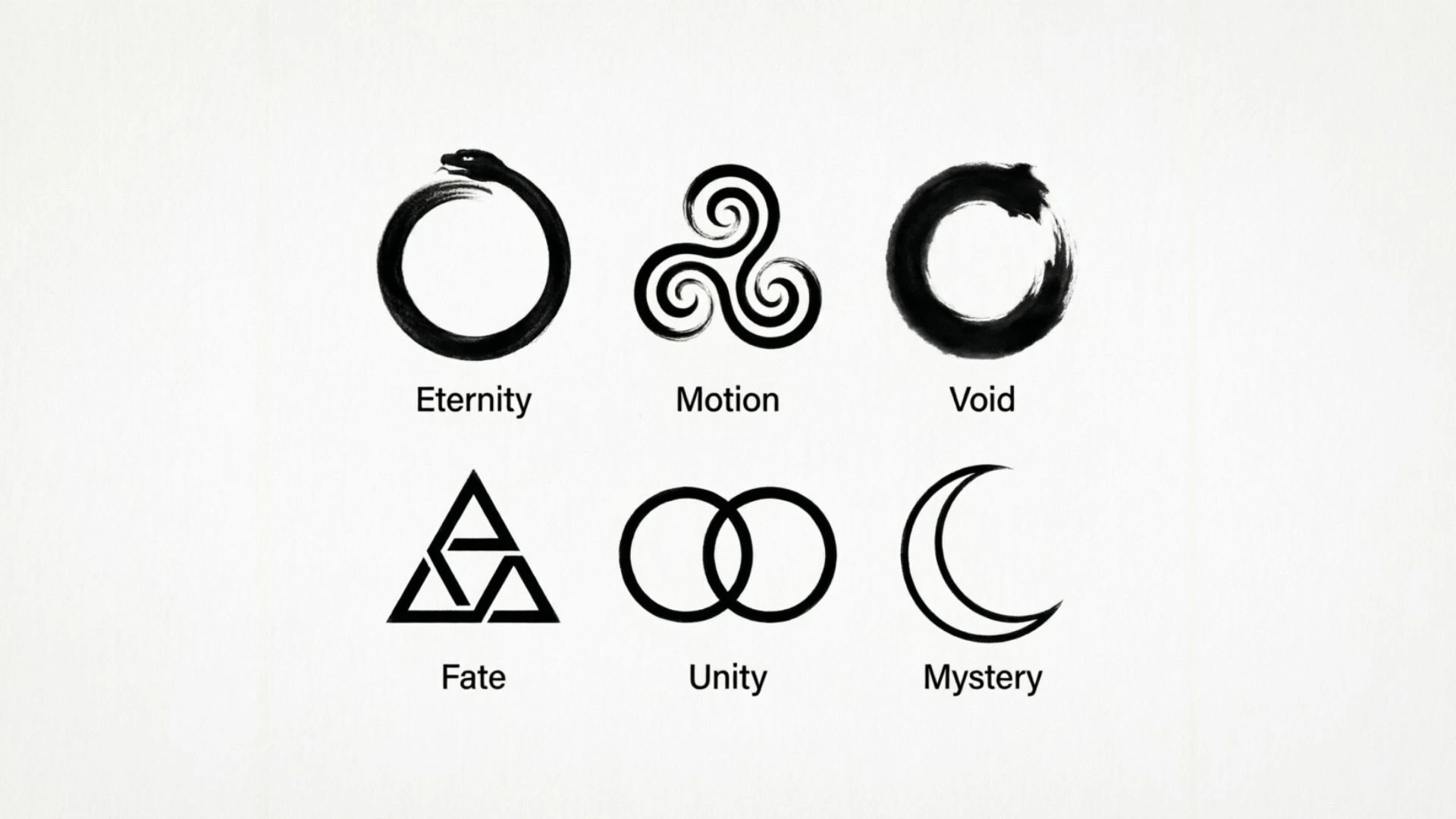
Symbols can say something meaningful without using a single sentence. A simple circle, animal, flower, star, object, or geometric shape can represent an emotion, belief, personal experience, cultural tradition, or important life idea.
If you are searching for unique symbols and meanings, you may be looking for an uncommon symbol for a tattoo, jewelry, artwork, logo, gift, personal project, or simply trying to understand the meaning behind a symbol you have seen.
Some symbols are associated with strength, protection, love, hope, freedom, wisdom, healing, transformation, or new beginnings. Others have deep religious, historical, or cultural meanings.
However, there is an important point to remember: symbols do not always have one fixed meaning. The same image can mean different things in different cultures, historical periods, religions, or works of art. Even natural images such as animals and plants may carry several possible meanings depending on their context.
That is why this guide goes beyond a simple list. It explains unique symbols by meaning, type, historical context, personal use, and practical purpose, so you can understand not only what a symbol may represent but also how to choose one responsibly.
What Are Unique Symbols and What Do They Mean? (Quick Answer)
A unique symbol is a distinctive, less-common, culturally specific, visually unusual, or personally meaningful image, shape, object, or sign that communicates an idea.
“Unique” does not necessarily mean that nobody has ever used the symbol. It usually means the symbol feels uncommon, distinctive, personal, or less predictable than familiar symbols such as a standard heart or smiley face.
Here are some examples:
| Symbol | Common Association | Type | Often Used For |
| Butterfly | Transformation | Nature | Growth, tattoos |
| Mountain | Strength and endurance | Nature | Resilience |
| Spiral | Growth and cycles | Geometric | Personal development |
| Key | Access and opportunity | Object | Jewelry, tattoos |
| Lotus | Purity and spiritual growth | Nature/religious | Spiritual designs |
| Phoenix | Rebirth and renewal | Mythological | Transformation |
| Tree | Growth, roots, family | Nature | Family, life |
| Star | Guidance and hope | Celestial | Hope, direction |
| Dove | Peace | Animal | Peace, spirituality |
| Moon | Cycles and change | Celestial | Transformation |
| Owl | Wisdom | Animal | Knowledge |
| Feather | Freedom and lightness | Natural | Personal symbolism |
| Infinity | Endless continuity | Abstract | Love, connection |
| Ankh | Life in ancient Egyptian context | Ancient | Historical/religious symbolism |
| Olive branch | Peace and reconciliation | Natural/cultural | Harmony |
These are common associations rather than universal definitions. A symbol’s meaning can change depending on where, when, and how it is used. Historical artworks, for example, often require visual and cultural context before their symbols can be interpreted accurately.
Unique Symbols and Meanings at a Glance
If you already know the idea you want your symbol to communicate, this quick guide can help you narrow your choices.
| Meaning | Symbol Ideas | Why They Work |
| Strength | Mountain, lion, oak tree | Suggest endurance and power |
| Protection | Shield, guardian animal, eye motif | Suggest defense or watchfulness |
| Love | Rose, interlocking circles, dove | Suggest affection or connection |
| Hope | Star, sunrise, lantern | Suggest light and new possibilities |
| Freedom | Bird, wings, butterfly | Suggest movement and independence |
| Wisdom | Owl, lamp, book, tree | Suggest knowledge and understanding |
| Peace | Dove, olive branch, open hands | Suggest harmony or reconciliation |
| Healing | New leaf, lotus, sunrise | Suggest renewal and recovery |
| Transformation | Butterfly, phoenix, spiral | Suggest change and rebirth |
| Family | Tree, roots, branches, nest | Suggest connection and ancestry |
| New beginnings | Seed, dawn, sunrise, open door | Suggest a fresh stage of life |
| Personal growth | Mountain, tree, spiral | Suggest progress and development |
| Good fortune | Clover, auspicious motifs, fish in some traditions | Depends strongly on cultural context |
| Spirituality | Om, mandala, cross, dharma wheel, ankh | Tradition-specific meanings |
The best choice depends on whether you want a traditional meaning, cultural meaning, modern interpretation, or personal meaning.
What Makes a Symbol Unique?
A symbol can feel unique for several different reasons.
It may be:
- Less commonly seen in everyday designs
- Connected to an ancient culture
- Based on an unusual geometric pattern
- Associated with a particular religious tradition
- Inspired by nature
- Taken from mythology or folklore
- A combination of familiar symbols
- Personally created
- Used in a modern or unconventional way
For example, a heart is a familiar symbol of love. A pair of interlocking circles can communicate connection in a less obvious way.
Likewise, a mountain is a recognizable natural object, but using a small mountain outline to represent overcoming a personal challenge gives it a more individual meaning.
Symbols are powerful partly because people can use familiar visual forms to communicate ideas that are otherwise difficult to express. Museums and artists often interpret symbols as part of a broader visual language rather than as isolated shapes.
Rare Symbols vs. Unique Symbols
A rare symbol is uncommon in use.
A unique symbol can simply be distinctive or personally meaningful.
These are not necessarily the same thing.
For example, the infinity symbol is extremely recognizable, but a person could create a unique design by combining infinity with a flower, constellation, or initials.
So, if you are looking for a meaningful symbol, do not focus only on finding the rarest image. Focus on finding a symbol whose meaning matches your intention.
Cultural Symbols vs. Personal Symbols
A cultural symbol has meaning connected to a particular community, historical period, religion, or tradition.
A personal symbol gets its meaning primarily from an individual’s experience.
For example, a tree may traditionally symbolize growth in many settings, while one person may associate a particular tree with a family member or childhood home.
Both types can be meaningful, but they should not be described in the same way.
Unique Symbols by Meaning
One of the easiest ways to find the right symbol is to start with the message you want to express.
Unique Symbols of Strength
Strength can mean physical power, emotional resilience, courage, endurance, or the ability to continue through difficulty.
Mountain
A mountain is a strong modern symbol of endurance and overcoming challenges.
Its height and difficult terrain make it a natural visual metaphor for obstacles and achievement.
Best for: resilience, personal growth, perseverance, and tattoos.
Lion
The lion is commonly associated with courage, leadership, confidence, and power.
Its symbolic use varies between cultures and historical traditions, so the surrounding context matters.
Best for: courage, leadership, confidence, and strength.
Oak Tree
An oak tree can symbolize stability, longevity, endurance, and rootedness.
Its deep roots and long life make it especially suitable for ideas involving resilience and family.
Best for: strength, family, heritage, and stability.
Bear
The bear can represent strength, protection, independence, and instinct in various modern symbolic interpretations.
Best for: courage, protection, and independence.
Unique Symbols of Protection
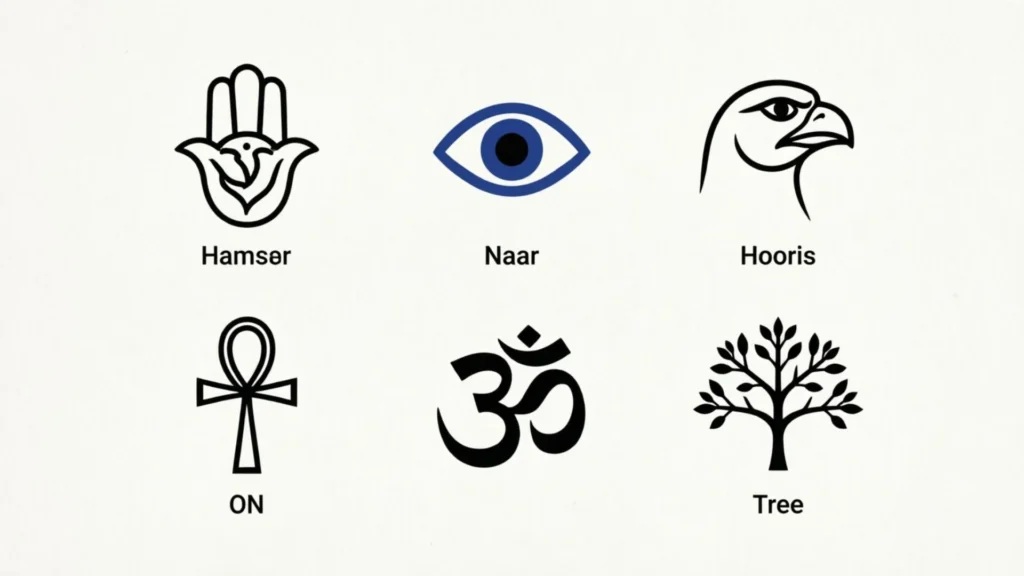
Protection symbols can communicate safety, defense, awareness, or the desire to guard something valuable.
Shield
The shield is one of the clearest visual representations of defense.
It can symbolize:
- Safety
- Courage
- Defense
- Security
- Protection
Guardian Animal
An animal such as a lion, wolf, bear, or eagle can be used as a guardian image.
The specific meaning depends on the animal and cultural context.
Eye Motif
Eye imagery has appeared in many cultures and contexts, including protective traditions. For example, The Metropolitan Museum of Art notes that some historical dot-in-circle motifs may have been associated with an abstract eye intended to ward off the evil eye, while also noting that similar motifs could later become decorative or have meanings that are uncertain.
This is an excellent example of why you should avoid assuming that every eye-shaped design has exactly the same meaning.
Unique Symbols of Love
Love can be represented by more than the traditional heart.
Rose
The rose is widely associated with love, beauty, affection, and devotion, although specific meanings can vary according to color and cultural tradition.
Interlocking Circles
Two linked circles can suggest:
- Connection
- Partnership
- Unity
- Continuity
This is particularly useful for modern minimalist designs.
Two Birds
Two birds facing or flying together can represent companionship and connection.
This is primarily a modern symbolic interpretation unless connected to a specific cultural tradition.
Infinity Symbol
The infinity symbol is often used in modern designs to communicate endlessness or lasting connection.
Its mathematical origin and its modern emotional use are different contexts, so it is better to describe “endless love” as a contemporary symbolic interpretation rather than an ancient definition.
Unique Symbols of Hope
Hope is often represented through images of light, growth, direction, and renewal.
Star
A star can symbolize guidance, hope, aspiration, or direction.
The exact meaning depends on the context.
Rising Sun
A rising sun can represent:
- A new beginning
- Renewal
- Hope
- Energy
- A fresh opportunity
Lantern
A lantern can symbolize light during darkness, guidance, and hope.
It works especially well as a metaphor for finding a way forward during difficult times.
New Leaf
A fresh leaf can suggest renewal, growth, and the beginning of a new phase.
Unique Symbols of Freedom
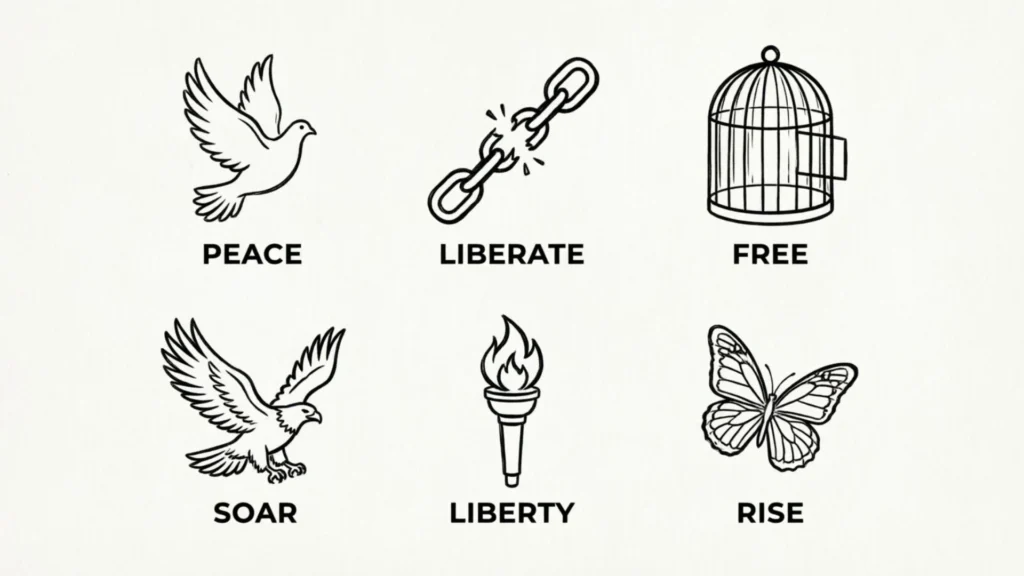
Freedom is naturally associated with movement, open space, and release from restrictions.
Bird
Birds are commonly used to represent freedom because of their ability to fly.
Wings
Wings can suggest:
- Freedom
- Independence
- Ambition
- Spiritual elevation
- Movement
Butterfly
The butterfly can represent transformation and freedom from an earlier state.
Open Circle
An incomplete or open circular form can be used in modern design to suggest openness rather than confinement.
This is primarily a contemporary interpretation, not a universal historical meaning.
Unique Symbols of Wisdom
Owl
The owl is widely associated with wisdom and observation in modern Western symbolism.
Book
A book can represent knowledge, education, learning, and accumulated wisdom.
Lamp
A lamp or light can represent understanding or knowledge overcoming ignorance.
Tree
A mature tree can symbolize experience, growth, and knowledge.
Again, the exact interpretation depends on context rather than being a universal rule.
Unique Symbols of Peace
Dove
The dove is one of the most recognizable modern peace symbols.
Olive Branch
The olive branch is strongly associated with peace and reconciliation in Western traditions.
Open Hands
Open hands can communicate welcome, trust, peace, giving, and openness.
White Flag
A white flag traditionally signals surrender or a truce rather than simply “peace.” This distinction is important when choosing a symbol for a specific message.
Unique Symbols of Healing and Recovery
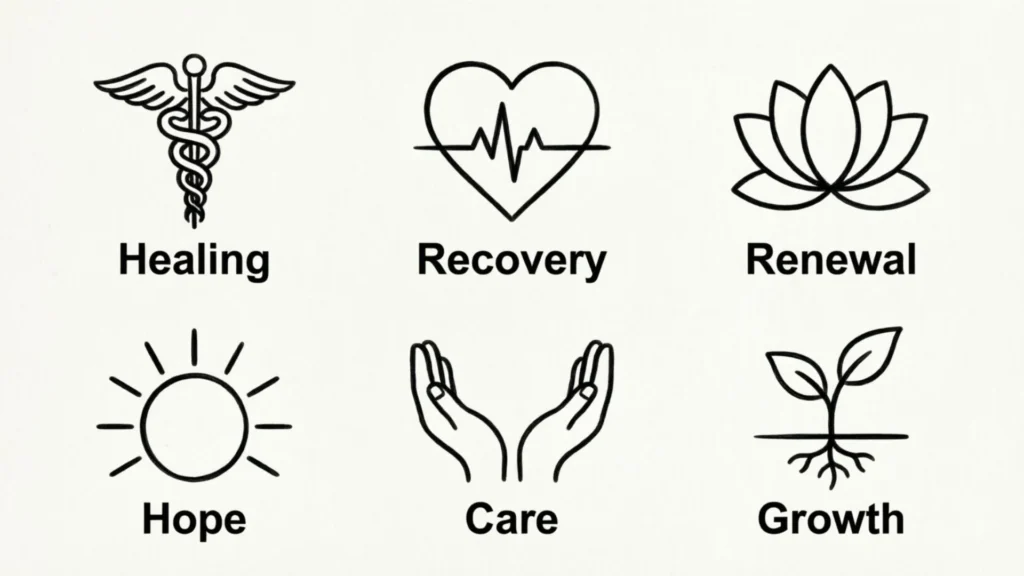
Symbolic healing should be understood as an emotional, spiritual, or personal metaphor, not a medical claim.
New Leaf
A new leaf can represent recovery, renewal, and moving forward.
Lotus
The lotus carries important spiritual and cultural meanings in South Asian and Buddhist traditions and is often associated with purity and spiritual development.
Butterfly
A butterfly can represent a personal transformation after a difficult period.
Sunrise
A sunrise can symbolize another beginning after darkness.
Growing Plant
A small plant emerging from the soil can represent resilience and gradual recovery.
Unique Symbols of Transformation
Transformation is one of the strongest themes in symbolic art.
Butterfly
The butterfly visually communicates change because of its life cycle.
Phoenix
The phoenix is a mythological image commonly used in modern symbolism to represent rebirth and renewal.
Spiral
A spiral can suggest movement, cycles, development, and continued growth.
Snake Shedding Its Skin
The image of a snake shedding its skin can symbolize renewal and transformation in modern symbolic interpretation.
However, snake symbolism is complex and varies greatly across cultures.
Moon Phases
The changing moon can represent cycles, change, time, and renewal.
Unique Symbols of New Beginnings
If you are choosing a symbol after a major life change, consider:
- Sunrise
- Seed
- New leaf
- Open door
- Dawn
- Butterfly
- Phoenix
- Rising star
- Fresh branch
A seed is especially effective as a metaphor because it represents potential before visible growth begins.
Unique Symbols of Family
Family symbols often focus on roots, ancestry, connection, and continuity.
Family Tree
The tree is one of the clearest modern metaphors for generations.
Roots
Roots can represent:
- Heritage
- Belonging
- Family history
- Stability
- Ancestry
Branches
Branches can represent individual family members growing from a shared foundation.
Nest
A nest can symbolize home, family, protection, and belonging.
Constellation
A constellation can be used as a modern metaphor for family members who remain connected even when they are physically separated.
Unique Symbols of Personal Growth
Personal growth is often represented through movement from one stage to another.
Good options include:
- Mountain
- Tree
- Seed
- Spiral
- Butterfly
- Rising sun
- Open door
- New leaf
The strongest symbol depends on the kind of growth you want to represent.
A mountain suggests overcoming challenges, while a seed suggests potential and a butterfly suggests transformation.
Unique Symbols by Type
Another useful way to explore symbolism is to organize symbols according to their visual or cultural type.
Unique Geometric Symbols and Meanings
Geometric symbols can look simple while carrying complex associations.
Circle
The circle is commonly associated with:
- Wholeness
- Unity
- Continuity
- Cycles
- Completion
But it does not have one universal meaning.
Spiral
The spiral can suggest:
- Growth
- Movement
- Cycles
- Development
- Expansion
Its meaning depends on the tradition and design.
Triangle
Triangles can communicate direction, stability, balance, or transformation in different symbolic systems.
The orientation can also change interpretation in some traditions.
Diamond
A diamond shape can suggest clarity, value, focus, or strength in modern symbolic design.
It can also simply be a geometric decorative shape.
Hexagon
The hexagon can communicate order, balance, structure, and harmony in modern design.
Because it occurs frequently in nature and mathematics, its presence does not automatically make it a religious or spiritual symbol.
Eight-Pointed Star
The eight-pointed star appears in several cultural and artistic traditions.
Its interpretation varies, so it should be identified according to its specific historical or cultural context rather than assigned one universal meaning.
Unique Nature Symbols and Meanings
Nature has provided symbolic imagery for thousands of years.
The important point is that a natural object does not automatically have one symbolic meaning. The Met notes that plants and animals can carry different meanings depending on the context of an individual artwork.
Tree
A tree can represent:
- Life
- Growth
- Family
- Stability
- Connection
- Heritage
Leaf
A leaf can represent:
- Renewal
- Growth
- Nature
- Fresh beginnings
Feather
A feather is often associated with:
- Freedom
- Lightness
- Flight
- Spirituality
- Guidance
Specific cultural interpretations can differ.
Lotus
The lotus has deep religious and cultural associations in several Asian traditions.
Its meaning should therefore be explained in relation to the specific tradition rather than treated simply as a generic flower symbol.
Sun
The sun commonly suggests:
- Light
- Energy
- Life
- Vitality
- Renewal
Solar imagery has also been used in many religious and political traditions.
Moon
The moon is commonly used in modern symbolism to represent:
- Cycles
- Change
- Mystery
- Time
- Renewal
Unique Animal Symbols and Meanings
Animals can be powerful symbols, but their meanings vary considerably.
Wolf
The wolf can suggest:
- Loyalty
- Instinct
- Independence
- Family
- Courage
Fox
The fox is commonly associated with cleverness, adaptability, and strategy in many modern interpretations.
Some cultures also give the fox supernatural or spiritual associations.
Owl
The owl is widely associated with wisdom, observation, and mystery.
Deer
The deer can suggest gentleness, grace, nature, and sensitivity.
Snake
Snake symbolism is particularly complex.
Depending on the cultural context, snakes may be connected with:
- Renewal
- Transformation
- Healing
- Danger
- Wisdom
- Fertility
- Rebirth
There is no single global meaning for the snake.
Butterfly
The butterfly commonly represents:
- Transformation
- Change
- Growth
- Rebirth
- Freedom
Unique Celestial Symbols and Meanings
Celestial imagery can create symbols that feel both simple and mysterious.
Sun
Represents light, life, energy, and vitality in many modern contexts.
Moon
Represents cycles, change, mystery, and renewal.
Crescent Moon
The crescent appears in many artistic, cultural, and religious settings. Its meaning depends on the specific context.
Star
Stars can symbolize hope, guidance, dreams, achievement, or direction.
North Star
The North Star has long been useful as a navigational reference and can therefore serve as a modern metaphor for direction or guidance.
Constellation
A constellation can symbolize connection, destiny, identity, or belonging in modern personal designs.
Unique Ancient and Mythological Symbols
Ancient symbols should be handled carefully because modern websites often assign them simplified meanings without sufficient historical evidence.
Ancient Egyptian Symbols
Ancient Egyptian symbolism includes several well-documented signs.
The ankh, for example, was used as a hieroglyph connected with “life” and also became a broader symbol associated with life. The Metropolitan Museum of Art documents this use in ancient Egyptian objects.
Other Egyptian symbols include:
- Ankh
- Djed
- Was
- Scarab
- Eye-related imagery
- Solar imagery
The meanings of these symbols are best understood within ancient Egyptian religious and cultural contexts.
Greek-Associated Symbols
Greek traditions include symbolic imagery such as:
- Labyrinth
- Laurel
- Owl
- Greek key or meander patterns
However, the meaning of each should be connected to the particular historical source rather than assumed from modern internet lists.
Celtic-Associated Symbols
Modern discussions frequently associate symbols such as:
- Triskelion
- Knotwork
- Spirals
with Celtic traditions.
Because “Celtic” covers many periods and communities, it is better to avoid claiming that every modern Celtic-style design had one specific meaning in ancient times.
Norse Symbols
Norse traditions also contain distinctive symbols and motifs.
If you are choosing one for a tattoo or artwork, research the specific historical symbol rather than relying on generalized “Viking symbol meaning” lists.
Mythological Symbols and Their Meanings
Phoenix
The phoenix is a powerful modern symbol of rebirth and renewal.
It is often chosen to represent rebuilding after a difficult period.
Ouroboros
The ouroboros is the image of a serpent or dragon forming a circle by biting its own tail.
It is commonly interpreted through ideas of cycles, continuity, and renewal.
Its historical meanings are more complex than the simplified phrase “eternal life,” so context matters.
Labyrinth
The labyrinth is often interpreted as a journey, complexity, or a path toward an objective.
Its meaning depends on the specific historical or artistic tradition.
Griffin
The griffin, a mythical creature combining features of different animals, has appeared in various historical traditions and artistic contexts.
Its associations can include strength, guardianship, and majesty.
Spiritual and Religious Symbols
Religious symbols should be treated differently from ordinary decorative shapes.
They can be sacred to living communities and may have specific meanings that cannot be reduced to a generic internet definition.
Hindu Symbols
Examples include:
- Om or Aum
- Lotus
- Swastika in its Hindu cultural and religious context
- Diya
- Trishula
- Yantra
Each has a specific history and should be researched within Hindu traditions.
Buddhist Symbols
Examples include:
- Dharma wheel
- Lotus
- Bodhi tree
- Endless knot
- Buddhist mandala
Meanings can vary among Buddhist traditions.
Christian Symbols
Examples include:
- Cross
- Ichthys
- Chi-Rho
- Dove
- Alpha and Omega
Their meanings are connected to Christian theology and history.
Islamic Symbols
Islamic visual culture includes many geometric, calligraphic, floral, and architectural motifs.
It is important not to assume that every crescent, star, or geometric pattern is inherently a religious symbol of Islam. Context matters.
Ancient Egyptian Religious Symbols
Symbols such as the ankh and djed belonged to ancient Egyptian religious and cultural systems.
The Met documents the ankh, djed, and was together as a combination of ancient Egyptian signs carrying distinct meanings.
Historical Meaning vs. Modern Symbolism
One of the most important distinctions when researching symbols is the difference between historical meaning and modern interpretation.
A symbol may have been created for one purpose in its original culture and later acquired a different popular meaning.
| Symbol | Historical/Cultural Context | Common Modern Interpretation |
| Ankh | Ancient Egyptian life symbol | Life, spirituality |
| Butterfly | Natural life-cycle imagery | Transformation |
| Mountain | Varies by cultural context | Strength and resilience |
| Infinity | Mathematical symbol | Endless love or continuity |
| Key | Practical object | Opportunity or access |
| Phoenix | Mythological tradition | Rebirth |
| Tree | Many cultural uses | Growth and family |
| Spiral | Appears across many traditions | Growth and cycles |
This distinction helps prevent a common mistake: presenting a modern symbolic interpretation as if it were an ancient fact.
Museums frequently examine symbols in relation to historical context, surrounding imagery, and intended function.
Symbols That Are Often Confused
Similar-looking symbols can have very different meanings.
Infinity Symbol vs. Ouroboros
Both may suggest continuity or endlessness in modern interpretation.
However, the infinity symbol comes from mathematical notation, while the ouroboros is an ancient symbolic image of a serpent or dragon forming a circle.
They should not be treated as historically identical.
Mandala vs. Yantra
Both can involve complex geometric designs and spiritual meanings, particularly in South Asian religious contexts.
However, they are not simply interchangeable terms.
A specific design should be identified according to its tradition and function.
Bindi vs. Tilak
Both can refer to marks worn on the forehead in South Asian traditions, but their uses, meanings, and religious contexts can differ.
Star vs. Pentagram
A five-pointed star is not automatically a pentagram with a specific religious meaning.
Its interpretation depends on orientation, surrounding imagery, cultural context, and use.
Decorative Pattern vs. Symbol
Not every repeated shape has symbolic meaning.
The Met provides a useful example in historical objects where a motif may have originally had a protective function but may later have become decorative, or its original meaning may simply be uncertain.
Unique Symbols for Tattoos
A meaningful tattoo does not have to use the most common symbol.
The best choice is often one that communicates your intended idea without relying on an overly complicated design.
Unique Symbols for Strength Tattoos
Consider:
- Mountain
- Lion
- Oak tree
- Bear
- Shield
- Strong geometric forms
Unique Symbols for Healing Tattoos
Consider:
- New leaf
- Lotus
- Sunrise
- Butterfly
- Growing plant
- Spiral
These should be understood as symbolic representations of healing or recovery rather than medical symbols.
Unique Symbols for Love Tattoos
Consider:
- Rose
- Interlocking circles
- Two birds
- Infinity design
- Botanical branch
- Moon and star combination
Unique Symbols for New Beginnings
Consider:
- Sunrise
- Seed
- Open door
- New leaf
- Butterfly
- Phoenix
Minimalist Unique Symbol Ideas
For a small tattoo, consider:
- Tiny star
- Simple spiral
- Single mountain line
- Small crescent
- Leaf outline
- Minimal key
- Small constellation
- Simple wave
- Single feather
Before using a religious or culturally specific symbol, learn how that symbol is used by the tradition from which it comes.
Unique Symbols for Jewelry
Symbols can work particularly well in necklaces, bracelets, rings, pendants, and charms because a small design can carry personal meaning.
Symbols for Personal Jewelry
Consider:
- Key for opportunity
- Star for guidance
- Tree for family
- Moon for change
- Infinity for continuity
- Compass for direction
- Feather for freedom
- Flower for growth
Symbols as Gifts
A symbolic piece of jewelry can become more meaningful when the design matches the recipient’s story.
For example:
- A mountain for someone overcoming challenges
- A compass for someone starting a new journey
- A tree for family
- A star for someone who inspires you
- A seed or leaf for a new chapter
The symbolism should be explained honestly as either traditional, cultural, or personal rather than inventing an ancient origin.
Unique Symbols for Different Emotions
| Emotion or Idea | Symbol Ideas |
| Love | Rose, heart, interlocking circles |
| Hope | Star, sunrise, lantern |
| Peace | Dove, olive branch |
| Courage | Lion, mountain |
| Freedom | Bird, wings |
| Joy | Sun, butterfly |
| Healing | New leaf, lotus |
| Grief | Willow, rain, fading flower |
| Growth | Tree, seed, spiral |
| Protection | Shield, guardian animal |
| Wisdom | Owl, book, lamp |
| Family | Roots, tree, branches |
| Change | Butterfly, moon phases |
| New beginnings | Sunrise, seed, open door |
These are useful starting points rather than fixed definitions.
Which Unique Symbol Is Right for You?
Choosing a symbol becomes much easier when you begin with the meaning, not the image.
| If You Want to Express… | Consider… |
| Strength | Mountain, lion, oak |
| Protection | Shield, guardian animal |
| Love | Rose, interlocking circles |
| Hope | Star, sunrise |
| Freedom | Bird, wings |
| Wisdom | Owl, lamp |
| Peace | Dove, olive branch |
| Healing | New leaf, lotus |
| Transformation | Butterfly, phoenix |
| Family | Tree, roots |
| New beginnings | Seed, sunrise |
| Personal growth | Spiral, mountain |
| Guidance | Star, compass |
| Opportunity | Key, open door |
Then ask yourself three questions:
- Do I want a traditional meaning or a personal meaning?
- Does the symbol belong to a culture or religion that I should research?
- Does the visual design communicate what I actually want to say?
This process is more reliable than choosing a symbol simply because it looks attractive.
How to Choose a Meaningful Unique Symbol
Start With One Main Idea
Choose the central concept first:
- Strength
- Love
- Hope
- Protection
- Freedom
- Family
- Healing
- Transformation
- Spirituality
- Wisdom
Trying to make one symbol represent everything can make the design confusing.
Research the Symbol’s Origin
Find out where the symbol comes from.
Ask:
- Is it ancient?
- Is it religious?
- Is it cultural?
- Is it modern?
- Is its meaning documented?
- Is its popular meaning mostly contemporary?
Check the Cultural Context
A symbol from a living religious or cultural tradition deserves extra care.
Do not assume that a design found on a tattoo website accurately represents its original tradition.
Decide Between Traditional and Personal Meaning
If you want a historical symbol, prioritize reliable sources.
If you want a personal symbol, you can create your own interpretation while clearly treating it as personal symbolism.
Consider the Visual Design
A good symbolic design should work at the size and location where you plan to use it.
A complex historical symbol may lose detail when reduced to a tiny tattoo or piece of jewelry.
How to Identify an Unknown Symbol
If you find an unfamiliar symbol on clothing, jewelry, architecture, artwork, a tattoo, or an old object, avoid guessing from shape alone.
Look at the Shape
Start by identifying the basic form:
- Circle
- Cross
- Star
- Spiral
- Triangle
- Eye
- Animal
- Plant
- Human figure
- Letter or character
Examine Surrounding Symbols
The symbols around an image can completely change its interpretation.
A flower next to a religious figure may have a different meaning from the same flower used alone.
Identify the Cultural Context
Ask where the object or design comes from.
Possible clues include:
- Country
- Religion
- Language
- Architecture
- Clothing
- Art style
- Historical period
Check the Historical Period
The same symbol may have different meanings across time.
Look for Inscriptions
Words, names, dates, or religious phrases can provide important clues.
Museum collections often use inscriptions and visual context to determine an object’s meaning, function, and history.
Don’t Assume Every Pattern Is Symbolic
This is one of the most important rules.
A repeated circle, flower, line, or geometric pattern may simply be decorative.
Historical evidence is needed before assigning a specific symbolic meaning.
Are All Symbol Meanings Historically Accurate?
No.
Many popular websites publish simplified lists such as:
“This symbol always means X.”
That approach can be misleading.
Symbolic meanings can develop through:
- Religion
- Mythology
- Art
- Folklore
- Literature
- Politics
- Architecture
- Jewelry
- Modern social media
- Tattoo culture
- Personal interpretation
The Smithsonian describes symbolism as a visual language that can evolve over time and across cultural contexts.
The Met similarly notes that a natural image can have multiple possible meanings and that interpretation depends heavily on the context of the artwork.
Therefore, when a meaning is uncertain, phrases such as “commonly associated with,” “in some traditions,” “in modern symbolism,” or “may represent” are often more accurate than absolute statements.
Why Do Symbols Have Different Meanings in Different Cultures?
Symbols are part of communication.
Just as words can have different meanings in different languages, visual symbols can have different associations across cultures.
For example, an animal may represent:
- Protection in one culture
- Wisdom in another
- Danger somewhere else
- A specific deity or historical figure in another tradition
- Nothing symbolic at all in a particular artwork
The surrounding context is therefore essential.
The Smithsonian’s educational material on signs and symbols emphasizes using historical and cultural context when interpreting visual meaning.
Are Unique Symbols Always Ancient?
No.
A symbol can be unique without being ancient.
There are at least four broad categories:
Historical Symbols
Symbols documented through historical objects, texts, art, or archaeological evidence.
Cultural Symbols
Symbols connected to a particular community, tradition, country, or identity.
Religious Symbols
Symbols used in religious belief, worship, ritual, or sacred art.
Modern Personal Symbols
Symbols created or interpreted by contemporary people for personal or artistic reasons.
Keeping these categories separate helps prevent modern meanings from being incorrectly presented as ancient traditions.
How Symbolic Meanings Are Determined
When researching a symbol, consider the evidence behind its meaning.
Historical Evidence
Look for surviving objects, inscriptions, manuscripts, archaeological evidence, or historical records.
Religious Sources
For religious symbols, consult appropriate religious texts, institutions, or scholarship.
Museum Collections
Museum descriptions can be especially useful because they often explain an object’s date, origin, function, and visual context.
Academic Research
University publications and scholarly books can help distinguish established interpretations from modern speculation.
Artistic Context
The same symbol may mean something different depending on the artwork in which it appears.
Modern Usage
A contemporary tattoo, logo, or social media symbol may have a meaning that developed recently.
This approach helps separate documented symbolism from internet folklore.
Unique Symbols vs. Common Symbols
A unique symbol is not necessarily better than a common symbol.
The difference is often about how recognizable or personal the image feels.
| Common Symbol | Less-Common Alternative |
| Heart | Interlocking circles |
| Dove | Open wings |
| Tree | Tree roots |
| Star | Constellation |
| Infinity | Spiral |
| Crown | Mountain peak |
| Key | Compass |
| Rose | Botanical branch |
| Butterfly | Moth |
| Sun | Rising horizon |
The alternative does not automatically have a deeper historical meaning.
Its value may simply be that it feels more personal and distinctive.
Frequently Asked Questions About Unique Symbols and Meanings
What is a unique symbol?
A unique symbol is a distinctive or less-common image, shape, object, or sign that communicates an idea, emotion, belief, identity, or personal message.
What is the most unique symbol?
There is no single “most unique” symbol because uniqueness is subjective. A symbol may feel unique because it is uncommon, culturally specific, visually unusual, or personally meaningful.
What symbol represents strength?
Mountains, lions, oak trees, bears, shields, and other powerful images can represent strength or resilience. The meaning depends on the cultural and visual context.
What symbol represents protection?
Shields, guardian animals, protective eye motifs, and certain religious or cultural symbols can represent protection. Specific meanings should be checked against the tradition where the symbol originated.
What symbol represents love?
Roses, hearts, interlocking circles, paired birds, and infinity designs are commonly associated with love or lasting connection.
What symbol represents hope?
Stars, rising suns, lanterns, new leaves, and rainbows can represent hope, guidance, renewal, or a new beginning.
What symbol represents freedom?
Birds, wings, butterflies, open forms, and flying arrows can symbolize freedom or independence.
What symbol represents healing?
New leaves, growing plants, lotus imagery, butterflies, and sunrises can be used as symbolic representations of renewal and healing. These are symbolic meanings rather than medical claims.
What symbol represents transformation?
Butterflies, phoenixes, spirals, moon phases, and snakes shedding their skin are commonly used to represent transformation or renewal.
What symbol represents family?
Trees, roots, branches, nests, circles, and constellations can represent family, ancestry, belonging, and connection.
What symbol represents new beginnings?
Seeds, sunrise imagery, new leaves, open doors, butterflies, and phoenixes can represent new beginnings.
What symbol represents wisdom?
Owls, books, lamps, trees, and eyes can be associated with wisdom or knowledge depending on the cultural setting.
Are symbol meanings universal?
No. Symbolic meanings can change according to culture, religion, history, artwork, and personal interpretation.
Can one symbol have multiple meanings?
Yes. A single symbol may have several meanings even within the same culture. Its surrounding imagery and historical context can help determine which interpretation is appropriate.
Are unique symbols always ancient?
No. Some are ancient, while others are modern, cultural, artistic, or personally created.
Can I create my own symbol?
Yes. You can combine shapes, objects, letters, natural forms, or other imagery to create a personal symbol. However, you should not claim that your newly created meaning is an ancient cultural tradition unless reliable evidence supports that claim.
What are good unique symbols for tattoos?
Mountains, spirals, constellations, leaves, roots, butterflies, phoenixes, keys, and minimalist geometric designs can work well. Religious and cultural symbols should be researched before being used.
What are good unique symbols for jewelry?
Keys, stars, moons, trees, feathers, infinity designs, flowers, compasses, and symbolic animals can work well as pendants, charms, rings, or bracelets.
How can I find the meaning of an unknown symbol?
Start with its shape, surrounding imagery, cultural origin, language, historical period, and location. Museum collections and reliable historical or academic sources are often more trustworthy than unsourced symbol lists.
Does every pattern have a symbolic meaning?
No. Some patterns are decorative. Even historical motifs that once had symbolic importance can later become decorative or lose their original meaning.
What is the difference between a cultural symbol and a personal symbol?
A cultural symbol has an established connection to a community or tradition, while a personal symbol receives its meaning primarily from an individual’s own experience.
Why do modern symbol meanings differ from ancient meanings?
Symbols can change as they move between cultures, artistic movements, religions, popular media, and modern design. A symbol’s contemporary interpretation may therefore be different from its historical use.
Sources and Further Reading
For reliable research into symbolism, prioritize sources that explain historical evidence, cultural context, and the actual use of a symbol rather than unsourced lists.
Useful starting points include museum collections and educational resources from institutions such as The Metropolitan Museum of Art and the Smithsonian. The Met’s resources demonstrate how symbols should be interpreted within individual artworks and historical contexts, while Smithsonian educational material emphasizes the relationship between symbols, culture, history, and visual communication.
For ancient Egyptian symbolism, museum collection records can provide especially useful evidence. For example, The Met’s documentation of the ankh identifies its use as a hieroglyph connected with life.
Conclusion
Unique symbols are powerful because a small visual form can communicate an idea that might otherwise require many words. A mountain can suggest resilience, a butterfly can represent transformation, a tree can express growth or family, a star can suggest hope or guidance, and a key can represent opportunity or access.
But finding the right unique symbols and meanings is about more than choosing an attractive image.
The most important step is to understand context. A symbol may have a historical meaning, a religious meaning, a modern popular interpretation, or a deeply personal meaning. These should not automatically be treated as the same thing.
If you are choosing a symbol for a tattoo, piece of jewelry, artwork, gift, or personal design, start with the idea you want to express. Then research the symbol’s origin, compare possible meanings, and consider whether it belongs to a living cultural or religious tradition.
The most meaningful symbol is not necessarily the rarest one. It is the one whose meaning, history, and visual form genuinely match the message you want to communicate.

Adam Sullivan is a dedicated writer who enjoys transforming everyday topics into engaging and informative content. His writing focuses on making complex ideas simple, practical and enjoyable for readers of all backgrounds. Adam is also the fictional author of The Lantern Beyond Autumn Hills and Where the Morning Horizon Waits. Outside of writing, he enjoys photography, traveling and discovering inspiration through new experiences. He believes great content should be both helpful and easy to connect with.
 Dylan Anderson