Utah state symbols tell the story of the state’s landscape, wildlife, history, culture, industry, and people. Some are familiar, such as the beehive, sego lily, elk, honeybee, and topaz. Others are less commonly known, including Utahraptor, Gila monster, honeycomb calcite, Native American rock art, and Spiral Jetty.
Utah’s official symbols have also changed over time. The state now has a new Beehive Flag, while its former flag is preserved as the historic state flag. Utah law also recognizes separate categories for a state fossil, state dinosaur, state mineral, state rock, state gem, and state stone.
If you are looking for a complete and easy-to-understand list of Utah state symbols, this guide covers the major official designations, what they mean, and why they are important.
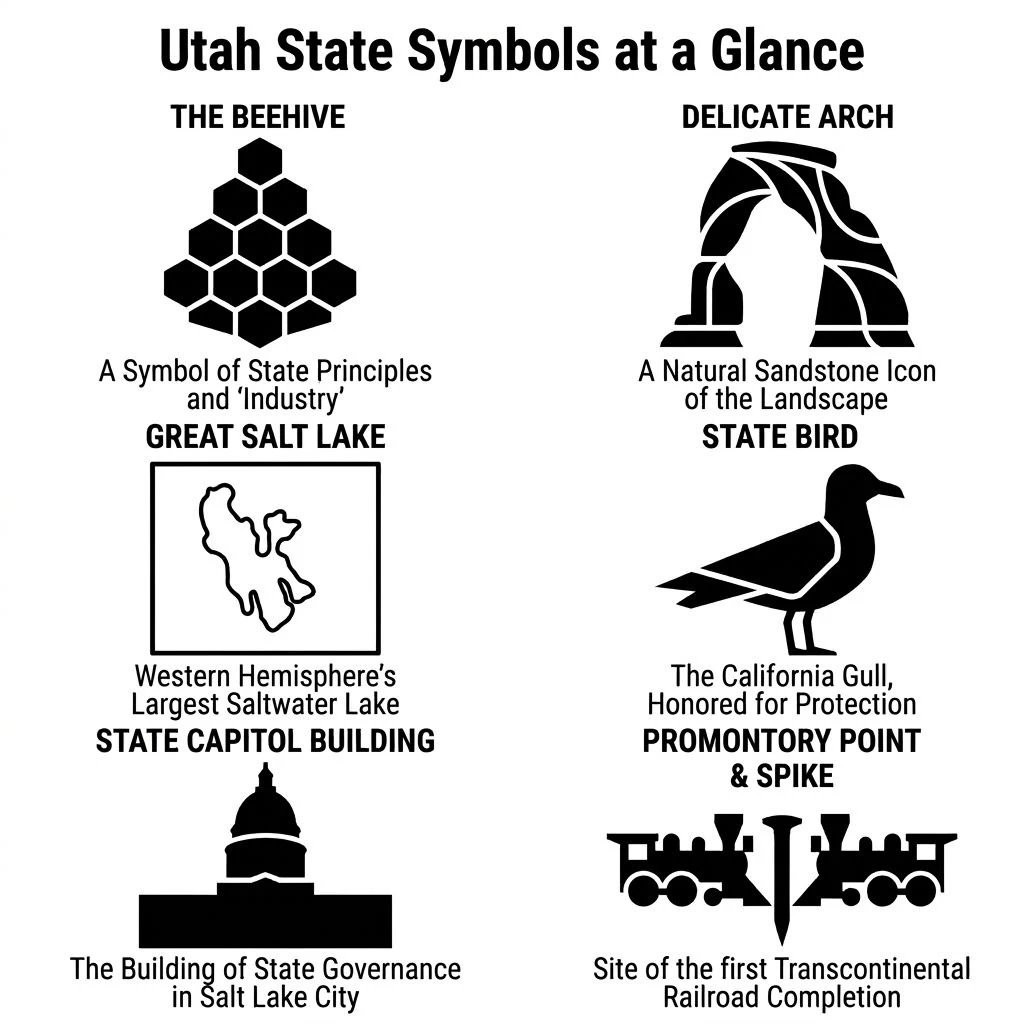
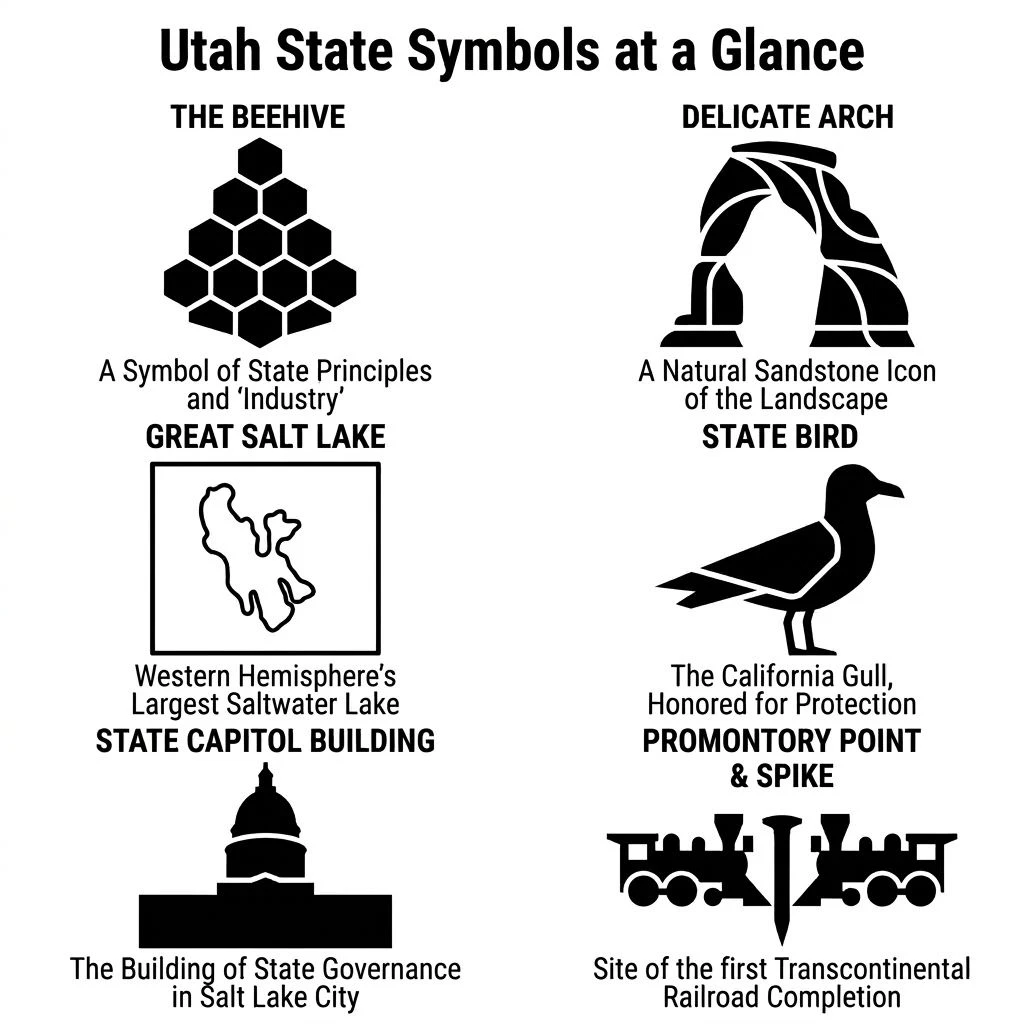
Utah State Symbols at a Glance
Utah’s official designations cover animals, plants, geology, astronomy, history, arts, transportation, sports, and cultural traditions. The current Utah Code lists 36 state-symbol categories, while Utah’s Online Public Library also presents the Great Seal and historic state flag as official symbols and emblems.
| Category | Utah State Symbol |
| State animal | Elk |
| State bird | Sea gull, commonly identified as the California gull |
| State bird of prey | Golden eagle |
| State reptile | Gila monster |
| State fish | Bonneville cutthroat trout |
| State insect | Honeybee |
| State crustacean | Brine shrimp |
| State dinosaur | Utahraptor |
| State fossil | Allosaurus |
| State flower | Sego lily |
| State tree | Quaking aspen |
| State grass | Indian rice grass |
| State fruit | Cherry |
| State vegetable | Spanish sweet onion |
| Historic state vegetable | Sugar beet |
| State mushroom | Porcini |
| State gem | Topaz |
| State mineral | Copper |
| State rock | Coal |
| State stone | Honeycomb calcite |
| State emblem | Beehive |
| State motto | “Industry” |
| State flag | Beehive Flag |
| State hymn | “Utah We Love Thee” |
| State song | “Utah, This Is the Place” |
| State folk dance | Square dance |
| State cooking pot | Dutch oven |
| State star | Dubhe |
| State astronomical symbol | Beehive Cluster |
| State tartan | Utah State Tartan |
| State winter sports | Skiing and snowboarding |
| State demonym | Utahn |
| State work of land art | Spiral Jetty |
| State works of art | Native American rock art |
| State railroad museum | Ogden Union Station |
| State military museum | Fort Douglas Military Museum |
| State firearm | John M. Browning-designed M1911 automatic pistol |
| Service and sacrifice emblem | Honor and Remember Flag |
The Utah Code is the best source for distinguishing current legal designations from historical or cultural associations.
Utah State Flag and Core Symbols
Utah State Flag
Utah’s current state flag is commonly called the Beehive Flag. It became the official state flag on March 9, 2024, following legislation approved in 2023. The former flag was redesignated as the historic state flag rather than simply disappearing from Utah’s history.
The new flag has three main horizontal areas: blue at the top, white in the middle, and red at the bottom. At its center is a blue hexagon with a gold outline, a gold beehive, and a white five-pointed Utah star.
Each part has a specific meaning under Utah law:
| Flag Element | Meaning |
| Beehive | Industry, community, and 1847 |
| White star | Hope and 1896 statehood |
| Hexagon | Strength of Utah’s people |
| Blue section | Utah’s skies and faith |
| White section | Snowy mountains and peace |
| Mountain peaks | Utah’s Indigenous peoples |
| Red section | Southern Utah’s red rocks, perseverance, and unique landscapes |
These meanings are established in the legislation describing the current flag.
The flag therefore combines Utah’s natural scenery with important parts of its history and identity.
Historic Utah State Flag
Utah’s former flag is now officially known as the historic state flag. It features the Great Seal of Utah on a blue background, including the eagle, shield, beehive, sego lilies, crossed American flags, and the dates 1847 and 1896.
The historic flag may still be displayed for appropriate ceremonial purposes. It also continues to appear during certain official state occasions, so it should not be described simply as a discarded or unofficial design.
Great Seal of the State of Utah
The Great Seal of the State of Utah is another important Utah emblem. It was adopted on April 3, 1896, during the first regular session of the Utah Legislature. The seal includes an American eagle, shield, six arrows, the motto “Industry,” a beehive, sego lilies, the date 1847, American flags, and the date 1896.
The two dates have an important historical connection to Utah. The seal uses 1847 and 1896 to connect Utah’s pioneer-era history with its achievement of statehood.
State Emblem: Beehive
The beehive is Utah’s official state emblem and one of the most recognizable Utah symbols.
It is closely connected with the state’s motto, “Industry.” The beehive is associated with hard work, cooperation, community, and persistence. Its importance is also visible in the current Beehive Flag.
State Motto: “Industry”
Utah’s official motto is “Industry.”
The motto reflects the idea of working together, being productive, and building a community through effort. It is closely connected to the beehive, which appears throughout Utah’s official symbolism.
Why Is Utah Called the Beehive State?
Utah is widely known as the Beehive State because of the importance of the beehive in Utah’s history and official identity.
The beehive appears in the state emblem, Great Seal, historic flag, and current Beehive Flag. It also connects directly with the state’s motto, “Industry.”
Utah State Animal and Wildlife Symbols
State Animal: Elk
The elk is Utah’s official state animal. Utah’s Online Public Library identifies it as the Rocky Mountain elk, while Utah law simply designates the elk as the state animal.
Elk are an important part of Utah’s wildlife heritage and can be found in mountain and forest environments across the state.
State Bird: California Gull
Utah law officially calls the state bird the sea gull, while Utah government resources commonly identify it as the California gull.
The California gull is particularly associated with Utah because of the famous story connecting gulls with the early settlers and an agricultural crisis involving destructive insects. For a simple answer, readers can remember:
Utah’s state bird is the California gull.
State Bird of Prey: Golden Eagle
The golden eagle is Utah’s official state bird of prey. It is different from the state bird, so these two designations should not be confused.
This distinction is useful because Utah has a specific symbol for its general state bird and another for its bird of prey.
State Reptile: Gila Monster
The Gila monster is Utah’s official state reptile. Its habitat includes southwestern Utah.
This symbol adds the desert environment to Utah’s list of wildlife symbols. It also shows that Utah’s official animal symbols are not limited to mountain species.
State Fish: Bonneville Cutthroat Trout
The Bonneville cutthroat trout is Utah’s official state fish.
It is associated with Utah’s freshwater environments and the historic Bonneville Basin. Its inclusion reflects the importance of native aquatic life in the state.
State Insect: Honeybee
The honeybee is Utah’s state insect.
Like the beehive, the honeybee connects strongly with Utah’s “Industry” theme. It also reinforces ideas of cooperation, work, and community.
State Crustacean: Brine Shrimp
Utah’s official state crustacean is Artemia franciscana, commonly called brine shrimp.
Brine shrimp are especially associated with the Great Salt Lake ecosystem and are an unusual addition to a state-symbol list. This is one reason a complete Utah symbols article should not stop with familiar animals such as elk and birds.
State Dinosaur: Utahraptor
The Utahraptor is Utah’s official state dinosaur.
This designation is different from Utah’s state fossil. That distinction is important:
- State dinosaur: Utahraptor
- State fossil: Allosaurus
Utah’s dinosaur heritage is especially significant because the state contains extensive fossil resources and has become well known for dinosaur discoveries.
State Fossil: Allosaurus
The Allosaurus is Utah’s state fossil.
Allosaurus lived during the Jurassic Period. Its presence as the state fossil highlights Utah’s long prehistoric history and the importance of paleontology in the state.
Utah State Plant and Food Symbols
State Flower: Sego Lily
The sego lily is Utah’s official state flower.
It is an important native Utah plant and has historical associations with early settlers. The flower is also incorporated into Utah’s historic state symbolism.
The sego lily is a good example of how one natural symbol can connect Utah’s environment, history, and official identity.
State Tree: Quaking Aspen
The quaking aspen is Utah’s state tree.
Aspens are especially recognizable in Utah’s mountain landscapes. Their bright seasonal color also makes them a familiar part of the state’s scenery.
State Grass: Indian Rice Grass
Utah’s official state grass is Indian rice grass.
This native grass represents another side of Utah’s plant life and demonstrates that the state’s symbols include both dramatic landscapes and less noticeable native vegetation.
State Fruit: Cherry
The cherry is Utah’s official state fruit.
The cherry represents Utah’s agricultural heritage and is especially associated with fruit-growing areas of the state.
State Vegetable: Spanish Sweet Onion
Utah’s current state vegetable is the Spanish sweet onion.
This is an important distinction because Utah also has a historic state vegetable.
Historic State Vegetable: Sugar Beet
The sugar beet is Utah’s historic state vegetable. It is not the same as the current state vegetable, which is the Spanish sweet onion.
Sugar beets have an important place in Utah’s agricultural and economic history. Including the word “historic” helps prevent confusion when readers find older lists identifying the sugar beet as Utah’s state vegetable.
State Mushroom: Porcini
Utah’s state mushroom is the porcini.
This is one of the less familiar Utah symbols and is easy to miss on short state-symbol lists.
Utah Geological and Fossil Symbols
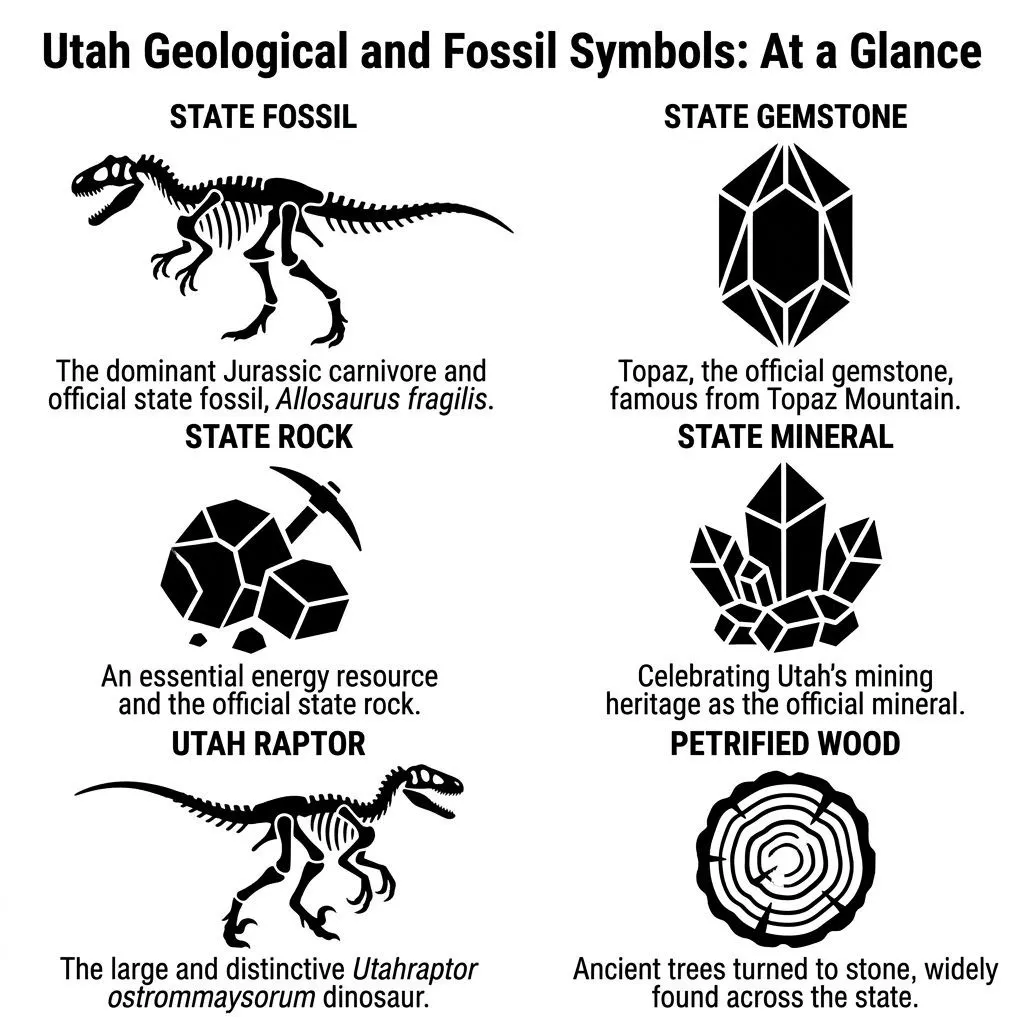
Utah has several separate geological designations, and they should not be treated as interchangeable. The Utah Geological Survey specifically explains the difference between minerals, rocks, and gems.
State Gem: Topaz
Topaz is Utah’s official state gem. It is prominently found in the Thomas Range in Juab County.
Utah Geological Survey information explains that topaz occurs in several Utah locations and is especially notable at Topaz Mountain. Natural Utah topaz can have amber coloring and may become lighter after exposure to sunlight.
State Mineral: Copper
Copper is Utah’s state mineral.
Copper has played an important role in Utah’s mining history and economy. The Utah Geological Survey notes that much of Utah’s copper production has been associated with the Bingham Canyon area.
State Rock: Coal
Coal is Utah’s official state rock.
Coal is classified as a rock even though it originates largely from accumulated plant material. Utah Geological Survey explains that most Utah coal mined historically has been bituminous coal.
State Stone: Honeycomb Calcite
Honeycomb calcite is Utah’s state stone, and Utah law specifies that it originates in Duchesne County.
This designation is easy to miss because many general lists only mention Utah’s gem, mineral, and rock. A complete article should include all four categories:
| Category | Utah Symbol |
| State gem | Topaz |
| State mineral | Copper |
| State rock | Coal |
| State stone | Honeycomb calcite |
This distinction is useful for students, collectors, and anyone trying to understand Utah’s geological symbols.
State Fossil vs. State Dinosaur
These two terms are often confused.
Allosaurus is the state fossil, while Utahraptor is the state dinosaur. Both are official Utah symbols, but they belong to different categories.
Remember it this way:
Utahraptor = dinosaur
Allosaurus = fossil
Utah Cultural and Historical Symbols
State Song: “Utah, This Is the Place”
Utah’s official state song is “Utah, This Is the Place,” written by Sam and Gary Francis.
The song expresses pride in Utah and its landscape and identity.
State Hymn: “Utah We Love Thee”
The official state hymn is “Utah We Love Thee,” written by Evan Stephens.
The hymn is separate from the state song, so these should not be treated as two names for the same work.
State Folk Dance: Square Dance
Utah’s official state folk dance is the square dance. Utah law’s definition includes several related forms of traditional dance, including squares, rounds, clogging, contra, line, and heritage dances.
This symbol represents Utah’s continuing connection with community-based traditional dance.
State Cooking Pot: Dutch Oven
The Dutch oven is Utah’s official state cooking pot.
Dutch ovens are strongly associated with outdoor cooking, pioneer traditions, camping, and community gatherings. Its official designation gives a familiar everyday object a place in Utah history.
State Tartan
Utah has an official state centennial tartan. Utah law says the tartan honors the first Scots known to have been in Utah and Utahns of Scottish heritage.
This symbol recognizes an important part of Utah’s Scottish heritage and gives the state’s cultural symbols a connection to textile traditions.
State Demonym: Utahn
A person from Utah is called a Utahn. Utah law officially recognizes “Utahn” as the state’s demonym.
This is a small but useful detail that is often missing from basic Utah state-symbol lists.
Utah’s Unique Official Symbols
State Star: Dubhe
Dubhe is Utah’s state centennial star. It is one of the seven bright stars that form the Big Dipper in the constellation Ursa Major.
This is one of Utah’s more unusual symbols because it connects the state with astronomy rather than a physical object found on the ground.
State Astronomical Symbol: Beehive Cluster
Utah’s state centennial astronomical symbol is the Beehive Cluster, located in the constellation Cancer the Crab.
The choice is especially fitting because the cluster’s name connects naturally with Utah’s long-standing beehive symbolism.
State Winter Sports: Skiing and Snowboarding
Utah’s official state winter sports are skiing and snowboarding.
This designation reflects the importance of Utah’s mountainous winter environment and its reputation for snow sports.
State Work of Land Art: Spiral Jetty
Spiral Jetty is Utah’s official state work of land art.
Located on the Great Salt Lake, Spiral Jetty is a large earthwork created by artist Robert Smithson in 1970. Its designation gives Utah’s official symbols a direct connection to contemporary art and landscape.
State Works of Art: Native American Rock Art
Utah’s state works of art are Native American rock art.
This designation recognizes the deep cultural history of Indigenous peoples in the region. It is also an important reminder that Utah’s history extends far beyond the pioneer period and includes Indigenous communities with longstanding connections to the land.
State Railroad Museum: Ogden Union Station
Ogden Union Station is Utah’s state railroad museum.
Its designation reflects Utah’s important place in railroad history and transportation.
State Military Museum: Fort Douglas Military Museum
Fort Douglas Military Museum is Utah’s state military museum.
It provides a connection between Utah’s official symbols and the state’s military history.
State Emblem of Service and Sacrifice: Honor and Remember Flag
Utah law recognizes the Honor and Remember Flag as the state’s emblem of service and sacrifice for military members who lost their lives in defense of freedom.
This designation is different from the main state flag and should not be confused with Utah’s Beehive Flag.
State Firearm
Utah officially designates the John M. Browning-designed M1911 automatic pistol as the state firearm.
This is a historical and legal designation connected with Utah-born firearms designer John M. Browning. It is best understood as part of Utah’s industrial and historical heritage rather than as a recommendation concerning firearms.
What Do Utah State Symbols Mean?
Utah’s symbols can be easier to understand when grouped by the ideas they communicate.
| Symbol | Main Association |
| Beehive | Industry and community |
| “Industry” | Work and productivity |
| Sego lily | Natural and historical heritage |
| Elk | Utah wildlife |
| California gull | Utah history and wildlife |
| Golden eagle | Bird of prey and wildlife |
| Gila monster | Desert wildlife |
| Honeybee | Cooperation and industry |
| Brine shrimp | Great Salt Lake ecosystem |
| Utahraptor | Dinosaur heritage |
| Allosaurus | Fossil and prehistoric heritage |
| Quaking aspen | Mountain landscape |
| Indian rice grass | Native plant life |
| Cherry | Agriculture |
| Spanish sweet onion | Agriculture |
| Sugar beet | Agricultural history |
| Topaz | Geological heritage |
| Copper | Mining and industry |
| Coal | Geological resources |
| Honeycomb calcite | Geological heritage |
| Dutch oven | Pioneer and outdoor traditions |
| Square dance | Folk culture |
| Tartan | Scottish heritage |
| Beehive Cluster | Astronomy and beehive symbolism |
| Dubhe | Utah’s centennial astronomy heritage |
| Spiral Jetty | Land art |
| Native American rock art | Indigenous cultural heritage |
| Skiing and snowboarding | Mountain recreation |
Not every symbol has one official one-word “meaning.” Some have meanings specifically defined in law, while others are better understood through their historical or cultural context. For accuracy, it is useful to separate those two ideas rather than assigning an unsupported meaning to every symbol.
Why Does Utah Have So Many State Symbols?
Utah’s symbols cover many parts of life because a state identity is not built around only one object or tradition.
Its official designations include:
- wildlife
- plants
- agriculture
- geology
- fossils
- astronomy
- music
- dance
- food traditions
- art
- transportation
- military history
- winter sports
- cultural heritage
This variety helps explain why a short list containing only the state flower, bird, tree, and animal does not provide a complete picture of Utah’s official symbols.
The current Utah Code includes newer and less familiar categories such as state dinosaur, reptile, stone, works of art, land art, and demonym.
Utah State Symbols by Category
For students or anyone trying to memorize the symbols, grouping them can make the information easier.
Animals and Living Things
Remember:
Elk → California gull → golden eagle → Gila monster → Bonneville cutthroat trout → honeybee → brine shrimp → Utahraptor
This group includes Utah’s major animal, bird, bird of prey, reptile, fish, insect, crustacean, and dinosaur designations.
Plants and Food
Remember:
Sego lily → quaking aspen → Indian rice grass → cherry → Spanish sweet onion → sugar beet → porcini
The sugar beet is the historic vegetable, while the Spanish sweet onion is the current state vegetable.
Rocks, Minerals, Gems, and Fossils
Remember:
Topaz → copper → coal → honeycomb calcite → Allosaurus
The easiest way to avoid confusion is:
- Topaz = gem
- Copper = mineral
- Coal = rock
- Honeycomb calcite = stone
- Allosaurus = fossil
Culture and History
Remember:
Beehive → Industry → Dutch oven → square dance → tartan → state song → state hymn
These symbols connect Utah with community, work, history, music, dance, and cultural traditions.
Modern and Unique Symbols
Remember:
Utahraptor → Spiral Jetty → Native American rock art → Beehive Cluster → Dubhe → skiing and snowboarding
These less familiar designations make Utah’s official symbol collection particularly distinctive.
Current vs. Historic Utah Symbols
One of the easiest ways to become confused about Utah state symbols is to use an older list without checking whether a designation has changed.
The clearest examples are the state flag and state vegetable.
The current state flag is the Beehive Flag, which became official on March 9, 2024. The previous flag is now the historic state flag.
The current state vegetable is the Spanish sweet onion, while the sugar beet is the historic state vegetable.
This is why a current Utah state-symbol guide should always distinguish present designations from historic ones.
Frequently Asked Questions
What is Utah’s state symbol?
Utah has many official state symbols rather than only one. The beehive is the state’s official emblem and one of its best-known symbols. Utah also has official symbols for its flag, animal, bird, flower, tree, dinosaur, fossil, gem, mineral, rock, stone, and many other categories.
What is Utah’s state animal?
Utah’s state animal is the elk.
What is Utah’s state bird?
Utah’s state bird is officially described in law as the sea gull and is commonly identified as the California gull.
What is Utah’s state flower?
Utah’s state flower is the sego lily.
What is Utah’s state tree?
Utah’s state tree is the quaking aspen.
What is Utah’s state dinosaur?
Utah’s state dinosaur is the Utahraptor.
What is Utah’s state fossil?
Utah’s state fossil is the Allosaurus. It is separate from the state dinosaur, which is Utahraptor.
What is Utah’s state gem?
Utah’s state gem is topaz. The Utah Geological Survey notes that topaz is found in several Utah locations, including the Thomas Range area.
What is Utah’s state mineral?
Utah’s state mineral is copper.
What is Utah’s state rock?
Utah’s state rock is coal.
What is Utah’s state stone?
Utah’s state stone is honeycomb calcite, which Utah law identifies as originating in Duchesne County.
What does the beehive mean in Utah?
The beehive is Utah’s state emblem and is closely associated with industry and community. The current state flag also connects the beehive with 1847 and Utah’s pioneer settlement history.
What does the Utah state flag represent?
The current Beehive Flag uses the beehive to represent industry, community, and 1847; the star represents hope and 1896 statehood; the hexagon represents the strength of Utah’s people; and the blue, white, and red sections represent Utah’s skies, snowy mountains and peace, and southern red-rock landscapes and perseverance.
Is the old Utah flag still official?
The former Utah flag is now officially designated the historic state flag. It can still be used and displayed in appropriate circumstances, but it is not the current state flag.
What is a person from Utah called?
A person from Utah is called a Utahn, which is the state’s official demonym.
Conclusion
Utah state symbols are much more than a list of familiar animals, plants, and colors. Together, they reflect Utah’s mountains, deserts, wildlife, geology, agriculture, history, Indigenous heritage, arts, industry, and community values.
The beehive and “Industry” remain central to Utah’s identity, while symbols such as Utahraptor, Gila monster, honeycomb calcite, Spiral Jetty, and Native American rock art show how broad the state’s official symbolism has become. The current Beehive Flag also brings many of these ideas together through its beehive, star, mountains, colors, and hexagon.
For a quick memory guide, remember the major symbols as beehive for industry, sego lily for flower, elk for animal, California gull for bird, quaking aspen for tree, Utahraptor for dinosaur, Allosaurus for fossil, topaz for gem, copper for mineral, coal for rock, and honeycomb calcite for stone.

Adam Sullivan is a dedicated writer who enjoys transforming everyday topics into engaging and informative content. His writing focuses on making complex ideas simple, practical and enjoyable for readers of all backgrounds. Adam is also the fictional author of The Lantern Beyond Autumn Hills and Where the Morning Horizon Waits. Outside of writing, he enjoys photography, traveling and discovering inspiration through new experiences. He believes great content should be both helpful and easy to connect with.
 Dylan Anderson