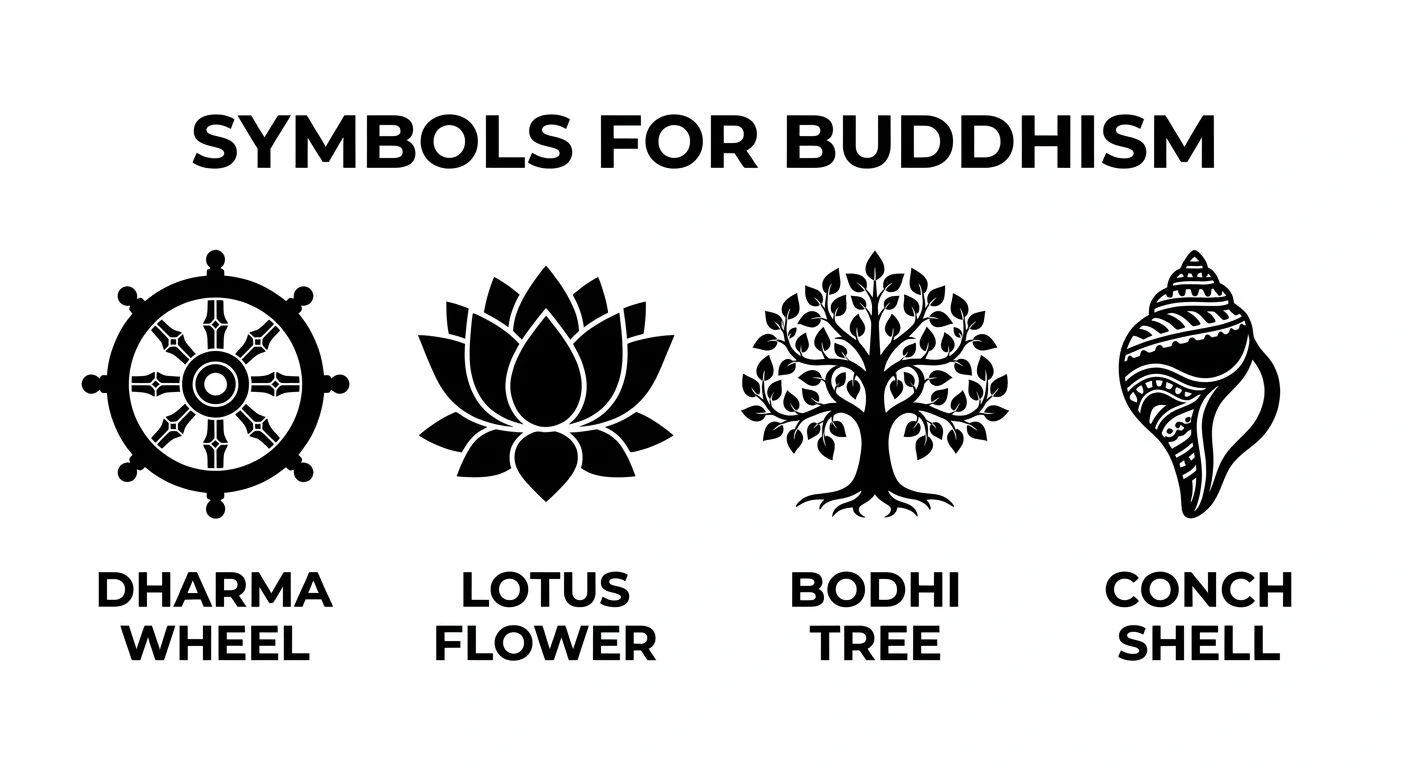
Buddhist symbols carry deep meanings connected to wisdom, peace, compassion, enlightenment, and the journey toward spiritual freedom. They appear in temples, statues, paintings, meditation spaces, religious ceremonies, and everyday objects. Some symbols remind people of the Buddha’s teachings, while others represent important ideas such as overcoming suffering, developing wisdom, and finding inner balance.
You may recognize the Dharma Wheel, lotus flower, Bodhi Tree, or Buddha statue. However, each symbol has its own meaning and history. Some are shared across many Buddhist traditions, while others are especially important in Tibetan Buddhism, Zen, or particular Asian cultures.
Understanding these symbols can help you appreciate Buddhist art, religious practices, and spiritual teachings. This guide explores 20 important Buddhist symbols, explains the Eight Auspicious Symbols, and discusses how different Buddhist traditions use them.
What Are Buddhist Symbols?
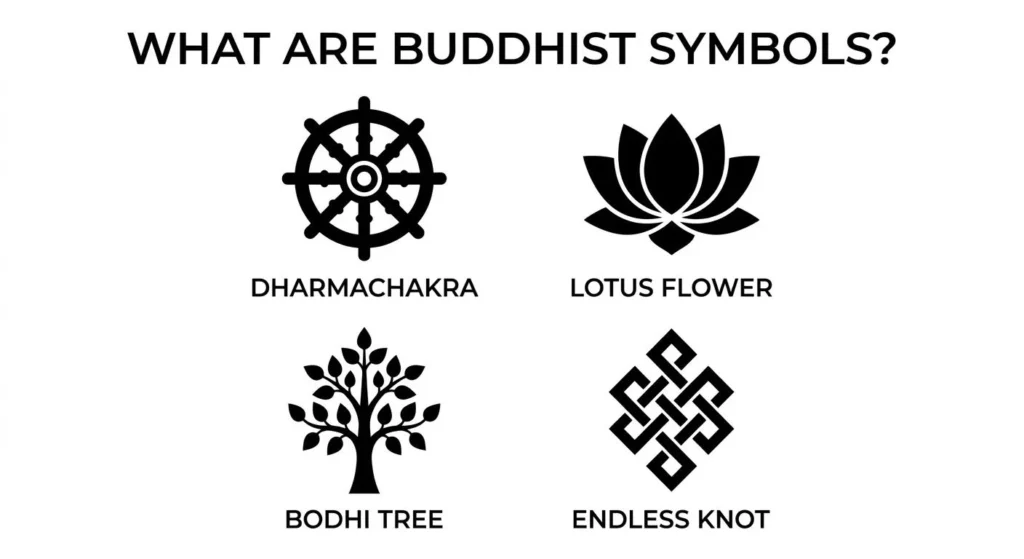
Buddhist symbols are images, objects, patterns, and traditional designs that communicate ideas from Buddhist teachings. They help people understand spiritual concepts that can sometimes feel difficult to explain through words alone.
For example, the lotus flower represents purity and spiritual growth. It grows from muddy water but produces a beautiful flower above the surface. This image reflects the Buddhist idea that people can develop wisdom and compassion even while living in a world filled with difficulties.
Similarly, the Dharma Wheel represents the Buddha’s teachings and the path toward enlightenment. The Bodhi Tree reminds Buddhists of the Buddha’s awakening, while the Endless Knot represents interconnectedness.
Buddhist symbols serve several purposes:
- Teaching: They communicate important Buddhist ideas through familiar images.
- Meditation: They provide visual points of focus during spiritual practice.
- Remembrance: They remind followers of the Buddha and his teachings.
- Devotion: They appear in temples, ceremonies, and religious offerings.
- Cultural expression: They reflect the artistic traditions of Buddhist communities around the world.
Not every symbol has the same meaning in every Buddhist country or tradition. Some meanings also developed over time as Buddhism spread across Asia.
20 Important Buddhist Symbols and Their Meanings
Buddhist art includes many symbols connected to the Buddha’s life, his teachings, and the spiritual path. Some are widely recognized, while others have a stronger connection to particular Buddhist traditions.
Here are 20 important Buddhist symbols and what they represent.
1. Dharma Wheel: The Symbol of Buddhist Teachings
The Dharma Wheel, also called the Dharmachakra, is one of the best-known symbols of Buddhism. It represents the Buddha’s teachings and the path that leads toward spiritual understanding.
The wheel commonly has eight spokes. These spokes represent the Noble Eightfold Path, which provides guidance for living with wisdom, ethical conduct, and mental discipline.
The eight parts are:
- Right View
- Right Intention
- Right Speech
- Right Action
- Right Livelihood
- Right Effort
- Right Mindfulness
- Right Concentration
The wheel’s circular shape can also suggest the continuous nature of Buddhist teaching and practice. Its movement represents the spreading of the Dharma, or the Buddha’s teachings, throughout the world.
You can find Dharma Wheels on Buddhist temples, religious flags, statues, paintings, and educational materials. For many Buddhists, this symbol is a reminder to follow the path with awareness and compassion.
2. Lotus Flower: Purity and Spiritual Growth
The lotus flower is one of the most meaningful images in Buddhist art. It represents purity, spiritual development, and the possibility of enlightenment.
A lotus grows in muddy water, yet its flower rises above the surface. This natural process offers a lesson about human life. People experience pain, confusion, and difficult situations, but they can still develop wisdom and kindness.
Different lotus colors may carry different associations in Buddhist art. However, their meanings can vary across traditions and artistic settings.
Common associations include:
- White lotus: Purity, spiritual clarity, and peace.
- Pink lotus: Often associated with the Buddha and the highest spiritual significance.
- Blue lotus: Wisdom and the development of knowledge.
- Red lotus: Compassion, love, and the qualities of the heart.
- Purple lotus: Spiritual mystery and, in some traditions, sacred teachings.
The lotus often appears beneath Buddha statues and in Buddhist paintings. It reminds people that spiritual growth does not require a perfect beginning. Instead, it comes through practice, patience, and understanding.
3. Bodhi Tree: The Symbol of Enlightenment
The Bodhi Tree holds a special place in Buddhist history. According to Buddhist tradition, Siddhartha Gautama attained enlightenment while meditating beneath a tree at Bodh Gaya in India.
After this awakening, he became known as the Buddha, meaning the Awakened One.
The tree is therefore associated with enlightenment, wisdom, meditation, and spiritual awakening. Its leaves are also recognizable features in Buddhist artwork.
The Bodhi Tree reminds followers that the search for truth requires patience and careful attention. It also represents the possibility of awakening through understanding rather than through material possessions or social status.
A descendant of the original Bodhi Tree is traditionally associated with the Mahabodhi Temple in Bodh Gaya. The site remains an important pilgrimage destination for Buddhists.
4. Endless Knot: Interconnection and Harmony
The Endless Knot is a decorative design made from interwoven lines without an obvious beginning or ending. It is one of the Eight Auspicious Symbols in Tibetan Buddhist traditions.
Its continuous pattern represents interconnectedness, the relationship between causes and effects, and the way different parts of life influence one another.
The symbol can also remind people of the connection between wisdom and compassion. Buddhist practice encourages both qualities because understanding without kindness can become cold, while kindness without understanding can lack direction.
The Endless Knot appears in temple decorations, traditional artwork, jewelry, textiles, and religious objects.
Its message is simple: Everything is connected, and our actions can affect others in ways we may not immediately see.
5. Buddha Statue: Wisdom, Peace, and Enlightenment
Buddha statues represent the Buddha and remind followers of his teachings. They are common in temples, meditation halls, homes, gardens, and religious spaces.
A Buddha statue is not simply a decorative figure. For many Buddhists, it serves as a reminder of the qualities they hope to develop, including wisdom, compassion, patience, and mindfulness.
Different statues show the Buddha in different postures. These postures often communicate particular teachings or moments from Buddhist tradition.
For example:
- Meditation posture: Represents concentration, calmness, and inner awareness.
- Teaching posture: Represents sharing the Dharma and explaining Buddhist teachings.
- Earth-touching posture: Represents the Buddha’s resolve and his awakening.
- Standing posture: Can represent protection, teaching, or compassionate presence.
- Reclining posture: Commonly represents the Buddha’s final passing into Parinirvana.
The meaning of a statue depends on its posture, hand gestures, artistic tradition, and surrounding details.
6. Two Golden Fish: Freedom and Good Fortune
The Two Golden Fish are among the Eight Auspicious Symbols, particularly familiar in Tibetan Buddhist art.
They represent freedom, happiness, and the ability to move through the difficulties of existence without being controlled by fear.
Fish move easily through water. This movement provides a visual image of freedom and confidence. In Buddhist interpretations, the pair can also suggest liberation from the ocean of suffering.
The Two Golden Fish often appear in decorative paintings, temple artwork, religious textiles, and traditional designs.
Their meaning encourages people to develop inner freedom and move through life’s challenges with awareness.
7. Buddhist Conch Shell: The Sound of the Dharma
The Conch Shell, traditionally shown as a white shell with a spiral, represents the spreading of the Buddha’s teachings.
Its sound can travel across a wide area. In Buddhist symbolism, this represents the way the Dharma reaches people and encourages them to awaken from ignorance.
The conch is one of the Eight Auspicious Symbols in Tibetan Buddhism. It is also used as a ritual instrument in some Buddhist ceremonies.
Its message connects sound with spiritual awareness. Just as a conch call can attract attention, Buddhist teachings invite people to examine their thoughts, actions, and understanding.
8. Precious Parasol: Protection from Suffering
The Precious Parasol is a traditional Buddhist symbol of protection. It represents spiritual shelter from suffering, harmful influences, and obstacles.
In older cultures, parasols protected people from the sun and rain. Buddhist symbolism develops this practical image into a spiritual meaning.
The parasol can represent protection offered by the Dharma and the benefits of living with wisdom and ethical discipline.
It is one of the Eight Auspicious Symbols and often appears in Tibetan Buddhist paintings and temple decorations.
The symbol reminds followers to seek protection through understanding, mindfulness, and compassionate behavior.
9. Treasure Vase: Abundance and Spiritual Wealth
The Treasure Vase is another member of the Eight Auspicious Symbols. It represents abundance, prosperity, long life, and the richness of spiritual qualities.
Its meaning goes beyond money or material possessions. In Buddhist interpretations, the vase can represent the lasting benefits of wisdom, compassion, good actions, and spiritual practice.
Traditional images often show a decorated vessel filled with precious objects or treasures.
The Treasure Vase reminds people that genuine richness includes inner qualities. A person can have many possessions yet still lack peace, generosity, or understanding.
10. Victory Banner: Triumph Over Negative Qualities
The Victory Banner represents victory over obstacles and negative mental states. It is traditionally associated with overcoming ignorance, anger, desire, and other conditions that prevent spiritual development.
In Buddhist teachings, the greatest victory is not defeating another person. It is gaining control over harmful habits and developing a clearer understanding of life.
The banner is one of the Eight Auspicious Symbols. It appears in religious paintings, temple decorations, and traditional Buddhist designs.
Its message encourages determination and reminds followers that spiritual progress comes through consistent effort.
11. Buddhist Swastika: Good Fortune and Auspiciousness
The swastika is an ancient symbol found in several Asian religious and cultural traditions, including Buddhism, Hinduism, and Jainism.
In many Buddhist settings, it represents auspiciousness, good fortune, harmony, and well-being. It may appear on Buddhist statues, temple walls, religious artwork, and traditional objects.
The symbol existed for thousands of years before the Nazi Party adopted a modified version as its political emblem in the twentieth century. The Nazi appropriation gave the symbol a deeply harmful association in much of the modern world.
It is important to understand the context when interpreting it. A Buddhist swastika in an Asian religious setting has a different historical and religious meaning from the Nazi emblem.
Its orientation and design can also vary between cultures and traditions. Avoid assuming that every version has exactly the same meaning.
12. Buddha’s Footprints: Following the Spiritual Path
Buddha’s footprints, also known as Buddhapada, represent the presence and teachings of the Buddha.
In early Buddhist art, artists sometimes used footprints to represent the Buddha instead of showing him in human form. This approach became an important part of early Buddhist visual culture.
The footprints may include special marks or symbols, depending on the artistic tradition. They can represent the Buddha’s qualities, teachings, and spiritual journey.
For followers, Buddha’s footprints offer a simple message: Walk the path of wisdom, compassion, and ethical living.
They also remind people that the Buddha’s teachings continue to guide those who practice them.
13. Vajra: Strength and Indestructible Wisdom
The Vajra is an important ritual object and symbol in Vajrayana Buddhism, particularly in Tibetan Buddhist traditions.
The word is often translated as “diamond” or “thunderbolt.” It represents indestructibility, spiritual strength, and the unshakable nature of enlightened wisdom.
A traditional Vajra has a central handle with pronged ends. It is sometimes used alongside a ritual bell during ceremonies.
The Vajra represents the quality of wisdom, while the bell is commonly associated with emptiness and insight. Together, they express the importance of combining wisdom with other essential aspects of Buddhist practice.
This symbol is especially significant in Vajrayana rituals and should not be treated as equally central in every Buddhist tradition.
14. Buddhist Mandala: The Universe and Spiritual Practice
A mandala is a carefully arranged geometric design used in several Buddhist traditions, especially Tibetan Buddhism.
It often represents a sacred space, a spiritual world, or a structured image of the universe. Mandalas can include circles, squares, gates, symbolic figures, and detailed patterns.
Creating or contemplating a mandala can form part of a meditation or ritual practice. In some Tibetan Buddhist traditions, monks create elaborate sand mandalas and later dismantle them.
This process can teach impermanence, the Buddhist understanding that things change and do not remain fixed forever.
Mandalas are also used in art and contemporary spiritual settings. However, their traditional religious meanings are more specific than simply being decorative patterns.
15. Buddhist Bell: Mindfulness and Wisdom
The Buddhist bell is used in several Buddhist ceremonies and meditation practices. Its clear sound can mark the beginning or end of a ritual, meditation session, or period of chanting.
In Tibetan Buddhist practice, the bell is often paired with the Vajra. Together, these objects represent complementary aspects of spiritual understanding.
The sound of a bell can also encourage mindfulness. It invites listeners to pause, pay attention, and return to the present moment.
Different Buddhist traditions use different types of bells. Their shapes, sounds, and ceremonial roles may vary.
16. Buddhist Stupa: The Buddha’s Presence and Enlightenment
A stupa is a sacred Buddhist structure that often contains relics or objects connected with the Buddha or respected Buddhist teachers.
Stupas developed as important places of devotion and pilgrimage. Their architectural forms vary across countries and Buddhist traditions.
A stupa can represent the Buddha’s enlightenment, his teachings, and the path toward liberation. Some Buddhist communities also understand its structure through symbolic associations with elements of the universe or stages of spiritual development.
Followers may walk around a stupa in a clockwise direction as a devotional practice. This activity is often called circumambulation.
Stupas are found in many Buddhist regions, including India, Nepal, Sri Lanka, Tibet, Thailand, Myanmar, China, and Japan.
17. Three Jewels: Buddha, Dharma, and Sangha
The Three Jewels, also known as the Triple Gem or Triratna, are central to Buddhist identity and practice.
They consist of:
- Buddha: The awakened teacher who discovered and taught the path to liberation.
- Dharma: The Buddha’s teachings and the truth they explain.
- Sangha: The Buddhist community, especially the community of ordained practitioners in traditional interpretations.
Taking refuge in the Three Jewels is an important expression of commitment to Buddhism.
Some Buddhist artwork represents the Three Jewels through a special emblem or combination of shapes. However, there is no single visual design used everywhere.
The Three Jewels remind followers that spiritual development involves a teacher, a path of practice, and a supportive community.
18. Enso Circle: Wholeness and Awareness
The Enso is a circle drawn with a single brushstroke. It is especially associated with Zen Buddhist art in Japan.
The circle can represent emptiness, wholeness, freedom, and the nature of the present moment. Its simple appearance encourages reflection rather than complicated explanation.
Some Enso circles are closed, while others remain open. An open circle may suggest movement, possibility, or the acceptance of imperfection. These interpretations depend on the artist and context.
The Enso is widely used in Zen-inspired artwork, calligraphy, and contemporary design.
It is important to remember that the Enso is particularly associated with Zen traditions. It is not a universal symbol used in every form of Buddhism.
19. Buddhist Prayer Wheel: Repetition and Compassion
A prayer wheel is a traditional religious object used in Tibetan Buddhist practice. It usually contains written mantras or sacred texts inside a rotating cylinder.
Practitioners turn the wheel as part of devotional practice. This action is connected with reciting or remembering the prayers and mantras contained within it.
Prayer wheels come in different forms. Some are small enough to hold in the hand, while others are installed in rows at monasteries and pilgrimage sites.
The practice is closely associated with the mantra of Avalokiteshvara, a bodhisattva connected with compassion, although prayer wheels can contain other sacred texts.
Prayer wheels remind practitioners to cultivate compassion, mindfulness, and devotion through repeated practice.
20. Buddhist Mala Beads: Focus and Meditation
Mala beads are used in Buddhist meditation and chanting. A traditional mala commonly has 108 beads, although other arrangements also exist.
Practitioners move through the beads while repeating a mantra, prayer, or meditation phrase. This gives the mind a simple point of focus and helps maintain attention during practice.
Mala beads can be made from different materials, including wood, seeds, gemstones, or other natural substances. The material may have particular meaning in some traditions, but its importance varies.
Mala beads are not one of the Eight Auspicious Symbols. They are better understood as a devotional and meditation tool.
Their main purpose is to support concentration, repetition, and spiritual discipline.
What Are the Eight Auspicious Symbols of Buddhism?
The Eight Auspicious Symbols, known as Ashtamangala, are a group of sacred emblems especially prominent in Tibetan and Himalayan Buddhist traditions.
They communicate teachings connected with enlightenment, good fortune, wisdom, protection, and spiritual progress.
These eight symbols often appear together in religious artwork, temple decorations, ritual objects, and traditional offerings.
The eight symbols are:
- Dharma Wheel
- Conch Shell
- Precious Parasol
- Victory Banner
- Lotus Flower
- Treasure Vase
- Two Golden Fish
- Endless Knot
Each symbol carries a distinct meaning, but together they express the benefits and qualities associated with following the Dharma.
Why Are There Eight Auspicious Symbols?
The number eight has an important place in Buddhist teachings. One well-known connection is the Noble Eightfold Path, which provides a practical guide for developing wisdom, ethical behavior, and mental discipline.
However, the Eight Auspicious Symbols and the Noble Eightfold Path are two different groups. They should not be treated as identical lists.
The auspicious symbols developed through Buddhist religious and artistic traditions. Their meanings can vary depending on the region and the community using them.
Eight Auspicious Symbols and Their Meanings
| Buddhist symbol | Main meaning |
| Dharma Wheel | Buddhist teachings and the path to enlightenment |
| Conch Shell | The spreading of the Dharma |
| Precious Parasol | Protection from suffering and obstacles |
| Victory Banner | Victory over negative qualities |
| Lotus Flower | Purity and spiritual growth |
| Treasure Vase | Abundance and spiritual wealth |
| Two Golden Fish | Freedom and happiness |
| Endless Knot | Interconnection and harmony |
Where Are the Eight Auspicious Symbols Displayed?
The Eight Auspicious Symbols often appear together in Tibetan Buddhist temples, monasteries, paintings, textiles, and ceremonial objects.
You may also find them on:
- Buddhist prayer flags
- Religious wall hangings
- Temple entrances
- Offering bowls
- Traditional clothing and fabrics
- Buddhist manuscripts and paintings
- Decorative objects used during ceremonies
Their arrangement and artistic style can differ. Some designs show all eight symbols separately, while others combine them into a single decorative composition.
Buddhist Symbols in Different Traditions
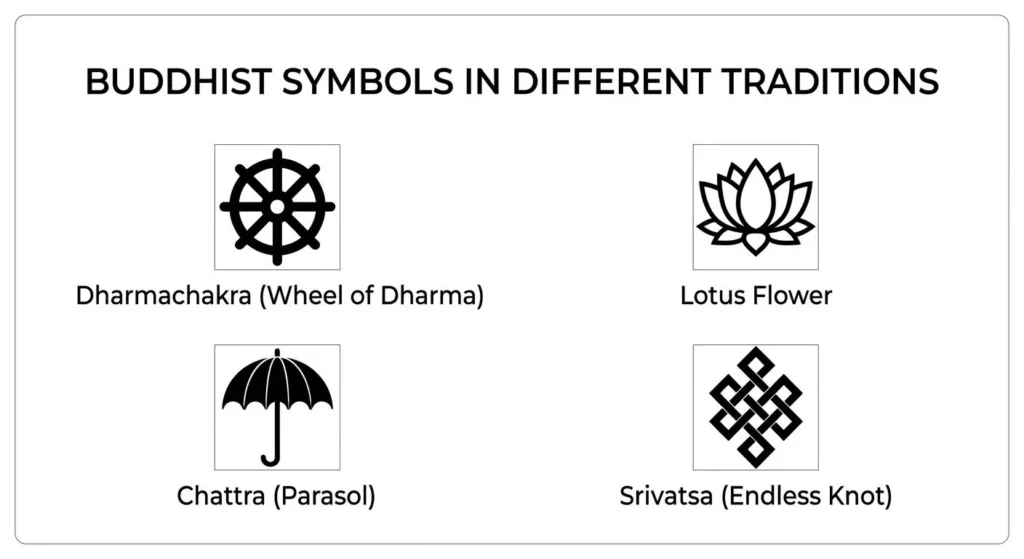
Buddhism developed across many regions over centuries. As it spread, local communities developed their own artistic styles, rituals, and ways of representing Buddhist teachings.
The same symbol may appear in different forms or carry slightly different associations across traditions.
Theravada Buddhist Symbols
Theravada Buddhism is practiced widely in countries such as Sri Lanka, Thailand, Myanmar, Cambodia, and Laos.
Important symbols include the Dharma Wheel, Bodhi Tree, Buddha statue, lotus flower, and stupa.
The Bodhi Tree is especially meaningful because it recalls the Buddha’s enlightenment. Stupas also play an important role in religious devotion and pilgrimage.
Mahayana Buddhist Symbols
Mahayana Buddhism includes many traditions practiced in countries such as China, Japan, Korea, and Vietnam.
Common symbols include the lotus flower, Dharma Wheel, Buddha and bodhisattva images, and mandalas in some traditions.
The lotus often appears in artwork connected with compassion and the possibility of awakening. Images of bodhisattvas, such as Avalokiteshvara, also communicate ideals of compassion and helping others.
Mahayana traditions are diverse, so their symbols and artistic practices are not identical.
Vajrayana Buddhist Symbols
Vajrayana Buddhism is especially associated with Tibet, Bhutan, Mongolia, and parts of the Himalayan region.
Its religious art includes many elaborate symbols and ritual objects, such as:
- Vajra
- Bell
- Mandala
- Prayer wheel
- Eight Auspicious Symbols
- Ritual implements and sacred images
These symbols often support specific meditation practices, ceremonies, and teachings. Their meanings can be highly detailed, so they should be understood within their traditional religious context.
Zen Buddhist Symbols
Zen Buddhism is especially associated with Japan, although Zen traditions also developed in other countries.
The Enso circle is one of its most recognizable artistic symbols. It represents ideas connected with awareness, emptiness, and wholeness.
Zen art also includes calligraphy, simple images, and carefully arranged spaces. These artistic forms often encourage direct attention and reflection.
Buddhist Flag: Colors and Their Meanings
The Buddhist flag is a recognizable symbol of Buddhist identity and unity. It was developed in the nineteenth century and is used by Buddhist communities in different parts of the world.
The flag contains five main colors: blue, yellow, red, white, and orange. A sixth stripe combines these colors.
The colors are commonly connected with qualities associated with the Buddha and his teachings. Interpretations can vary, but common explanations include:
| Color | Common association |
| Blue | Compassion and peace |
| Yellow | The Middle Way |
| Red | Blessings and spiritual achievement |
| White | Purity and freedom |
| Orange | Wisdom and strength |
| Combined colors | The unity of Buddhist teachings |
The flag is displayed at Buddhist temples, religious gatherings, Vesak celebrations, and community events.
It represents a shared Buddhist identity across different countries and traditions. However, it does not mean that all Buddhist communities follow the same customs or beliefs in every detail.
Buddhist Symbols Used in Meditation
Many Buddhist symbols help practitioners focus their attention during meditation. Some are used as visual objects, while others are connected with chanting, breathing, or devotional practices.
The symbol itself is not necessarily the goal of meditation. Instead, it can provide a reminder of a teaching or quality that the practitioner wants to develop.
Lotus Flower for Spiritual Growth
The lotus can remind meditators that personal growth is possible even during difficult times.
Its image encourages patience and helps people reflect on how wisdom and compassion can develop through everyday challenges.
Buddha Image for Mindfulness
A Buddha statue or image can provide a visual focus during meditation.
Practitioners may reflect on the Buddha’s qualities, such as calmness, compassion, and awareness. The image can also remind them to approach their practice with patience.
Mandala for Concentration
Mandalas can serve as visual supports in certain Buddhist meditation practices.
Their balanced patterns and detailed arrangements can help focus attention. In some traditions, however, mandala meditation involves specific teachings and guidance rather than simply looking at a design.
Mala Beads for Repetition
Mala beads help practitioners count mantras or prayers.
Moving from one bead to another creates a steady rhythm that can support concentration and reduce distractions.
Prayer Wheel for Devotional Practice
Prayer wheels are used in Tibetan Buddhist practice as a way to engage with sacred mantras and texts.
Turning a prayer wheel can form part of a wider devotional routine that includes chanting, reflection, and the development of compassion.
Buddhist Symbols and Their Meanings for Tattoos
Buddhist symbols sometimes appear in tattoos because people connect with their messages of peace, wisdom, compassion, and personal growth.
However, a symbol can have a sacred meaning that goes beyond its appearance. Before choosing a Buddhist tattoo, learn about its cultural and religious context.
Here are some commonly considered designs.
Lotus Flower Tattoo
A lotus tattoo often represents purity, personal growth, and the ability to rise above difficult experiences.
People may choose it to mark a period of change or a commitment to becoming more patient and understanding.
Dharma Wheel Tattoo
The Dharma Wheel can represent a commitment to Buddhist teachings and the Noble Eightfold Path.
Its eight spokes make it a meaningful choice for someone who values ethical living, mindfulness, and spiritual development.
Endless Knot Tattoo
The Endless Knot can represent interconnectedness, relationships, and the connection between wisdom and compassion.
Some people also choose it as a reminder that their actions influence the world around them.
Bodhi Tree Tattoo
A Bodhi Tree tattoo can represent enlightenment, wisdom, meditation, and the search for truth.
Its meaning is especially connected with the Buddha’s awakening beneath the Bodhi Tree.
Enso Circle Tattoo
An Enso tattoo can represent wholeness, awareness, freedom, and acceptance of imperfection.
It is especially associated with Zen Buddhist art and should be understood in that context.
Is It Respectful to Get a Buddha Tattoo?
Views on Buddha tattoos differ across Buddhist communities and cultures.
Some people see them as expressions of respect or spiritual interest. Others consider placing a Buddha image on the body inappropriate, especially in locations regarded as disrespectful.
In some Buddhist-majority countries, Buddha tattoos have caused cultural and religious controversy.
If you are considering one, research local customs and think carefully about placement. A design that looks attractive to you may carry a sacred meaning for someone else.
Where Are Buddhist Symbols Used?
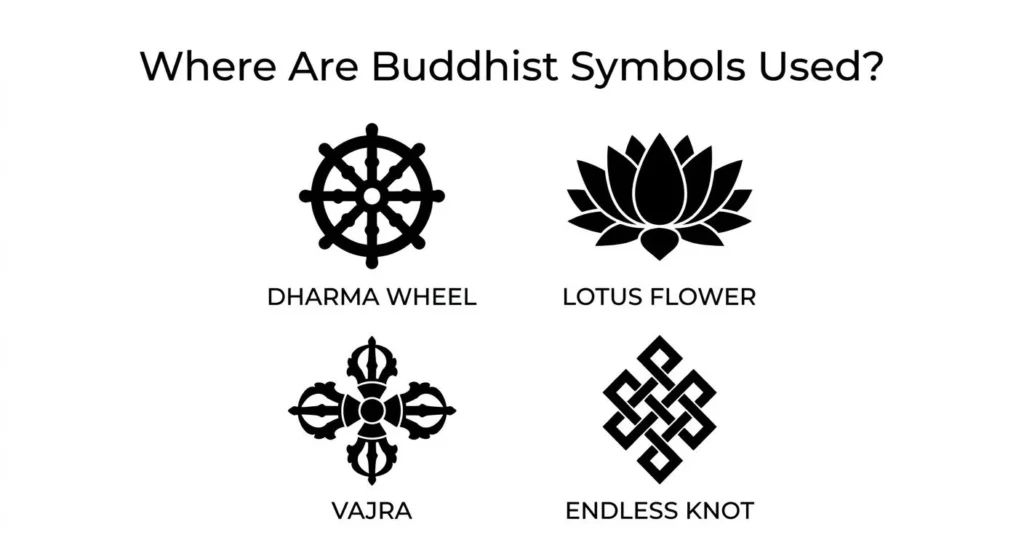
Buddhist symbols appear in many places because they help communicate religious teachings and preserve cultural traditions.
Their use depends on the symbol, Buddhist community, and purpose.
Buddhist Temples and Monasteries
Temples and monasteries often feature the Dharma Wheel, lotus flower, Buddha images, stupas, and other traditional designs.
These symbols help create a religious environment and remind visitors of Buddhist teachings.
Religious Paintings and Sculptures
Buddhist artists use symbols to communicate stories, spiritual qualities, and important events from Buddhist history.
A lotus beneath a Buddha statue, for example, can emphasize purity and spiritual awakening.
Prayer Flags and Religious Textiles
Prayer flags are especially associated with Tibetan Buddhist traditions. They often include prayers, mantras, and sacred images.
The Buddhist flag, meanwhile, is used to express Buddhist identity and unity.
Meditation Spaces
People may place Buddha statues, meditation images, or other meaningful objects in meditation spaces.
These objects can create a calm environment and serve as reminders to practice mindfulness.
Jewelry and Decorative Objects
Some Buddhist symbols appear on pendants, bracelets, necklaces, and home decorations.
Their meanings should not be reduced to fashion alone. People who use sacred designs should consider their cultural and religious significance.
Why Are Buddhist Symbols Important?
Buddhist symbols help make complex teachings easier to understand and remember. They connect visual images with ideas that guide Buddhist practice.
Their importance extends beyond decoration.
They Make Buddhist Teachings Easier to Understand
Ideas such as enlightenment, impermanence, compassion, and interconnectedness can be difficult to explain in simple words.
Symbols offer visual ways to explore these ideas. The lotus, for example, provides a familiar image of growth through difficult conditions.
They Encourage Mindfulness
A symbol can remind someone to pause and become aware of their thoughts and actions.
Seeing a Dharma Wheel or Buddha image may encourage a person to reflect on their behavior and choices.
They Preserve Religious and Cultural Traditions
Buddhist symbols have appeared in artwork, architecture, manuscripts, and religious objects for centuries.
They help preserve artistic traditions and connect modern Buddhist communities with earlier generations.
They Support Devotional Practices
Some symbols and objects have practical roles in Buddhist ceremonies and meditation.
Prayer wheels, bells, malas, and mandalas can form part of religious practices in particular traditions.
They Communicate Shared Values
Although Buddhist communities differ in their customs, many symbols express widely recognized values such as compassion, wisdom, peace, and spiritual development.
These ideas help explain why Buddhist symbols continue to appear in religious art and cultural life around the world.
Frequently Asked Questions About Buddhist Symbols
What Is the Most Important Symbol in Buddhism?
The Dharma Wheel is one of the most widely recognized and important Buddhist symbols. It represents the Buddha’s teachings and the Noble Eightfold Path. The lotus flower and Bodhi Tree are also highly significant.
What Are the Eight Auspicious Symbols of Buddhism?
The Eight Auspicious Symbols are the Dharma Wheel, Conch Shell, Precious Parasol, Victory Banner, Lotus Flower, Treasure Vase, Two Golden Fish, and Endless Knot. They are especially prominent in Tibetan and Himalayan Buddhist traditions.
What Does the Lotus Flower Mean in Buddhism?
The lotus flower represents purity, spiritual growth, and the possibility of enlightenment. Its growth from muddy water into a beautiful flower reflects the idea that wisdom and compassion can develop despite life’s difficulties.
What Does the Dharma Wheel Represent?
The Dharma Wheel represents the Buddha’s teachings, known as the Dharma. Its eight spokes commonly represent the Noble Eightfold Path, which guides people toward wisdom, ethical behavior, and mental discipline.
What Does the Bodhi Tree Symbolize?
The Bodhi Tree represents the Buddha’s enlightenment. According to Buddhist tradition, Siddhartha Gautama attained awakening while meditating beneath a tree at Bodh Gaya.
What Does the Endless Knot Mean in Buddhism?
The Endless Knot represents interconnectedness, cause and effect, and the relationship between wisdom and compassion. It is one of the Eight Auspicious Symbols in Tibetan Buddhist traditions.
What Is the Buddhist Symbol for Peace?
There is no single symbol that represents peace in every Buddhist tradition. The Buddha image, lotus flower, Dharma Wheel, and other Buddhist symbols can communicate calmness, wisdom, and harmony.
What Do the Colors of the Buddhist Flag Mean?
The Buddhist flag has five main colors: blue, yellow, red, white, and orange. They are commonly associated with qualities such as compassion, the Middle Way, spiritual achievement, purity, and wisdom. A sixth stripe combines the five colors.
Are Buddhist Symbols the Same in Every Buddhist Tradition?
No. Buddhist symbols differ across Theravada, Mahayana, Vajrayana, and Zen traditions. Some symbols are widely recognized, while others have particular importance in certain regions or religious practices.
Is It Disrespectful to Wear Buddhist Symbols?
It depends on the symbol and how it is used. Many Buddhist designs appear in jewelry and clothing, but sacred images such as Buddha figures deserve special respect. Learn about the symbol’s meaning and cultural context before wearing it.
Conclusion
Buddhist symbols communicate important ideas about wisdom, compassion, enlightenment, and the path toward freedom from suffering. The Dharma Wheel represents the Buddha’s teachings, while the lotus flower reminds people of purity and spiritual growth. The Bodhi Tree recalls the Buddha’s awakening, and the Endless Knot reflects the connection between all things.
Other symbols, including the Vajra, mandala, prayer wheel, and Eight Auspicious Symbols, have important roles in particular Buddhist traditions. Their meanings may differ across cultures, but they share a connection with Buddhist teachings and spiritual practice.
Understanding these symbols helps you appreciate Buddhist history, art, and religious traditions. More importantly, their meanings offer reminders to live with greater awareness, kindness, patience, and wisdom.

Adam Sullivan is a dedicated writer who enjoys transforming everyday topics into engaging and informative content. His writing focuses on making complex ideas simple, practical and enjoyable for readers of all backgrounds. Adam is also the fictional author of The Lantern Beyond Autumn Hills and Where the Morning Horizon Waits. Outside of writing, he enjoys photography, traveling and discovering inspiration through new experiences. He believes great content should be both helpful and easy to connect with.
 Dylan Anderson