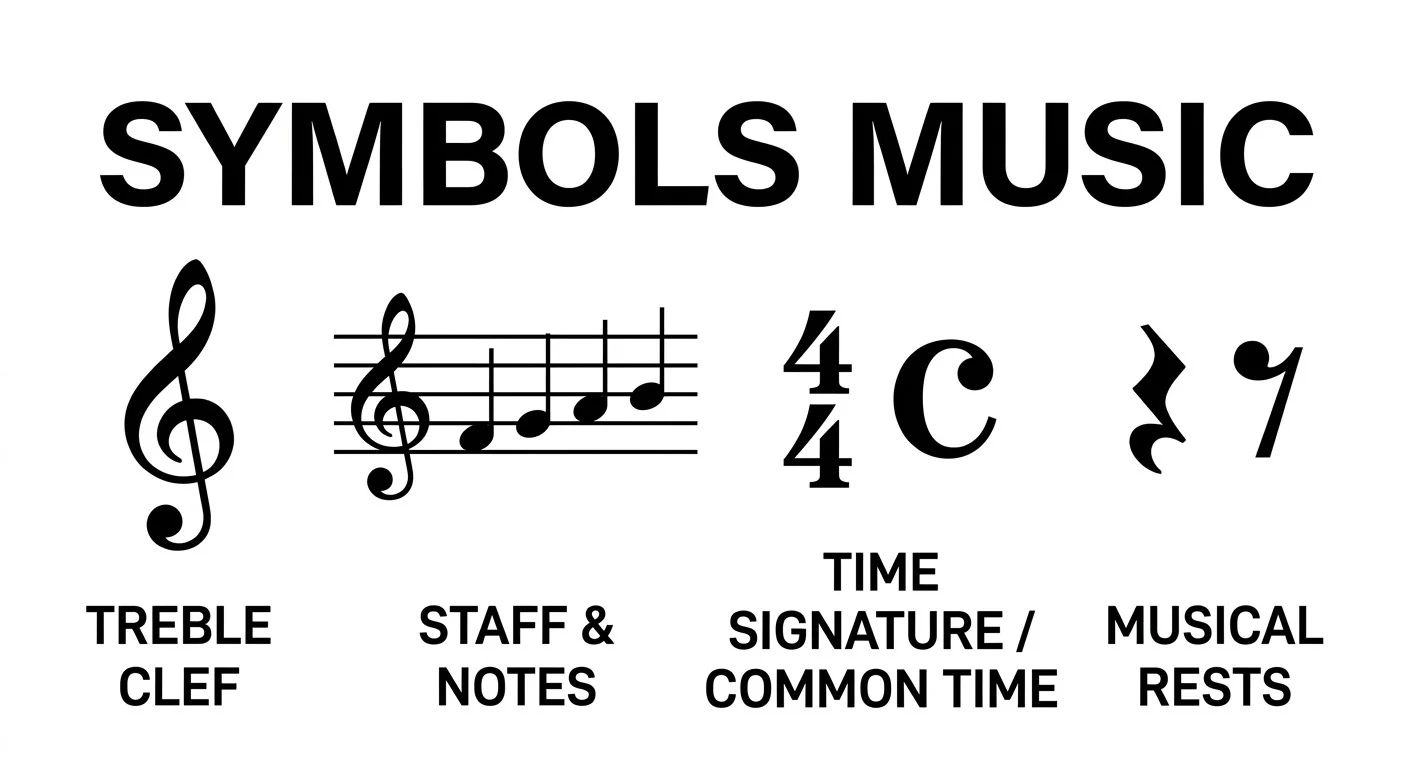
Music symbols are the signs musicians use to read, write, and perform music. They show which notes to play, how long to hold them, when to pause, and how to shape a melody. You can find these symbols in piano books, guitar tabs, orchestral scores, music lessons, and digital notation software.
Some symbols are easy to recognize, such as the treble clef, quarter note, and sharp sign. Others explain more specific instructions, including tempo changes, repeated sections, pedal use, and musical expression.
This guide covers common music symbols with their names and meanings. It also includes note and rest charts, piano and guitar notation, music emojis, and copy-and-paste characters. Whether you are learning to read sheet music or simply need a musical symbol for a caption, you will find the information in one place.
What Are Music Symbols?
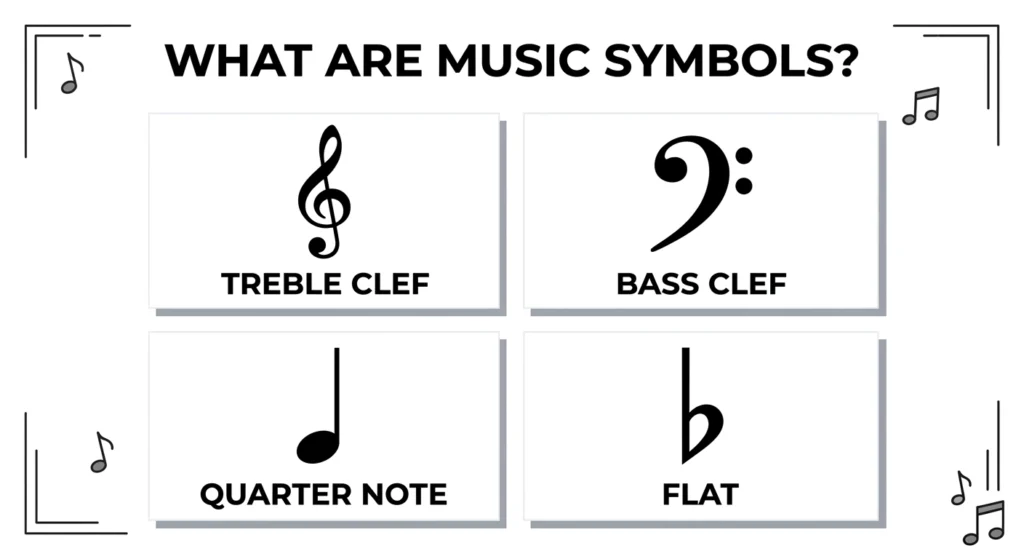
Music symbols are written signs that communicate musical information. They help performers understand a composition without relying only on a recording or verbal instructions.
A music score uses several types of symbols. Each group has a different job:
- Pitch symbols: Identify which notes to play or sing.
- Rhythm symbols: Show how long notes and silences last.
- Clefs: Establish the pitch reference for a staff.
- Accidentals: Raise or lower written pitches.
- Time signatures: Explain how beats are grouped.
- Dynamics: Show how loudly or softly to perform.
- Articulation marks: Explain how notes should sound.
- Navigation signs: Tell performers when to repeat or move to another section.
These markings work together. For example, a note’s position on the staff identifies its pitch, while its shape shows its duration. A dynamic marking may tell you to play that note softly.
Music Symbols at a Glance
Here are some of the most recognizable symbols used in Western music notation.
| Symbol | Name | Meaning |
| 𝄞 | Treble clef | Establishes the G reference line |
| 𝄢 | Bass clef | Establishes the F reference line |
| 𝄡 | C clef | Identifies the middle C line |
| 𝅝 | Whole note | Four quarter-note beats in common 4/4 time |
| 𝅗𝅥 | Half note | Two quarter-note beats |
| 𝅘𝅥 | Quarter note | One quarter-note beat |
| 𝅘𝅥𝅮 | Eighth note | Half a quarter-note beat |
| 𝅘𝅥𝅯 | Sixteenth note | One-quarter of a quarter-note beat |
| 𝄻 | Whole rest | Four beats of silence in 4/4 time |
| 𝄼 | Half rest | Two beats of silence in 4/4 time |
| 𝄽 | Quarter rest | One beat of silence |
| ♯ | Sharp | Raises a pitch by one semitone |
| ♭ | Flat | Lowers a pitch by one semitone |
| ♮ | Natural | Cancels an applicable sharp or flat |
| 𝄐 | Fermata | Holds a note or rest longer |
| 𝄆 𝄇 | Repeat signs | Mark a passage to repeat |
| 𝆒 | Crescendo symbol | Indicates a gradual increase in volume |
| 𝆓 | Decrescendo symbol | Indicates a gradual decrease in volume |
The note and rest durations in this table assume common 4/4 time. Their actual rhythmic value depends on the time signature and musical context.
Types of Music Symbols
Music symbols become easier to understand when you group them by function.
Note and rest symbols control sound and silence. Clefs and staff markings help identify pitch. Accidentals and key signatures control the notes used in a composition.
Other markings guide performance. Dynamics control volume, articulation shapes individual notes, and tempo markings set the speed. Repeat and navigation signs help musicians follow the correct order of a piece.
Music Symbols With Names and Pictures
A visual music-symbol chart helps beginners recognize markings faster. The following tables provide a text reference. For a proper visual learning resource, place each symbol on a five-line musical staff in your published page.
Music Note Symbols
| Symbol | Name | Basic Duration in 4/4 |
| 𝅜 | Breve | Eight quarter-note beats |
| 𝅝 | Whole note | Four quarter-note beats |
| 𝅗𝅥 | Half note | Two quarter-note beats |
| 𝅘𝅥 | Quarter note | One quarter-note beat |
| 𝅘𝅥𝅮 | Eighth note | Half a quarter-note beat |
| 𝅘𝅥𝅯 | Sixteenth note | One-quarter of a quarter-note beat |
| 𝅘𝅥𝅰 | Thirty-second note | One-eighth of a quarter-note beat |
| 𝅘𝅥𝅱 | Sixty-fourth note | One-sixteenth of a quarter-note beat |
A whole note has an open oval notehead without a stem. A half note has an open notehead with a stem. A quarter note has a filled notehead and a stem.
Shorter notes use flags or beams. One flag indicates an eighth note, while two flags indicate a sixteenth note. Beams connect shorter notes when they appear together in a rhythmic group.
Music Rest Symbols
Rests represent silence. Each rest has a specific duration, just like a note.
| Symbol | Name | Basic Duration in 4/4 |
| 𝄻 | Whole rest | Four quarter-note beats |
| 𝄼 | Half rest | Two quarter-note beats |
| 𝄽 | Quarter rest | One quarter-note beat |
| 𝄾 | Eighth rest | Half a quarter-note beat |
| 𝄿 | Sixteenth rest | One-quarter of a quarter-note beat |
| 𝅀 | Thirty-second rest | One-eighth of a quarter-note beat |
| 𝅁 | Sixty-fourth rest | One-sixteenth of a quarter-note beat |
A whole rest usually hangs below a staff line. A half rest sits above a staff line. Both look like small rectangles, so their positions help you tell them apart.
The quarter rest has a distinctive zigzag shape. Shorter rests use flags or curved markings.
Music Clef Symbols
| Symbol | Clef Name | Main Use |
| 𝄞 | Treble clef | Higher-pitched musical parts |
| 𝄢 | Bass clef | Lower-pitched musical parts |
| 𝄡 | C clef | Middle C reference |
| 𝄥 | Drum clef character | Percussion-related notation |
The C clef can be placed on different staff lines. Its position determines whether it functions as an alto or tenor clef. A text character alone does not show that placement.
Music Accidental Symbols
| Symbol | Name | Meaning |
| ♯ | Sharp | Raises a pitch by one semitone |
| ♭ | Flat | Lowers a pitch by one semitone |
| ♮ | Natural | Cancels an applicable accidental |
| 𝄪 | Double sharp | Raises a pitch by two semitones |
| 𝄫 | Double flat | Lowers a pitch by two semitones |
These symbols appear in key signatures or directly before individual notes. Their exact effect depends on the written music and the applicable notation rules.
Music Note Symbols and Their Meanings
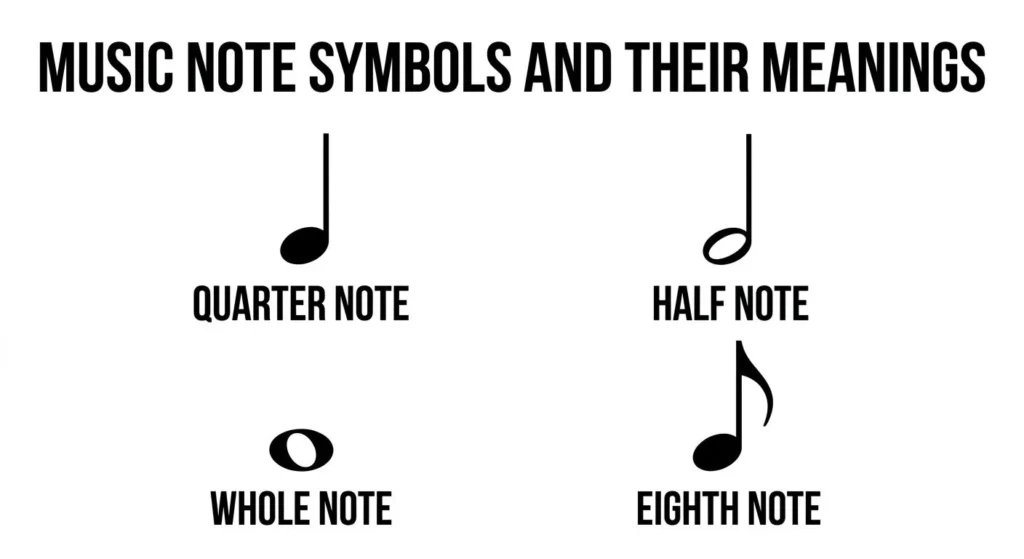
Notes tell musicians which pitches to play and how long to hold them. Their shape provides rhythmic information, while their position on the staff identifies pitch.
Whole, Half, Quarter, and Eighth Notes
The whole note is an open oval without a stem. In 4/4 time, it lasts for four quarter-note beats.
The half note has an open oval with a stem. It lasts for two quarter-note beats.
The quarter note has a filled notehead and a stem. It lasts for one quarter-note beat.
The eighth note has a filled notehead, a stem, and one flag. It lasts for half a quarter-note beat.
A simple 4/4 measure could contain four quarter notes, two half notes, or one whole note. Each combination fills the same four-beat measure.
Sixteenth and Shorter Notes
Sixteenth notes are shorter than eighth notes. They have filled noteheads, stems, and two flags when written separately.
Thirty-second notes have three flags. Sixty-fourth notes have four.
When several short notes appear together, beams often connect their stems. This makes rhythmic groups easier to read.
Short notes do not automatically mean fast music. The overall tempo and the surrounding rhythm determine how quickly they are performed.
Dotted Music Notes
A dot placed after a note increases its duration by half of its original value.
For example:
| Note | Original Duration | Dotted Duration |
| Half note | 2 beats | 3 beats |
| Quarter note | 1 beat | 1.5 beats |
| Eighth note | 0.5 beat | 0.75 beat |
| Sixteenth note | 0.25 beat | 0.375 beat |
A dotted quarter note lasts one and a half quarter-note beats. In a simple counting exercise, you can think of it as one full beat plus half of the next beat.
A second dot adds half the value of the first dot. For example, a double-dotted half note lasts three and a half quarter-note beats.
Tied and Beamed Notes
A tie is a curved line connecting two notes of the same pitch. It combines their durations into one sustained sound.
For example, a half note tied to a quarter note lasts three quarter-note beats. You play the first note and continue holding it through the second note’s value.
A beam connects the stems of shorter notes. It groups notes visually but does not change their total duration.
A slur also uses a curved line, but it connects notes that should be performed smoothly. A tie joins the same pitch; a slur usually connects different pitches.
Music Rest Symbols and Their Meanings
Music rests tell performers when to remain silent. They help create rhythm, separate musical phrases, and give a composition space to breathe.
Whole and Half Rests
A whole rest usually looks like a small filled rectangle hanging from the fourth staff line. It commonly represents a full measure of silence in 4/4 time.
A half rest looks similar, but it sits above the third staff line. It represents two quarter-note beats in 4/4 time.
The difference is easy to remember: the whole rest hangs down, while the half rest sits up.
However, a whole rest can also represent an entire empty measure in time signatures with a different number of beats. Its practical meaning depends on the measure and notation convention.
Quarter, Eighth, and Sixteenth Rests
A quarter rest represents one quarter-note beat. It has a distinctive angled shape.
An eighth rest represents half a beat. A sixteenth rest represents one-quarter of a quarter-note beat.
Shorter rests use additional flags. These symbols may look complex at first, but their values follow the same pattern as their matching note lengths.
Remember that rests count toward the measure. If you ignore them, your rhythm will become inaccurate.
Music Clef Symbols and Their Meanings
A clef appears at the beginning of a staff. It establishes the pitch reference for the lines and spaces.
The same staff position can represent a different note under a different clef. That is why you should always identify the clef before reading individual notes.
Treble Clef
The treble clef is also called the G clef. Its spiral circles the second line from the bottom, identifying that line as G.
The five lines of the treble staff are E, G, B, D, and F from bottom to top. The four spaces are F, A, C, and E.
Treble clef is commonly used for violin, flute, trumpet, clarinet, guitar, and the right hand of piano music.
Bass Clef
The bass clef is also called the F clef. Its two dots surround the fourth line from the bottom, identifying that line as F.
The five bass staff lines are G, B, D, F, and A from bottom to top. The spaces are A, C, E, and G.
Bass clef is common in cello, double bass, bass guitar, bassoon, trombone, and the left hand of piano music.
Alto and Tenor Clefs
The alto and tenor clefs are both forms of the C clef. The center of the clef points to the line that represents middle C.
In alto clef, middle C sits on the third staff line. This clef is most closely associated with the viola.
In tenor clef, middle C sits on the fourth staff line. It appears in some cello, bassoon, and trombone passages.
The same C-clef character can represent either clef. The position on the staff makes the difference.
Percussion Clef
Percussion clef is used for instruments that do not follow ordinary pitched notation in the same way as a violin or piano melody.
It commonly appears in drum-set and percussion parts. Staff positions identify particular instruments or sounds according to the score’s legend or notation system.
Some percussion instruments have definite pitches, while others produce sounds without a single clearly defined pitch.
Musical Staff, Lines, Spaces, and Ledger Lines
The musical staff is the foundation of standard written music. It gives notes a visual location so performers can identify their pitches.
The Five Staff Lines
A standard five-line staff contains five horizontal lines and four spaces.
Notes can sit directly on a line or inside a space. Their position moves upward or downward as the pitch changes.
The staff is read from left to right, just like ordinary written text in English-language sheet music.
The Four Staff Spaces
The spaces sit between the five lines. Each line and space represents a different note position.
In treble clef, the spaces from bottom to top spell F, A, C, and E. In bass clef, they spell A, C, E, and G.
Learning the line and space names helps beginners identify notes more quickly.
Ledger Lines and Middle C
Ledger lines are short horizontal lines added above or below the regular staff. They allow musicians to write notes that fall outside the five main lines.
Middle C is a familiar example. It sits on a ledger line below the treble staff or above the bass staff.
The note is the same pitch in both cases. Only its written position changes according to the clef.
The Grand Staff
The grand staff combines a treble staff and a bass staff. A brace usually connects them when they belong to one instrument, such as a piano.
The treble staff generally carries higher notes, while the bass staff carries lower notes. Both staves work together to show the full range of the instrument.
Middle C sits between the two staves and acts as an important reference point for piano learners.
Music Accidental Symbols: Sharp, Flat, and Natural
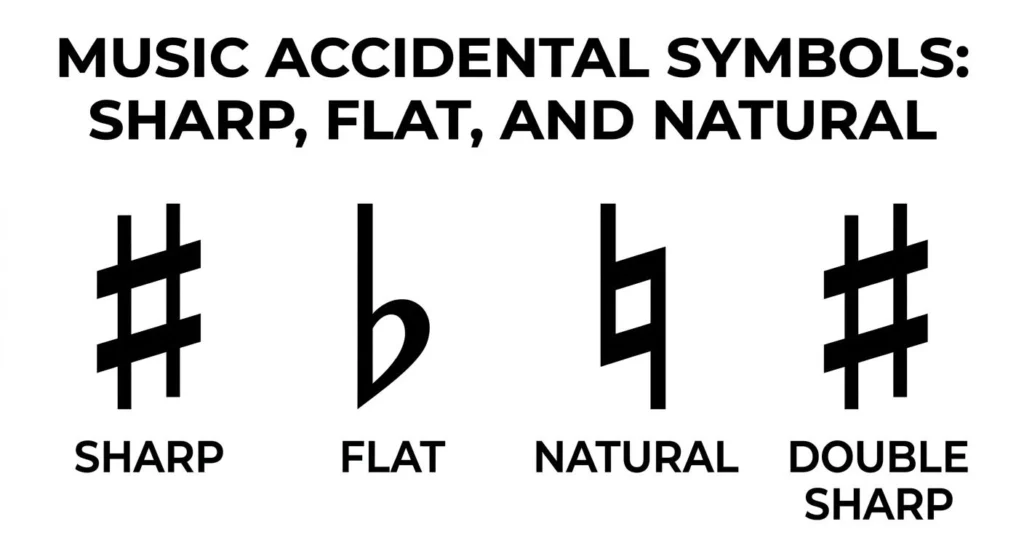
Accidentals change the pitch of a note. They can appear in a key signature or immediately before an individual note.
Sharp Symbol (♯)
A sharp raises a note by one semitone, also called a half step.
For example, F becomes F-sharp. On a piano, F-sharp is the key immediately to the right of F.
The sharp symbol is not the same character as the keyboard number sign (#). Use ♯ when you want the actual music accidental.
Flat Symbol (♭)
A flat lowers a note by one semitone.
For example, B becomes B-flat. On a piano, B-flat is the key immediately to the left of B.
The music flat sign is different from the lowercase letter b, even though the two may look similar in plain text.
Natural Symbol (♮)
A natural sign cancels an applicable sharp or flat. It tells the performer to play the natural form of the note.
For example, if the key signature makes F sharp, an F-natural sign changes that note back to F natural.
Double Sharp and Double Flat
A double sharp raises a note by two semitones. A double flat lowers it by two semitones.
These markings may seem unusual, but they help preserve the spelling and structure of notes within a key or chord.
How Long Does an Accidental Last?
In standard common-practice notation, an accidental written before a note generally applies to that same pitch and octave for the rest of the measure.
A bar line normally resets the accidental. The key signature then determines the default pitch again.
There are notation conventions and modern scores that use additional rules, so always follow the score’s instructions when they differ.
Key Signature Symbols and Their Meanings
A key signature appears after the clef and before the time signature in many standard scores. It shows which notes are regularly raised or lowered throughout the piece.
What Is a Key Signature?
A key signature is a group of sharps or flats placed at the beginning of each staff system.
It helps establish the notes used in a musical key. For example, the key of G major has one sharp: F-sharp.
The key of F major has one flat: B-flat.
Key signatures reduce the need to write the same accidental before every affected note.
How Sharps and Flats Work in a Key Signature
Sharps and flats appear in standard orders.
The sharp order is:
F, C, G, D, A, E, B
The flat order is:
B, E, A, D, G, C, F
For example, a key signature with two sharps contains F-sharp and C-sharp. A key signature with two flats contains B-flat and E-flat.
A key signature alone does not always tell you whether a piece is major or minor. G major and E minor share the same one-sharp key signature, for example. The music’s tonal center helps identify the key.
Time Signature and Rhythm Symbols
A time signature tells musicians how beats are organized into measures. It usually appears after the clef and key signature.
The top number indicates how many units are in a measure. The bottom number identifies the note value used as the unit.
Common Time Signatures
| Time Signature | Common Description | Basic Meaning |
| 2/4 | Two-four time | Two quarter-note units per measure |
| 3/4 | Three-four time | Three quarter-note units per measure |
| 4/4 | Four-four time | Four quarter-note units per measure |
| 2/2 | Cut time | Two half-note units per measure |
| 3/8 | Three-eight time | Three eighth-note units per measure |
| 6/8 | Six-eight time | Six eighth-note units per measure |
| 9/8 | Nine-eight time | Nine eighth-note units per measure |
| 12/8 | Twelve-eight time | Twelve eighth-note units per measure |
The time signature does not tell you the complete rhythm by itself. The notes and rests show how the beats are filled.
Simple and Compound Time
In simple time, each main beat divides naturally into two equal parts.
Common examples include 2/4, 3/4, and 4/4. A quarter-note beat can divide into two eighth notes.
In compound time, each main beat usually divides into three equal parts.
A common example is 6/8. It often feels like two main beats, with each beat divided into three eighth notes.
You can count many 6/8 passages as:
1-and-a, 2-and-a
This is different from counting six separate quarter-note beats. The musical grouping creates the characteristic compound rhythm.
Common Time and Cut Time
Common time is represented by a large C-like symbol: 𝄴. It stands for 4/4 time.
Cut time is represented by a C-like symbol with a vertical line: 𝄵. It stands for 2/2 time.
These symbols are traditional shorthand. They do not mean that the music has no time signature.
Bar Lines and Measures
Bar lines divide a staff into measures, also called bars.
A single bar line separates one measure from the next. A double bar line marks a section boundary or important change. A final bar line shows the end of a piece.
Repeat bar lines indicate that a passage should be performed again.
Music Dynamics Symbols and Their Meanings
Dynamics tell musicians how loudly or softly to play. They help create contrast, build emotion, and shape the movement of a musical passage.
Most traditional dynamic markings use Italian words or abbreviations.
Piano and Forte
| Marking | Name | Meaning |
| ppp | Pianississimo | Extremely soft |
| pp | Pianissimo | Very soft |
| p | Piano | Soft |
| mp | Mezzo-piano | Moderately soft |
| mf | Mezzo-forte | Moderately loud |
| f | Forte | Loud |
| ff | Fortissimo | Very loud |
| fff | Fortississimo | Extremely loud |
| sfz | Sforzando | Sudden strong emphasis |
These markings give performers a relative guide. They do not specify an exact sound level in decibels.
Crescendo and Decrescendo
A crescendo tells the musician to gradually increase the volume. It is often shown with a hairpin that opens outward.
A decrescendo tells the musician to gradually decrease the volume. Its hairpin closes inward.
The symbols are best understood when shown on a musical staff. A plain less-than or greater-than character may be used as a rough text substitute, but it is not a complete notation example.
Sforzando and Other Dynamic Markings
Sforzando, often abbreviated as sfz, indicates a sudden strong emphasis.
A marking such as subito piano means the music should become suddenly soft. Subito forte means it should become suddenly loud.
These directions create contrast within a phrase. They are different from gradual changes such as crescendo and decrescendo.
Music Articulation Symbols
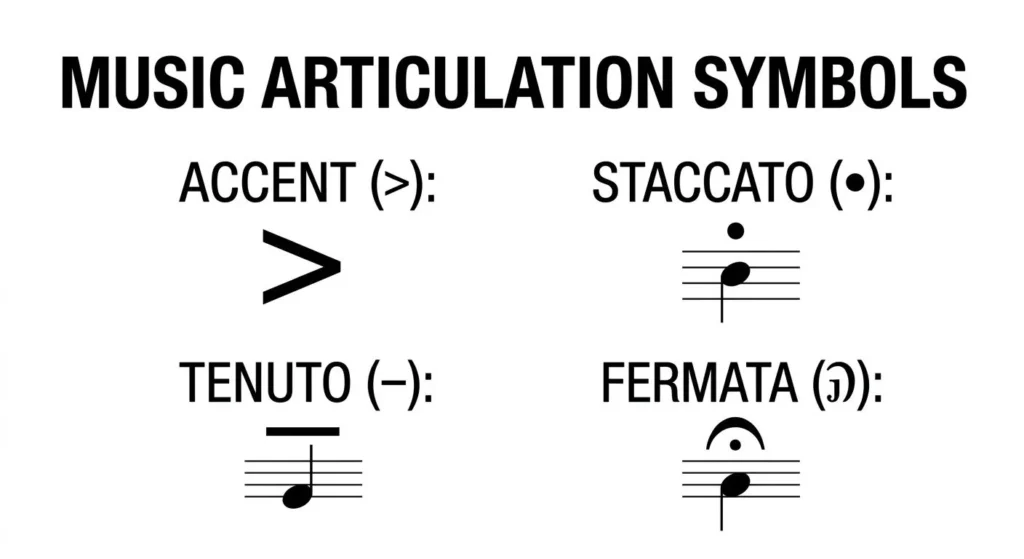
Articulation markings explain how individual notes should begin, continue, and end. They give a melody its character and help musicians avoid playing every note in the same way.
Staccato and Staccatissimo
Staccato is shown by a small dot above or below a note. It tells the performer to play the note short and separated from nearby notes.
Staccatissimo indicates an even shorter, more sharply detached note. It is often shown with a small wedge or vertical mark, depending on the notation style.
The exact length of a staccato note depends on the tempo, instrument, and musical context.
Legato and Slurs
Legato means that notes should connect smoothly.
A slur is a curved line placed over or under a group of notes. It commonly tells the performer to connect those notes without unnecessary gaps.
On instruments such as violin or flute, legato may involve a continuous bow or breath. On piano, it often means connecting notes smoothly through timing and touch.
Accent, Marcato, and Tenuto
An accent mark emphasizes a note so it stands out from the surrounding music.
Marcato gives a note a stronger, more pronounced emphasis. It is often represented by a small wedge or pointed mark.
Tenuto is shown by a short horizontal line above or below a note. It asks the performer to give the note its full value or a slight emphasis, depending on the context.
These markings are related, but they do not mean exactly the same thing.
Ties and Other Articulation Markings
A tie joins two notes of the same pitch so their durations combine into one sustained sound.
Other articulation markings include combinations such as accent-staccato and marcato-staccato. They combine emphasis with a detached note.
Some instruments also use specialized marks for bowing, tonguing, plucking, and other playing techniques.
Music Tempo Symbols and Their Meanings
Tempo describes the speed of a piece. A composer can use an Italian direction, a beats-per-minute number, or both.
Common Italian Tempo Terms
| Tempo Term | General Meaning |
| Largo | Very slow and broad |
| Lento | Slow |
| Adagio | Slow and relaxed |
| Andante | At a walking pace |
| Moderato | Moderate speed |
| Allegretto | Moderately fast |
| Allegro | Fast and lively |
| Vivace | Lively and brisk |
| Presto | Very fast |
| Prestissimo | Extremely fast |
These words provide a general direction rather than one universal speed. Musical style and interpretation influence the final tempo.
Beats Per Minute
Beats per minute, or BPM, gives a numerical tempo reference.
For example, a marking of ♩ = 120 means the quarter note receives 120 beats each minute.
A lower BPM usually indicates slower music, while a higher BPM usually indicates faster music. However, the beat unit matters. A tempo marking based on a half note is not directly identical to one based on a quarter note.
Accelerando, Ritardando, and A Tempo
Accelerando means gradually getting faster.
Ritardando means gradually slowing down. It often appears near the end of a phrase or piece.
A tempo tells the performer to return to the previous or original tempo after a temporary change.
These markings help shape musical movement instead of keeping every section at one fixed speed.
Music Ornaments and Expression Symbols
Ornaments add decorative notes or movements to a melody. They can make a passage sound more expressive, elegant, or elaborate.
Trill, Turn, and Mordent
A trill is a rapid alternation between a written note and the note above it. It creates a fluttering effect.
A turn is an ornament that moves around the main note using nearby pitches. The exact notes depend on the written sign and musical context.
A mordent is a short ornament that quickly moves from the main note to an adjacent note and returns.
Grace Notes and Appoggiatura
Grace notes are small notes printed before a main note. They add a brief decorative movement.
An acciaccatura is a type of grace note usually played very quickly before the main note.
An appoggiatura is generally given more expressive weight and may take part of the main note’s time. Its performance depends on the musical period and notation instructions.
Fermata, Breath Mark, and Caesura
A fermata (𝄐) tells the performer to hold a note or rest longer than its written value.
A breath mark (𝄒) indicates a place for a singer or wind player to take a breath. It may also suggest a slight break for other instruments.
A caesura (𝄓) indicates a noticeable pause or break in the music. The conductor or performer determines the length according to the context.
Glissando and Arpeggio
A glissando is a continuous slide between pitches. The effect differs by instrument. A pianist may sweep across a series of keys, while a string player can slide along a string.
An arpeggio plays the notes of a chord one after another rather than simultaneously.
An arpeggio marking is often shown as a wavy vertical line beside a chord.
Music Repeat and Navigation Symbols
Repeat and navigation signs guide performers through a score. They can send musicians back to an earlier passage or forward to a special ending.
Repeat Signs
A repeat sign usually appears as two dots beside a double bar line.
The left repeat sign marks where the repeated passage begins. The right repeat sign marks where it ends.
If the score has no earlier left repeat sign, performers commonly repeat from the beginning.
Segno and Coda
The segno symbol (𝄋) marks a point in the score. The instruction D.S. tells the performer to return to that sign.
The coda symbol (𝄌) marks a special ending section. A “To Coda” instruction tells the musician when to jump to that section.
Da Capo and Dal Segno
Da Capo, abbreviated D.C., means “from the beginning.” It tells the performer to return to the start of the piece.
Dal Segno, abbreviated D.S., means “from the sign.” It directs the performer back to the earlier segno marking.
Fine and To Coda
Fine marks the point where the piece or passage ends.
D.C. al Fine means to return to the beginning and continue until Fine.
D.S. al Coda means to return to the segno and follow the score until the instruction to jump to the coda.
These directions can look complicated at first. Follow them in the order they appear rather than reading straight through every measure.
Music Symbols for Piano and Keyboard
Piano music uses several symbols that help players coordinate both hands, manage chords, and control the instrument’s sound.
Grand Staff and Middle C
Piano music commonly uses a grand staff made from two connected five-line staves.
The upper staff usually uses treble clef for the right hand. The lower staff usually uses bass clef for the left hand.
Middle C sits between the two staves. It can appear on a ledger line below the treble staff or above the bass staff.
Right-Hand and Left-Hand Notation
The right hand often plays melodies and higher notes. The left hand often plays bass notes, chords, or accompaniment.
This is a common arrangement, not an absolute rule. Composers may ask either hand to play in a different range or cross over the other hand.
Finger numbers may also appear above or below notes. In standard piano teaching, 1 represents the thumb, 2 the index finger, 3 the middle finger, 4 the ring finger, and 5 the little finger.
Piano Pedal Symbols
Piano pedal markings show when to press and release a pedal.
The sustain pedal is commonly marked with the word Ped. Press it at the marking and release it at the corresponding star-like release sign or written instruction.
Some scores use pedal lines to show how long the pedal should remain down. Other markings indicate half-pedaling or changes in pedal position.
The sostenuto and una corda pedals have different functions. Follow the score’s instructions because pedal notation can vary between editions.
Chord and Octave Markings
A chord places several notes together so they sound at the same time. Notes stacked vertically on a staff usually indicate a chord.
An octave marking such as 8va tells the performer to play the passage one octave higher than written. 8vb indicates one octave lower.
These markings reduce the need for many ledger lines and make difficult passages easier to read.
Guitar, Drum, and Percussion Music Symbols
Different instruments use notation methods that suit their playing techniques. Guitar tablature and drum notation are two common examples.
Guitar Tablature Symbols
Guitar tablature, usually called tab, uses six horizontal lines to represent the six strings of a standard guitar.
Numbers show which fret to press. A 0 means play an open string, while a 3 means press the third fret.
Common guitar-tab markings include:
| Marking | Common Meaning |
| 0 | Open string |
| 3 | Play the third fret |
| h | Hammer-on |
| p | Pull-off |
| / | Slide up |
| Slide down | |
| b | Bend |
| r | Release a bend |
| x | Muted or percussive note, depending on context |
| ~ | Vibrato or sustained effect, depending on notation |
Tab conventions can differ between publishers and players. Check the legend when one is provided.
Guitar Chord Diagrams
Chord diagrams show where to place your fingers on the fretboard.
Vertical lines represent strings, and horizontal lines represent frets. Dots show finger positions.
An X above a string means you should not play it. An O means the string is played open.
Numbers may identify which fingers to use. The diagram may also show a barre, where one finger presses several strings at once.
Drum and Percussion Notation
Drum notation places different sounds at different positions on a staff.
A common drum-set score may use one position for the bass drum, another for the snare, and different positions for cymbals and toms.
X-shaped noteheads often identify cymbals or other unpitched percussion sounds. Standard round noteheads may identify drums.
There is no single universal layout used by every drum book or software program. Read the instrument key or legend that comes with the score.
Music Symbols Copy and Paste
You can use musical characters in messages, documents, usernames, captions, and other text fields. Select a character from the tables below and copy it using your device’s normal text-selection controls.
These are Unicode text characters. They are useful for short musical references, but they do not automatically create a properly formatted music score.
Music Note Symbols Copy and Paste
| Symbol | Unicode Name | Code Point |
| ♩ | Quarter Note | U+2669 |
| ♪ | Eighth Note | U+266A |
| ♫ | Beamed Eighth Notes | U+266B |
| ♬ | Beamed Sixteenth Notes | U+266C |
| 𝅝 | Musical Symbol Whole Note | U+1D15D |
| 𝅗𝅥 | Musical Symbol Half Note | U+1D15E |
| 𝅘𝅥 | Musical Symbol Quarter Note | U+1D15F |
| 𝅘𝅥𝅮 | Musical Symbol Eighth Note | U+1D160 |
| 𝅘𝅥𝅯 | Musical Symbol Sixteenth Note | U+1D161 |
| 𝅘𝅥𝅰 | Musical Symbol Thirty-Second Note | U+1D162 |
| 𝅘𝅥𝅱 | Musical Symbol Sixty-Fourth Note | U+1D163 |
The familiar characters ♩ and ♪ are convenient for ordinary text. The longer note characters belong to the Musical Symbols Unicode block and may need a compatible font.
Music Clef Symbols Copy and Paste
| Symbol | Unicode Name | Code Point |
| 𝄞 | Musical Symbol G Clef | U+1D11E |
| 𝄡 | Musical Symbol C Clef | U+1D121 |
| 𝄢 | Musical Symbol F Clef | U+1D122 |
| 𝄥 | Musical Symbol Drum Clef-1 | U+1D125 |
| 𝄦 | Musical Symbol Drum Clef-2 | U+1D126 |
A clef character copied into a text field does not create a complete staff. Proper notation software controls its size, position, and alignment.
Music Rest Symbols Copy and Paste
| Symbol | Unicode Name | Code Point |
| 𝄻 | Musical Symbol Whole Rest | U+1D13B |
| 𝄼 | Musical Symbol Half Rest | U+1D13C |
| 𝄽 | Musical Symbol Quarter Rest | U+1D13D |
| 𝄾 | Musical Symbol Eighth Rest | U+1D13E |
| 𝄿 | Musical Symbol Sixteenth Rest | U+1D13F |
| 𝅀 | Musical Symbol Thirty-Second Rest | U+1D140 |
| 𝅁 | Musical Symbol Sixty-Fourth Rest | U+1D141 |
These advanced rest characters may not appear correctly on every device. If a character shows as an empty box, try a font with musical-symbol support.
Music Accidentals Copy and Paste
| Symbol | Unicode Name | Code Point |
| ♭ | Music Flat Sign | U+266D |
| ♮ | Music Natural Sign | U+266E |
| ♯ | Music Sharp Sign | U+266F |
| 𝄪 | Musical Symbol Double Sharp | U+1D12A |
| 𝄫 | Musical Symbol Double Flat | U+1D12B |
Use the actual sharp and flat characters when writing note names such as F♯ and B♭. The keyboard characters # and b are not the same Unicode symbols.
Other Music Symbols Copy and Paste
| Symbol | Name | Code Point |
| 𝄐 | Fermata | U+1D110 |
| 𝄒 | Breath Mark | U+1D112 |
| 𝄓 | Caesura | U+1D113 |
| 𝄆 | Left Repeat Sign | U+1D106 |
| 𝄇 | Right Repeat Sign | U+1D107 |
| 𝄋 | Segno | U+1D10B |
| 𝄌 | Coda | U+1D10C |
| 𝄴 | Common Time | U+1D134 |
| 𝄵 | Cut Time | U+1D135 |
Music Emojis Copy and Paste
Music emojis are useful for social media, messages, and decorative text. They are not formal notation signs.
| Emoji | Name | Common Use |
| 🎵 | Musical Note | Music captions and playlists |
| 🎶 | Multiple Musical Notes | Songs and performances |
| 🎼 | Musical Score | Sheet music and musicians |
| 🎹 | Musical Keyboard | Piano and keyboard posts |
| 🎸 | Guitar | Guitarists and rock music |
| 🎤 | Microphone | Singing and recording |
| 🎧 | Headphone | Listening to music |
| 🥁 | Drum | Drumming and rhythm |
| 🎻 | Violin | Classical music |
| 🎷 | Saxophone | Jazz and instrumental music |
| 🎺 | Trumpet | Brass music |
| 🎙️ | Studio Microphone | Recording and podcasts |
| 🎚️ | Level Slider | Audio mixing |
| 🎛️ | Control Knobs | Sound production |
| 📻 | Radio | Radio and music listening |
| 💿 | Optical Disc | Albums and recorded music |
Music Emojis and Decorative Symbols for Social Media
Music emojis can make a caption or profile feel more personal. They help communicate musical interests without requiring formal notation.
Music Note and Instrument Emojis
Use note emojis when you want to suggest a song, performance, or musical mood.
For example:
- 🎵 Listening to my favorite song.
- 🎶 Music makes the day better.
- 🎸 Guitar practice tonight.
- 🎹 Learning a new piano piece.
- 🎤 Ready for the next performance.
- 🎧 Lost in the music.
You can combine instrument emojis with a note or headphone symbol to create a short music-themed line.
Music Symbols for Instagram and TikTok
Short musical characters can decorate social media captions and video descriptions.
Examples:
- ♫ Just enjoying the rhythm ♫
- ♪ A little music, a little peace ♪
- 🎧 On repeat today
- 🎶 Good music, good mood
- 🎤 Behind the microphone
- 🎸 Practice makes progress
Use a few symbols rather than filling every line with decorative characters. Too many can make a caption difficult to read.
Music Symbols for Bios and Captions
Here are simple music-themed bio ideas:
- 🎵 Music is part of my story.
- ♫ Living life one song at a time.
- 🎧 Always finding a new rhythm.
- 🎹 Learning, playing, and growing.
- 🎤 Creating sounds and memories.
- 🎸 Guitar, music, and good energy.
These examples are original caption ideas. You can adjust them to match your style or musical interests.
How to Type Music Symbols on a Keyboard or Phone
You can enter music symbols by copying them, using a character viewer, or inserting a Unicode character through a supported application.
Copying and Pasting Characters
The easiest method is to copy a symbol from a chart and paste it into your document or message.
- Select the symbol you want.
- Copy it using your device’s copy command.
- Open the application where you want to use it.
- Paste the character into the text field.
- Check that it displays correctly before publishing.
This method works for many common music characters, including ♩, ♪, ♫, ♭, ♮, and ♯.
Unicode and Character Compatibility
Every Unicode character has a code point, such as U+266A for the eighth-note character ♪.
Some applications let you insert characters by searching their character map or symbol panel. Others support Unicode input through specific keyboard shortcuts.
Advanced musical symbols may require a font with the correct glyphs. If a symbol appears as a square or question mark, the application or font may not support it.
How to Type Music Symbols on a Phone
On a phone, the simplest option is usually to copy a character from a symbol chart and paste it into your message.
Some keyboard applications also provide a symbol panel or emoji search. Search for terms such as “music,” “note,” “guitar,” or “piano” to find available emoji characters.
The available characters depend on your keyboard, operating system, application, and font support.
Printable Music Symbols Chart
A printable music symbols chart can help students, teachers, and beginners review notation without opening a digital guide every time.
A useful chart should show the symbol, its name, and its purpose. For note and rest values, include a duration comparison. For clefs, show the symbol on a five-line staff.
What to Include in a Printable Chart
A beginner-friendly reference should contain:
- Treble and bass clefs.
- Staff lines and spaces.
- Whole, half, quarter, eighth, and sixteenth notes.
- Whole, half, quarter, eighth, and sixteenth rests.
- Sharp, flat, natural, double sharp, and double flat.
- Common time signatures.
- Basic dynamic markings.
- Staccato, legato, accent, and tenuto.
- Repeat signs and fermata.
For a piano reference, add the grand staff and middle C. For a guitar reference, include basic tablature markings.
How to Make the Chart Easy to Read
Use a large, readable music font. Keep symbols aligned with their names and meanings.
Avoid using ordinary text characters as substitutes for complete notation when the visual shape matters. A proper music-notation program can place notes, stems, flags, rests, and clefs correctly on a staff.
You can print the chart for practice or keep a digital copy for quick reference.
How to Read Music Symbols on Sheet Music
Reading sheet music becomes easier when you follow the same order each time. Begin with the clef and key signature, then identify the time signature, notes, rests, and performance instructions.
Start With the Clef
Find the clef at the beginning of the staff. It is usually treble or bass clef in beginner music.
The clef tells you which pitches the staff lines and spaces represent. Do not identify notes until you know which clef is in use.
Check the Key and Time Signatures
Look immediately after the clef for the key signature. It tells you which notes are regularly sharp or flat.
Next, check the time signature. It shows how beats are grouped into measures.
These markings help you understand the musical framework before you start playing.
Identify Notes and Rests
Read the note positions to identify pitch. Then check their noteheads, stems, flags, and beams to determine duration.
Count rests just as carefully as notes. Silence still takes up time in a measure.
Follow Dynamics and Expression Markings
Look for volume instructions, tempo words, articulation signs, and navigation markings.
A piece may begin softly, grow louder, and then slow down near the end. These directions help turn the written notes into a musical performance.
Common Mistakes Beginners Make With Music Symbols
Beginners often recognize a symbol but confuse its purpose when reading a complete score. Avoid these common mistakes:
- Confusing a note with a rest: A note produces sound, while a rest represents silence.
- Mixing up sharp and flat: Sharp raises a pitch; flat lowers it.
- Ignoring the clef: Staff positions mean different pitches under different clefs.
- Forgetting the time signature: Rhythm depends on how beats are grouped.
- Misreading 6/8: Many 6/8 passages have two main beats, each divided into three eighth notes.
- Confusing a tie with a slur: A tie joins the duration of notes with the same pitch; a slur connects notes smoothly.
- Treating every dynamic as an exact volume: Dynamics provide relative performance instructions.
- Ignoring accidentals: A written accidental can change a note for the rest of the measure under standard notation rules.
- Confusing music emojis with notation: Emojis decorate text but do not explain how to perform a score.
- Assuming every Unicode symbol will display: Advanced characters need compatible fonts and applications.
Practice one category at a time. Learn the clefs first, then note values, rests, and accidentals. Add dynamics and expression markings as you become more comfortable.
Frequently Asked Questions About Music Symbols
What are the 12 basic music symbols?
There is no single official list of exactly 12 basic music symbols. Beginners commonly start with the treble clef, bass clef, whole note, half note, quarter note, eighth note, whole rest, half rest, quarter rest, sharp, flat, and natural.
What are music symbols called?
Music symbols are also called musical notation symbols or music notation signs. They include notes, rests, clefs, accidentals, time signatures, dynamics, articulation marks, and other performance instructions.
What do symbols on sheet music mean?
Symbols on sheet music tell performers which notes to play, how long to hold them, and when to remain silent. Other markings explain tempo, volume, expression, and the order in which sections should be played.
What are the symbols used in piano music?
Piano music commonly uses treble clef, bass clef, notes, rests, accidentals, time signatures, dynamics, pedal markings, chord markings, and octave signs. The two staves are usually connected as a grand staff.
What is the difference between a music note and a music emoji?
A music note in notation represents a pitch and rhythmic value. A music emoji is a decorative character used in digital communication. Emojis do not provide the detailed performance instructions found in sheet music.
How do I copy and paste music symbols?
Select a character from a music-symbol chart, copy it, and paste it into your message or document. Common characters include ♩, ♪, ♫, ♭, ♮, and ♯. Check that the character displays correctly after pasting.
How do I type a music note symbol on my keyboard?
You can copy a note character from a symbol chart or use your application’s character viewer or symbol-insertion feature. The exact keyboard shortcut depends on your operating system and application.
Why are some music symbols not showing on my phone?
Your phone or application may not have a font that supports the character. Advanced musical symbols can appear as empty boxes when the required glyph is missing. Try a different font or use a simpler text symbol.
What does a dot above a music note mean?
A dot above or below a note usually indicates staccato. It tells the performer to play the note short and detached. A dot placed after a notehead has a different meaning: it increases the note’s duration by half.
What is the difference between a tie and a slur?
A tie connects two notes of the same pitch and combines their durations into one sustained sound. A slur connects notes that should be played smoothly, even when their pitches differ.
Can I print a music symbols chart?
Yes. You can print a chart that lists note values, rests, clefs, accidentals, dynamics, and other common markings. Use a music-notation font or notation software for accurate staff symbols.
Are music symbols the same in every musical tradition?
No. This guide focuses mainly on common Western staff notation. Other musical traditions use different systems, symbols, oral practices, and ways of recording music. Their notation should be understood within its own musical context.
Conclusion
Music symbols help musicians turn written instructions into sound. Notes and rests explain rhythm, clefs identify pitch, and accidentals change the notes used in a piece. Time signatures organize beats, while dynamics and articulation shape the performance.
Start with the basic symbols and practice reading them on a staff. Then move on to key signatures, tempo markings, piano notation, and other instrument-specific signs. If you need decorative characters, use the copy-and-paste charts or music emojis.
With regular practice, these markings become easier to recognize. You will be able to follow sheet music with more confidence and understand how its symbols work together.

Adam Sullivan is a dedicated writer who enjoys transforming everyday topics into engaging and informative content. His writing focuses on making complex ideas simple, practical and enjoyable for readers of all backgrounds. Adam is also the fictional author of The Lantern Beyond Autumn Hills and Where the Morning Horizon Waits. Outside of writing, he enjoys photography, traveling and discovering inspiration through new experiences. He believes great content should be both helpful and easy to connect with.
 Dylan Anderson